Strategy · New game
Chess(3)
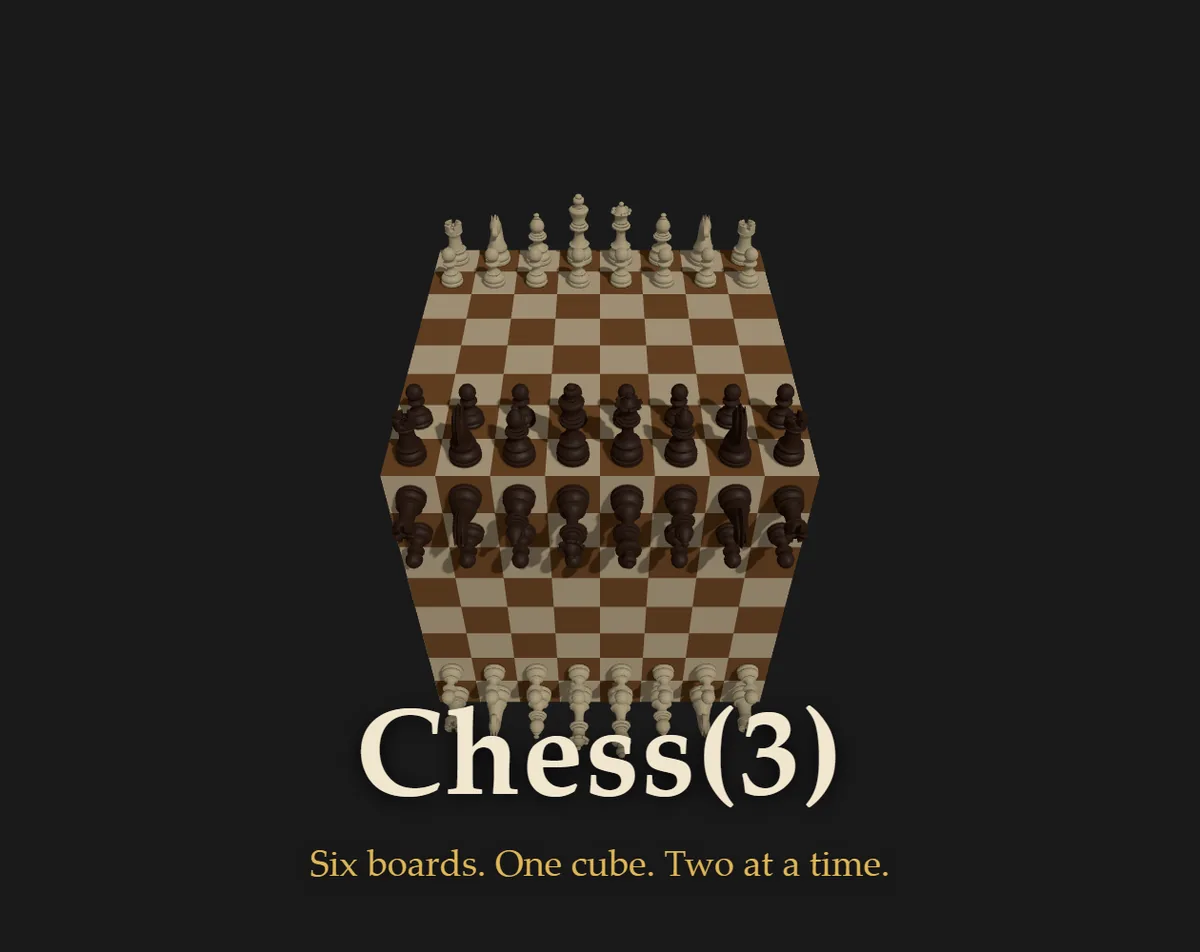
Chess(3), pronounced Chess Cubed, stacks six complete chess games on a cube and has two players share one screen while boards run on independent turn clocks.
#10 this weekAI-assisted: Unspecified
The game runs in this tab. No install, no account.
The short answer
Chess(3) is a browser-based 3D chess variant where six full chess boards sit on one cube and two boards are played at once. Two players share a screen, each board keeps its own turn order, and winning a board lets the victor bank one piece for a later board. It is free and runs in the browser.
What is Chess(3)?
Chess(3), which is spoken as Chess Cubed, places six complete chess boards on a single cube. The game is a browser-based strategy title for two players sharing one screen. Its core twist is not a new piece or a special move; it is the way those six ordinary games are paired, displayed, and scored. Only two boards are live at once, and they appear together because they share an edge. Each board starts with the usual chess setup and follows the usual rules for movement, captures, check, and the end of a game. Pieces do not travel between boards during normal play. Instead, every board tracks its own turn order, so one game can be several moves ahead while its partner is still near the opening. A player who has no move to make on one board can switch attention to the other. The result is a match that feels like two chess clocks running in parallel, with the cube's geometry deciding which games are paired and which saved pieces can later enter.
How to play
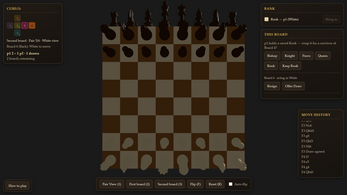
Matches move through six boards in three fixed pairs. The two boards in the current pair sit on screen together because they meet at a shared edge; that border is called the seam. Each board is a full chess game with the familiar starting array and complete rules, so castling, en passant captures, promotion, checkmate, and stalemate all remain in play. The boards do not share a turn. When one board waits for Black, White can play on the other, so neither player has to sit idle. A board can be twenty moves along while its partner remains in the opening.
Winning a board gives the victor a choice: bank one surviving piece other than the king, then bring it into a later board. Only one piece can be held at a time. If another board is won while a piece is banked, the player must choose which one to keep; the other is lost. A saved piece can enter only on a board that touches the board where it was won, and the cube's layout leaves some destinations unavailable. The match goes to the player with the most board wins. Four wins ends it outright, and drawn boards award nothing. If the score is level after six boards, Sudden Death uses one clean board, assigns colors by coin toss, and excludes saved pieces. A drawn Sudden Death is replayed with colors reversed until a winner emerges.
Controls
Chess(3) is controlled with a mouse and keyboard. Clicking a piece reveals its legal destinations; clicking a square then makes the move. Dragging the view rotates the cube so the player can inspect the current pair. The number 1 key returns to the view with both boards visible, while 2 and 3 focus on the first or second board straight on. F swaps perspective, R resets the camera, and Esc cancels an attempt to bring in a saved piece. The right-side panels handle match actions: resigning, offering a draw, banking a piece, and bringing a saved piece into play. A help option is always one click away. Because the current release is local two-player only, both players use the same screen and take turns with the mouse or sit close enough to share the display. The controls are built for quick switching between two live boards rather than for managing a single chess position.
| Input | Action |
|---|---|
| Click a piece | Reveal the squares that piece can move to |
| Click a square | Move the selected piece there |
| Drag | Look around the cube |
| 1 | Show both boards |
| 2 / 3 | Focus the first or second board straight on |
| F | Swap perspective |
| R | Reset the view |
| Esc | Cancel bringing in a saved piece |
| Right-side panels | Resign, offer a draw, or manage a banked piece |
Tips for your first run
Treat the two live boards as separate games. Each one keeps its own turn order, so a lead on one board can sit beside an opening on the other. Use the view keys to check both positions before committing to a plan, and do not expect a move on one board to affect the other.
Banked pieces need a geometric check. A saved piece can enter only on a board that touches the board where it was won, so some wins are more flexible than others. Holding one piece also blocks a second bank, which means a later board win may force a choice between two useful pieces. Keep the score in view: four board wins end the match, and draws count for neither side. A level match moves to Sudden Death, where saved pieces are gone and a single clean board decides the result.
- Use 1, 2, and 3 to switch views instead of losing track of the inactive game.
- Watch pawn races toward the seam, where promotion happens at the border between boards.
- Bank a piece only when a future destination board touches the board where it was won.
- Before banking, check whether a later board win would force a choice between two pieces.
- Remember that four board wins end the match and drawn boards award nothing.
Content and replayability
Six boards form the full match, arranged as three pairs in a fixed order. That structure gives each session a clear arc: early pairs establish board wins, later pairs decide whether a saved piece can return and whether the match needs Sudden Death. Replay value comes from the changing pair states. One game can be a quiet opening while its partner is deep in an endgame, and the banked-piece rule means a win on one board can influence a future board only if the geometry allows it. Local two-player play supports pass-the-mouse sessions or two people sitting side by side. The current version is local two-player only. A planned v1.0.1 update is set to add threefold-repetition handling and coin-toss color assignment for the first and third pairs. The fixed cube layout and the most-board-wins score give matches a definite finish, with Sudden Death covering a level score.
Presentation and performance
Chess(3) presents its six games as a 3D cube built for the browser. The camera controls exist because the cube hides some boards at any moment: the 1 key restores the two-board view, 2 and 3 focus on one board straight on, F changes the perspective, and R resets the camera. Dragging the view lets a player look around the cube. The two live boards share an edge and sit on screen together, so the seam between them is visible during play. The visual style is abstract and board-game focused. Right-side panels keep match actions close, covering resignation, draw offers, and banked-piece entry. The game runs in HTML5 and requires no installation. The practical setup is to open the page and start a local two-player match; no download step is involved.
Who should play it
Chess(3) is aimed at players who already know standard chess and want a variant that changes the match structure rather than the movement rules. The six-board cube, independent turn order, and banked-piece rule reward players who can track two positions at once and plan across pairs. It suits local two-player sessions, whether the pair shares a mouse or sits side by side. The current release is local two-player only, so a nearby opponent is needed. The fixed pair order and most-board-wins score give competitive pairs a clear target, while Sudden Death prevents a level match from ending without a winner. The free browser release makes it easy to try with someone nearby. Anyone who prefers standard one-board chess may find the constant switching demanding, but the underlying rules remain familiar.
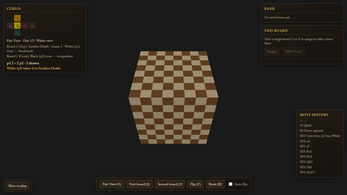
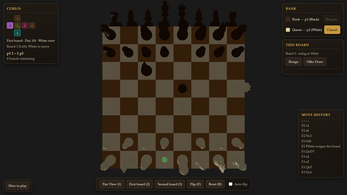
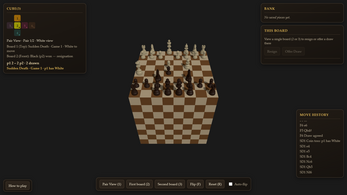
Screenshots
How we tested it
The build was loaded from games.debutplay.com in a headless Chromium session on ; the canvas started and no request was blocked. The guide was last checked on .
From the developer
Chess(3)Pronounced "Chess Cubed." That's the whole joke. Six boards. One cube. Regular chess on every one of them. Everything else is what's different. Two boards at a time. The cube has six boards, played in three pairs in a fixed order. The two boards in a pair share an edge, so both are on screen at once. Each one is a complete game of chess: standard setup, standard rules, standard pieces. Nothing moves between boards. Nobody's waiting. Every board keeps its own turn order. There's no single turn for the whole cube, so the two boards drift apart. Board 1 might be twenty moves deep while Board 2 is still in the opening. When it's Black's move on one board, White doesn't sit there. White goes and plays the other one. The seam. The shared edge between the two live boards is the seam. Pawns on both boards head toward it, so a pawn that runs the whole length of its board promotes right at the border with the other game. It doesn't do…
Frequently asked questions
How many boards are in Chess(3)?
Six complete chess boards sit on one cube. They are played as three pairs in a fixed order, with two boards live at a time.
Is Chess(3) free?
Yes. It is free to play and runs in the browser.
Can two players use one screen?
Yes. The current release is local two-player only, with players sharing a mouse or sitting side by side.
What happens when a board is won?
The winner can bank one surviving piece other than the king and bring it into a later board. Only one piece can be held at a time, and the destination board must touch the board where the piece was won.
How does the match end?
The player with the most board wins takes the match. Four wins ends it outright. A level score after six boards goes to Sudden Death on one clean board, with colors decided by coin toss and no saved pieces. A drawn Sudden Death is replayed with colors swapped.
Does Chess(3) include standard chess rules?
Each board uses standard setup and rules, including castling, en passant, promotion, checkmate, and stalemate. The cube rules sit around those games; pieces do not move between boards during normal play.
What games are similar to Chess(3)?
The closest matches on DebutPlay are Machine Manager, Comando Exato, Lantern Isle — Free Demo. They share the same genre, so the controls and the pace carry over.
Something wrong or missing? Tell us. How we test games.