Action · New game
Ringflip: Circus Pinball
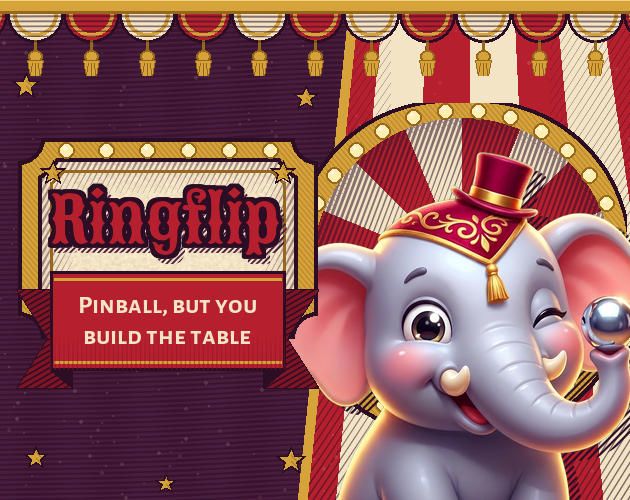
A pinball roguelite set in a travelling 1900s circus, where each show closes with a choice of new table parts and each town finishes against a rival circus.
Play on itch.io
Play Ringflip: Circus Pinball
Ringflip: Circus Pinball is a browser pinball roguelite. Clear a show, pick one of three circus acts, and bolt it onto a ring of a table you are building yourself. Chains between different acts drive the crowd multiplier toward x10,…
Play on itch.io ↗itch.io blocks third-party embeds, so the game opens on the developer's page. No install, no account.
The short answer
Ringflip: Circus Pinball is a browser pinball roguelite. Clear a show, pick one of three circus acts, and bolt it onto a ring of a table you are building yourself. Chains between different acts drive the crowd multiplier toward x10, tickets buy training, rings and posters backstage, and each town closes with a rival showdown. It is free to play in the browser with nothing to install.
What is Ringflip: Circus Pinball?
Ringflip: Circus Pinball is a 2D pinball roguelite from developer Rui Codex, staged around a travelling circus in the 1900s. The table is not handed over finished. A run gives you a ring to fill, and the layout you end up playing is one you assembled piece by piece out of circus acts.
Every act placed is working table hardware with a temperament of its own: bumpers, targets, hoops, spinners, saucers and lanes all respond differently when the ball arrives. That makes routing matter twice over, first when you decide what goes where, and again when you try to reach it under pressure.
The browser build covers Meadowbrook, the game's first town, and it costs nothing to start here. It runs in portrait, includes a fullscreen button for a clearer view of the playfield, and is a single-player, touch-friendly arcade title released on 21 October 2026.
How to play
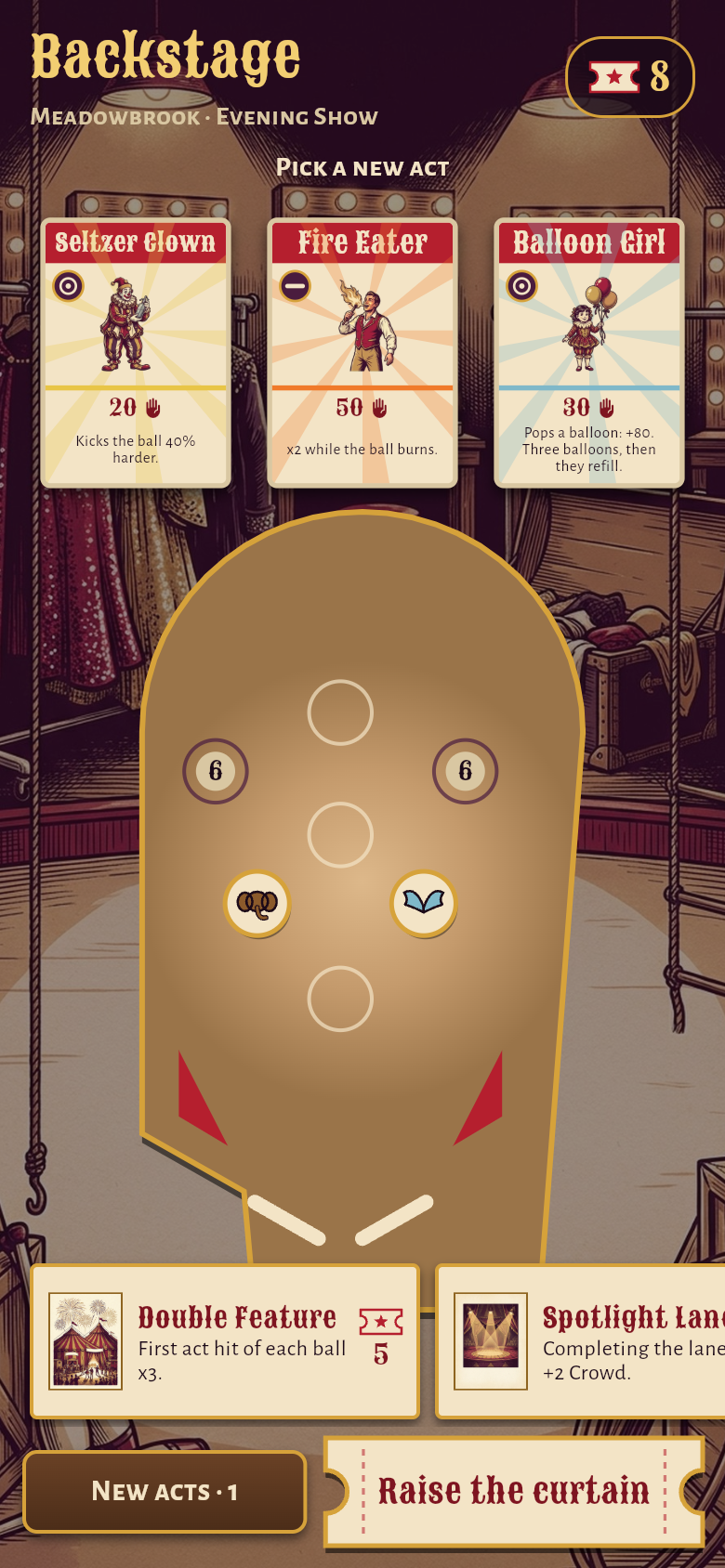
After each show you are offered three circus acts and only one joins the table, slotted onto a ring in the layout. Because each act is a functioning part of the playfield rather than a cosmetic unlock, the pick changes which shots exist for the rest of the town.
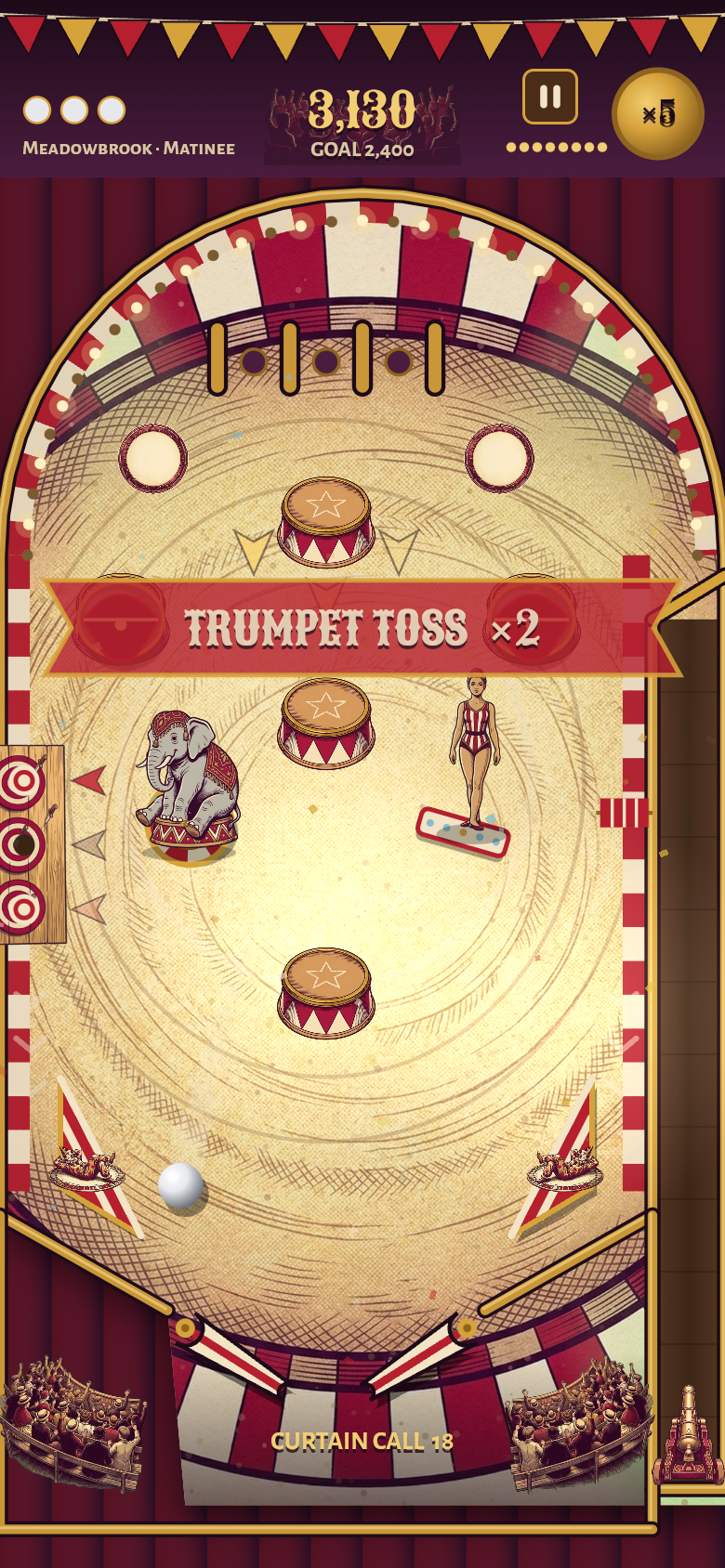
Scoring is built on movement across the table. Hitting a run of different acts forms a chain, and the crowd multiplier grows with it, reaching x10 at the top end. A table with varied, reachable pieces simply gives the ball more interesting places to go next.
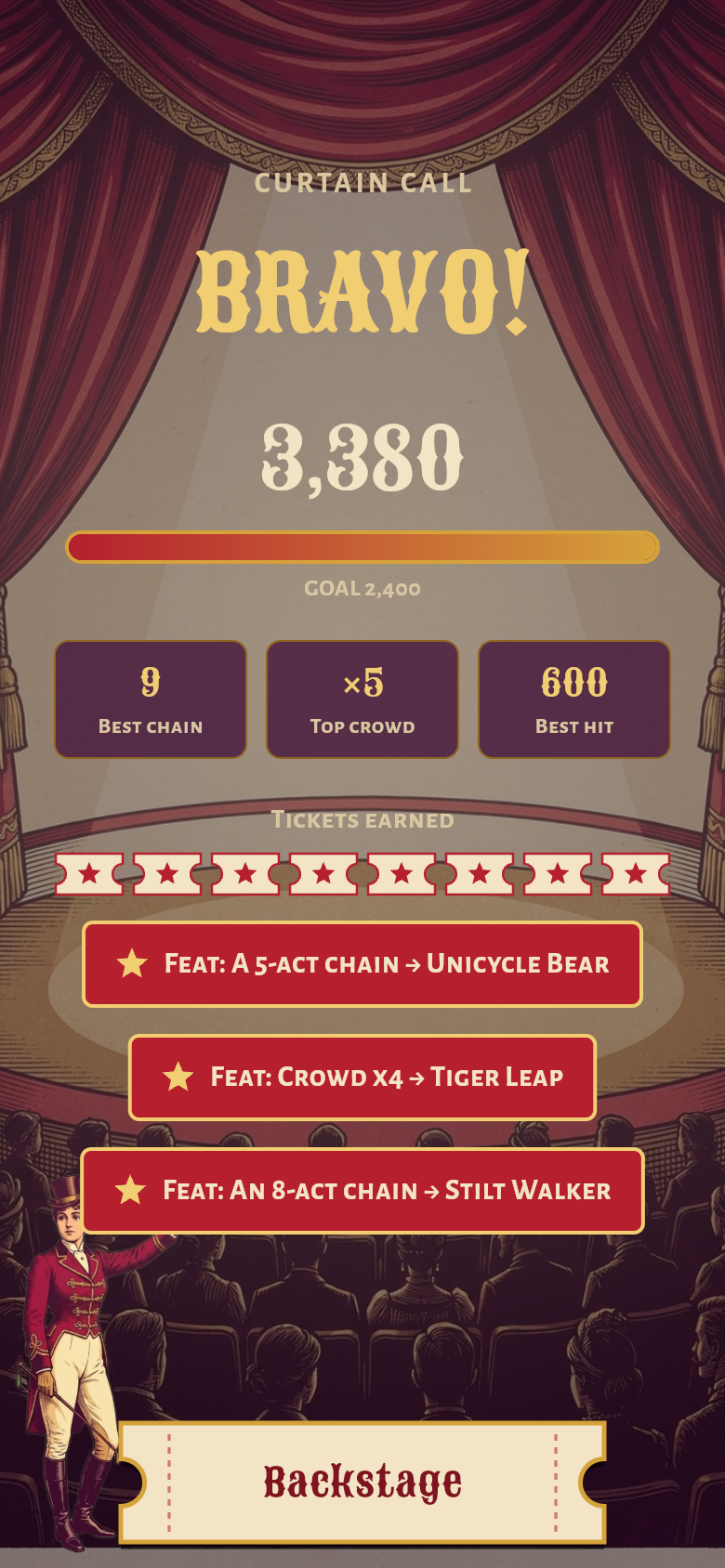
Tickets are the currency between shows. Spend them backstage to train the acts already placed, to open extra rings so more of the table can be built, or to hang posters that rewrite how the table behaves. Every town finishes with a showdown against a rival circus, where the build gets tested.
Controls
With touch or a mouse, the screen splits the work in half: the left side drives the left flipper and the right side drives the right flipper. The plunger is a hold-and-release on the right side, so keep the press held to pull it back and let go to send the ball out.
A quick swipe nudges the table when the ball needs a shove out of trouble. Keyboard players get the same options on keys: Left, A or Z for the left flipper, Right, D or M for the right, Space or Down to launch, and P or Esc to pause.
Portrait orientation keeps both flipper halves within reach of the thumbs, and the fullscreen button strips away browser clutter for an uninterrupted view of the ring.
| Input | Action |
|---|---|
| Mouse or touch, left half of screen | Flip the left flipper |
| Mouse or touch, right half of screen | Flip the right flipper |
| Hold on the right side, then release | Pull the plunger and launch the ball |
| Quick swipe | Nudge the table |
| Left arrow, A or Z | Left flipper |
| Right arrow, D or M | Right flipper |
| Space or Down arrow | Launch the ball |
| P or Esc | Pause |
Tips for your first run
The opening run is mostly about learning what each act does once a moving ball is involved. Place a new act somewhere the ball can reach it from something already on the table, because chains reward travelling between different acts rather than leaning on one favourite target.
If the table stops feeling productive, the fix is usually layout rather than reflexes. A ring crowded with similar pieces gives the chain nowhere to travel, while a spread of distinct acts keeps the multiplier climbing.
- Favour acts within comfortable reach of the flippers before chasing unusual ones; a shot you can repeat beats a shot you only admire.
- Watch the multiplier as the chain builds and keep rotating through different acts instead of settling on a single target.
- Balance early tickets between training what is already placed and opening another ring, since extra rings give a chain more room to continue.
- Treat posters as rule changes rather than small stat bumps, and pick the one that suits the acts already on the table.
- Let go of the plunger only when you are ready, because the release is what launches the ball.
- Keep a thumb on each half of the screen and use the swipe nudge when the ball drifts away from the flippers.
Content and replayability
Meadowbrook is not a stripped-down sampler. The browser build carries the town's three shows, its rival circus, 20 acts, 8 posters and 2 ringmasters, alongside the weekly Mini Gala, and it plays in 11 languages.
Progress is kept in the browser's local storage. That means a return visit can pick up where the last one stopped without an account, but clearing site data or moving to a different browser starts a fresh game.
Everything beyond the first town lives on Android. The Full Tour adds three more towns with their rivals, 40 more acts, 17 more posters, 3 more ringmasters, Encore 3 through 10 and the complete Grand Gala, bought once inside the app. Nothing is sold in the browser version.
Replay comes from the act pool. With 20 acts available and only one addition per show, tables diverge as a town progresses, and the weekly Mini Gala adds a fixture that changes on top of the main run.
Presentation and performance
The setting is a travelling circus in the 1900s, drawn in 2D with the playfield framed as a ring that keeps growing. Physics carries the character: bumpers, spinners, saucers and lanes are physical objects the ball meets, so learning an act means learning the way it throws the ball back at you.
This is an HTML5 build that runs in portrait, with a fullscreen button for a wider view. No ads run alongside play and no analytics are collected, and saving is handled locally rather than through an account or login.
Because the action stays on a flat playfield rather than a 3D environment, the table remains readable at portrait width, which matters when both flipper halves need to stay under the thumbs at once.
Who should play it
Pinball players who enjoy learning a layout will recognise the shape of the challenge but not the pace. The table mutates as a town goes on, so routes have to be re-learned rather than memorised once.
Roguelite players get a three-way decision after every show plus a ticket economy that trades immediate power for structural room, which is the familiar tension between upgrading what exists and opening new space.
Casual players get short, discrete shows in a browser tab with no install and no account. Anyone on a touch device gets a portrait layout built around one thumb per flipper, with a swipe available for nudging.
It is a weaker fit for players who want a fixed tournament-style table or a large library without paying anything, since the browser build stops at Meadowbrook and further towns sit in the Android Full Tour.
Screenshots
From the developer
Ringflip is a pinball roguelite set in a travelling 1900s circus, and the table is yours to build. This is the browser version of the game's free first town. How it plays After every show, pick one of three circus acts and place it on a ring of your table. Every act is a real piece of the table with its own trick: bumpers, targets, hoops, spinners, saucers and lanes. Hit different acts in a row to build a chain. The crowd multiplier climbs all the way to x10. Spend tickets backstage to train acts, open new rings and hang posters that bend the rules. Every town ends with a showdown against a rival circus. Controls Touch or mouse: left half of the screen for the left flipper, right half for the right flipper. Hold on the right side to pull the plunger and let go to launch. A quick swipe nudges the table. Keyboard: Left, A or Z and Right, D or M for the flippers. Space or Down to launch. P or Esc to pause. About this browser version The…
Read the full description on itch.io →Frequently asked questions
Is Ringflip: Circus Pinball free to play?
The browser version is free, and nothing is sold inside it. An Android release is also free to start, with the Full Tour content offered as a one-time purchase in the app.
Does progress save automatically?
Progress is held in the browser's local storage, so a return visit picks up from the last session. Clearing site data or switching to a different browser begins a new game.
Can it be played on a phone or tablet?
The game accepts touch input, with each half of the screen working one flipper, and the layout is portrait. The build itself is HTML5 and runs in a browser, with a fullscreen button available.
What is included in the browser version?
Meadowbrook, the first town: its three shows, its rival circus, 20 acts, 8 posters, 2 ringmasters, the weekly Mini Gala and 11 languages.
How does a town finish?
Each town closes with a showdown against a rival circus, which puts the table built across the run to the test.
Is there keyboard support?
Yes. Left, A or Z operate the left flipper, Right, D or M the right, Space or Down launches the ball, and P or Esc pauses.
Something wrong or missing? Tell us.