Shooter · New game
Dread Vector
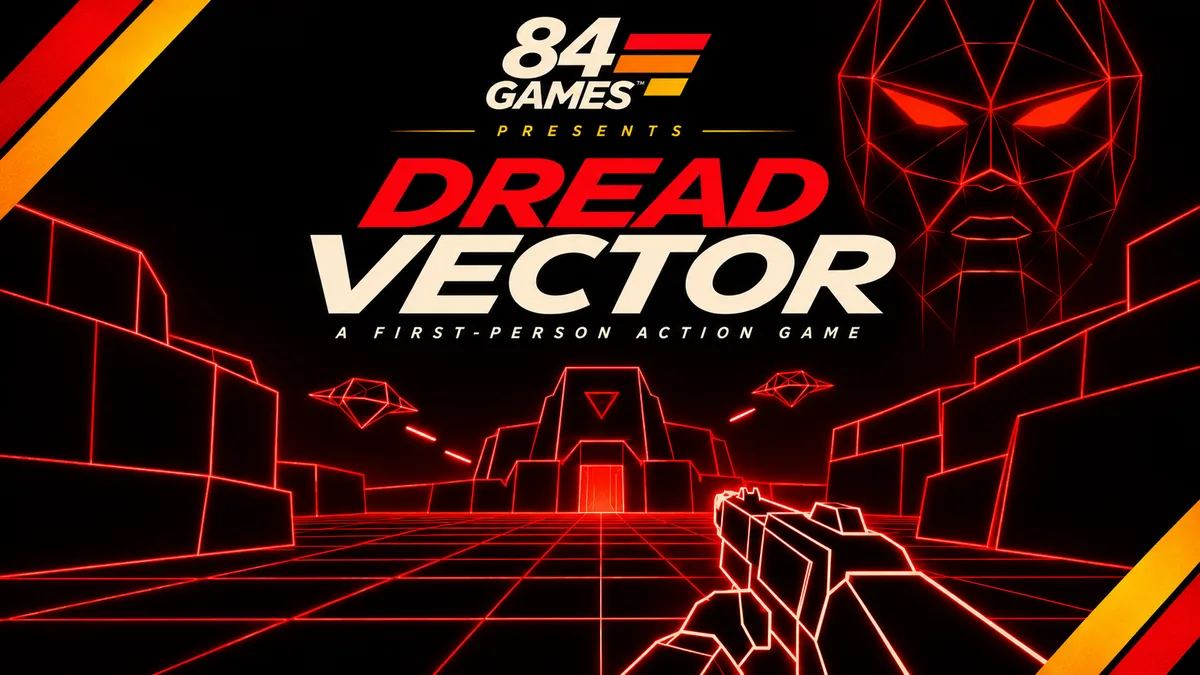
A wireframe first-person shooter set inside a corrupted data bank, where a combat simulation program hunts ten identity cards while hacker Donna Frey guides him through the grid.
#10 this weekAI-assisted: Code
The game runs in this tab. No install, no account.
The short answer
Dread Vector is a fast-paced vector-graphics first-person shooter that runs in a browser. You play Melvin Nine, a combat sim built to resemble a 1990s action hero, and push through hostile computational sectors to recover ten Continuity Ten identity cards before Bobby AI locks the system for good. Eight weapons, an arena wave mode, and a top-down arcade shooter sit alongside the campaign.
What is Dread Vector?
Dread Vector is a first-person shooter drawn in clean vector wireframe, set inside a corrupted computational data bank. The last human recovery team did not come back, and their digitised personalities are now locked in sector storage somewhere on a hostile network.
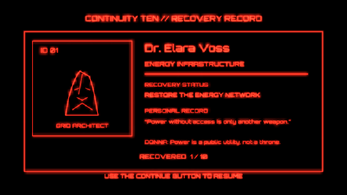
You are Melvin Nine, a combat simulation program modelled on the action heroes of 1990s shooters. A hacker named Donna Frey talks you through the job. The mission is singular: get inside the grid, work past the heavy security sectors, take down the Guardian subroutines and pull out all ten Continuity Ten identity cards before Bobby AI seals the system for good.
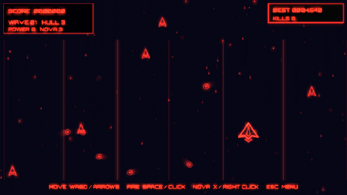
There is more here than the campaign. An eight-weapon sandbox with alternative fire modes sits at the centre of the fighting, an Arena mode delivers wave survival across five maps, and a top-down arcade shooter called Starfall breaks up the first-person action. EightFour Games developed it as a singleplayer browser game, published on 3 November 2026, and it costs nothing to play.
How to play
The campaign is the spine of the game. Melvin Nine works through eleven escalating security sectors, each one guarded by heavy subroutines, among them the Sentinel, the Hunter, the Warden and finally Bobby AI. Progress is measured in identity cards: ten of them sit locked in storage while the system is being shut down around you. How the recovery ends shapes the fate of the team, because the game ships with more than one ending.
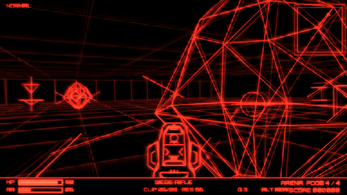
Combat is fast and kinetic, built on movement and on picking the right gun for the space ahead. Eight weapons are available, six of them named: a Siege Rifle, a pump-action Breacher, a high-yield Flak Cannon, a precision Shock Rifle, a Link Gun built to track multiple targets, and a heavy Rocket Launcher. Each one carries a tactical alternative fire, so a single slot can cover two very different jobs.
Arena mode drops the campaign for pure wave survival across five separate maps: Scrapyard, Crossroads, Reactor, Fracture and Pillar Maze. Spawn pods have to be destroyed under heavy pressure before they overrun the arena. Starfall is a different proposition again, a top-down vertical arcade space shooter with wave survival and boss encounters, held back as a change of pace from the first-person fighting.
Controls
Dread Vector uses a compact keyboard and mouse setup that takes about a minute to learn. WASD handles movement. The mouse controls where Melvin looks, which is also how targets are acquired and tracked. The left mouse button fires the primary mode, and the right mouse button triggers the secondary or alternative fire.
Weapon selection runs two ways. The scroll wheel cycles through the arsenal, or the number keys one through eight jump straight to a slot. That direct mapping is worth committing to memory, because the alternative fire on each gun is what turns eight weapons into a much wider tactical set than the raw count suggests. Movement and aim stay in constant use, so the switching keys are the only part of the scheme that needs practice.
| Input | Action |
|---|---|
| WASD | Move |
| Mouse | Look and aim |
| Left mouse button | Primary fire |
| Right mouse button | Secondary or alternative fire |
| Scroll wheel or number keys 1-8 | Select a weapon |
Tips for your first run
Treat the opening sectors as a test range. The wireframe presentation keeps sightlines clean and shapes readable against a minimal background, which is exactly what fast movement needs. A few habits will carry a new player further than raw aim.
- Learn the number keys early. Jumping directly to a specific slot beats scrolling past three guns while a Hunter closes the distance.
- Take the alternative fires one at a time. Each secondary mode is a separate tool, and getting comfortable with one before moving to the next keeps the arsenal legible under pressure.
- In Arena mode, hunt the spawn pods first. They are the thing that overruns a map, so clearing them under pressure matters more than mopping up whatever is already walking around.
- Keep an eye on the card count. Ten Continuity Ten cards decide how the campaign finishes, and the ending is worth reaching deliberately rather than by accident.
- Switch to Starfall when the pace starts to blur. Its wave survival and boss fights run at a completely different rhythm from the shooting.
Content and replayability
The campaign runs across eleven security sectors with four named Guardian types standing in the way, from the Sentinel and Hunter through to the Warden and Bobby AI. Ten Continuity Ten identity cards are the prize, and because the game offers multiple endings tied to how the recovery goes, a second pass has a reason to be played differently rather than identically.
The eight-weapon arsenal does a lot of the replay work on its own. Alternative fires mean the Siege Rifle and the Rocket Launcher are not just two flavours of the same decision, and the Link Gun's multi-target behaviour suggests a crowd-control role that the Breacher and Flak Cannon do not fill. Experimenting with loadout habits is a legitimate way to spend an evening.
Arena mode adds five maps to learn separately, each one a wave-survival problem built around destroying spawn pods before they overwhelm the space. Starfall layers in a top-down arcade shooter with waves and bosses. A single player can move between a first-person sector crawl, a survival arena and a vertical space shooter without leaving the same release.
Presentation and performance
The visual identity is vector wireframe, deliberately stripped of texture and clutter. Environments are minimalist by design, engineered so that shapes read clearly at speed. That choice suits the pacing: fast kinetic movement is easier to read when the background refuses to compete with the things trying to kill you.
The look leans retro rather than realistic, and the first-person view is rendered in 3D with a wireframe finish. It is a style that travels well through a browser, since the game is delivered as an HTML5 build inside a playable frame rather than as a downloadable client.
Audio, frame rate behaviour and load times on specific hardware fall outside what has been established, so treat the first session as a check on how the build performs on your own machine. The visual language itself is consistent: clean lines, strong silhouettes, and a corrupted data bank rendered as geometry rather than scenery.
Who should play it
Dread Vector is aimed at players who remember 1990s shooters fondly and want that speed back without the baggage. The eight-weapon sandbox with dual fire modes rewards people who enjoy learning a toolkit, not just a favourite gun. The vector wireframe style will appeal to anyone tired of visual noise in modern first-person games.
Solo players are the intended audience. The game is built as a singleplayer experience, so nobody needs to coordinate a squad or wait in a queue to start. An arcade streak runs through the whole package as well: wave survival, boss encounters and a top-down space shooter are all present for people who like score-chasing sessions rather than long campaigns.
Anyone who wants a competitive multiplayer shooter should look elsewhere, and players who need a heavy narrative or realistic presentation will find the stripped-back wireframe approach severe. For a browser-first release that costs nothing, the combination of a sector campaign, a five-map arena and an arcade sub-mode is a broad package for players who like their shooters quick, readable and mechanically tight.
Screenshots
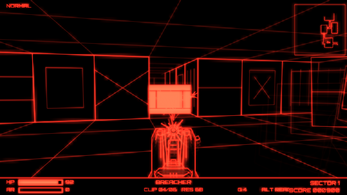
How we tested it
The build was loaded from games.debutplay.com in a headless Chromium session on ; the canvas started and no request was blocked. The guide was last checked on .
From the developer
DREAD VECTOR (DV-84 Rev 1.0) A FAST-PACED VECTOR-GRAPHICS FIRST-PERSON SHOOTER SET INSIDE A CORRUPTED COMPUTATIONAL DATA BANK. THE BRIEFING Humanity’s last recovery team has failed. Their digitised personalities are currently locked in sector storage across a hostile computational network. You are Melvin Nine, a combat simulation program modeled after classic 1990s action heroes. Guided by hacker Donna Frey, your objective is singular: breach the grid, bypass heavy security sectors, defeat the Guardian subroutines, and retrieve the 10 Continuity Ten identity cards before Bobby AI seals the system permanently. KEY FEATURES High-Octane Vector FPS Combat: Clean, minimalist wireframe environments engineered for high visual readability and fast-paced kinetic movement.8-Weapon Tactical Sandbox: Master a distinct arsenal featuring tactical alt-fires—including the Siege Rifle, pump-action Breacher, high-yield Flak Cannon, precision Shock…
Frequently asked questions
What is Dread Vector?
A vector-graphics first-person shooter set inside a corrupted computational data bank. Melvin Nine, a combat simulation program, is guided by hacker Donna Frey through hostile sectors to recover ten Continuity Ten identity cards before Bobby AI seals the system.
How many weapons are in Dread Vector?
Eight, each with a tactical alternative fire. The named ones are the Siege Rifle, pump-action Breacher, high-yield Flak Cannon, precision Shock Rifle, multi-target Link Gun and heavy Rocket Launcher.
What are the Continuity Ten identity cards?
Ten identity cards holding the digitised personalities of the lost recovery team. Recovering all of them fully restores humanity, and how far the recovery goes determines which ending the campaign reaches.
Does Dread Vector have modes beyond the campaign?
Yes. Arena mode is pure wave survival across five maps, Scrapyard, Crossroads, Reactor, Fracture and Pillar Maze, where spawn pods must be destroyed before they overrun the space. Starfall is a top-down vertical arcade space shooter with waves and boss fights.
Is Dread Vector free?
Yes. It costs nothing to play and runs in a browser as an HTML5 build, so there is no purchase to make before trying the first sector.
How many endings does Dread Vector have?
More than one. Success in recovering the ten Continuity Ten identity cards determines the fate of the team, so the ending shifts depending on how complete the recovery is when the campaign closes.
What games are similar to Dread Vector?
The closest matches on DebutPlay are ECHOES OF THE VOID, Onion Dweller Game: MyMy's Rescue Mission, HELLBREACH: TARTARUS. They share the same genre, so the controls and the pace carry over.
Something wrong or missing? Tell us. How we test games.