Fighting · New game
FINAL HONOR: FEUDAL GRUDGE — GBC Demo
A free browser demo of a Game Boy Color fighting game set in a fictional feudal Japan, where a mother with a diaper projectile faces a bill-collecting rival across one lantern-lit arena.
#49 this weekAI-assisted: Code, Graphics, Sound, Text
The game runs in this tab. No install, no account.
The short answer
Final Honor: Feudal Grudge is an in-development Game Boy Color fighter that runs in the browser, and this free demo narrows the action to a single festival arena with two selectable fighters: Akane Kiba, who fights with a baby in tow, and Genzo the Collector, who throws sealed bills and calls in colleagues. Play it now to test blocks, launchers, throws and specials.
What is Final Honor: Feudal Grudge?
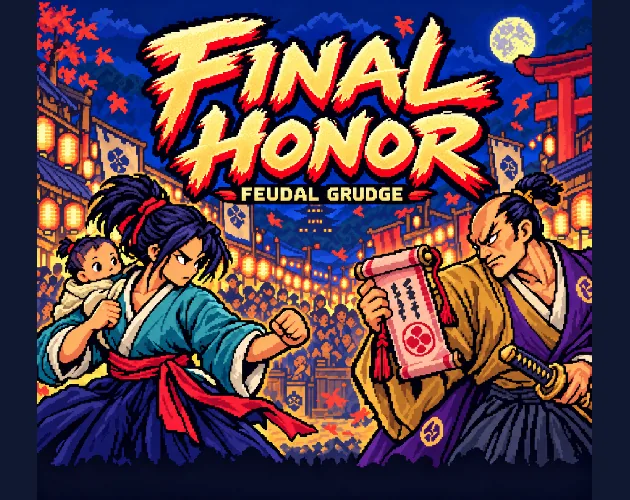
Final Honor: Feudal Grudge is an original fighting game built as a native Game Boy Color cartridge project, and the version playable here is a free one-arena demo that runs in the browser. The setting is a fictional feudal Japan where paperwork carries real danger: several grudges converge on a document called the Five Seals charter, and the motives behind them range from a mother protecting her baby to a collector chasing forged accounts, a poet hunting stolen verse, a monk tracking missing charity rice and a scarred rescuer deciding who deserves to see his face.
The demo trims that premise to a single windy lantern festival, where a family outing turns into the least peaceful event in the province. Two fighters are selectable: Akane Kiba and Genzo the Collector. The project is in active development, so this build is a slice of the idea rather than the finished roster.
How to play
Every round in this demo comes down to a two-fighter matchup at a lantern festival, with blocks, throws, launchers and timed combos carrying the fight. Guarding is directional: hold away from the opponent to block. Pressing forward and the heavy button together launches, while back plus heavy turns the character into a turning back kick, complete with follow-ups the player performs rather than automatic sequences.
Light and heavy attacks share a button pair, and pressing both at once produces a throw. Specials sit behind a held direction: keep down pressed and then hit light, heavy or the two-button combination. Each fighter carries three specials. Combo timing rewards clean inputs, because attack buttons need to be released between taps instead of mashed.
Kiba's kit leans on family business: a diaper projectile and a special called Motherly Love with a dangerous heart. Genzo works the way a collector should, tossing pink sealed bills, gathering money and life, and summoning two persuasive colleagues. When the collector falls, the moneybags keep coming.
Controls
Arrow keys handle movement and guard, so the left-right axis doubles as offense and defense. Z maps to the A button for light attacks, X maps to B for heavy attacks, Enter covers Start and Shift covers Select, mirroring the original handheld layout. Holding away from the opponent blocks; forward plus B launches; back plus B becomes a back kick; A plus B throws; holding down while pressing A, B or A plus B fires a special.
Gamepads and touch controls are supported alongside the keyboard, so the same fight can be played on the keys or with a pad in hand. The in-game move guide is the fastest reference when a motion fails, since it explains the conditions attached to certain attacks and marks which moves run out of uses.
Nothing about the button layout is hidden behind a tutorial gate, which matters for a demo built around a single matchup: the inputs are few, but the spacing between a block, a launcher and a throw is where the fight is decided.
| Input | Action |
|---|---|
| Arrow keys | Move and guard |
| Z | A button, light attack |
| X | B button, heavy attack |
| Enter | Start |
| Shift | Select |
| Gamepad | Supported for play |
| Touch controls | Supported for play |
Tips for your first run
The demo is short but not shallow — three specials per fighter, launchers, throws and follow-up routes give plenty to test before the festival ends. Start in Training, choose one of the three difficulty settings, and spend the opening minutes with the in-game move guide, which spells out the conditions behind particular attacks and the moves with limited uses.
- Hold away from the opponent to block rather than hunting for a dedicated guard button.
- Open with forward plus B to launch, then follow up while the opponent is still airborne.
- Use back plus B to turn a crowded exchange into a back kick.
- Reach for A plus B when an opponent sits behind a block, since the same press throws.
- Keep down held and press A, B or A plus B for specials, saving limited-use moves for the moments that decide the round.
- Release the attack buttons between combo taps, because mashing breaks the chain.
- As Genzo, do not assume the fight ends when the collector goes down; the moneybags keep arriving.
Content and replayability
Beyond a single festival fight, the demo carries real structure: three difficulty settings, a Training mode and an in-game move guide that covers the conditions behind attacks and the limited-use options. Preferences for fighter, difficulty, music and sound persist on the device, and a Saves and settings panel offers an export backup. Fight progress itself is not retained, so each session opens the matchup fresh. Victories unlock Feudal Moves, and the humor stays broad — the whole premise rests on paperwork being as dangerous as a punch.
The larger development build is set to carry five fighters, fifteen arenas with their own music and atmosphere, individual stories, a tournament ladder, awards, opponent-boundary saves and a two-cartridge link mode. This demo keeps its focus on the Kiba-versus-Genzo festival bout, so those extras belong to the road ahead rather than to today's download.
Presentation and performance
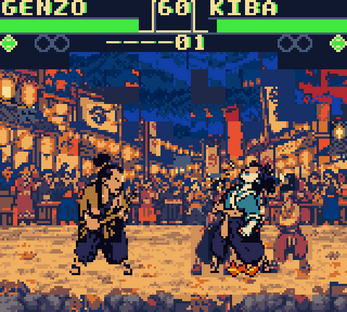
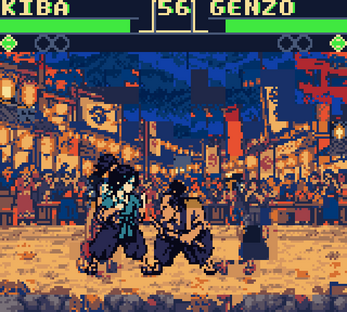
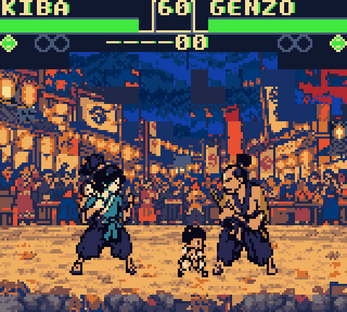
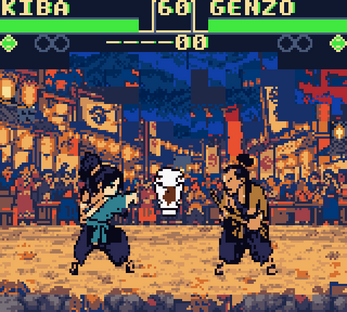
Everything on screen comes from a native Game Boy Color project: bright native pixels, deliberate pauses on impact to sell the weight of hits, and readable anime cut-ins for the bigger moments. Music runs through four channels, joined by effects and the occasional sampled voice. The gameplay screenshots enlarge those native pixels, while the promotional cover art is a separate piece of artwork.
The browser build runs the same cartridge demo that the gameplay film draws from, and that 73-second film uses controlled setups for its move and defeat examples, with every frame and sound taken from the native ROM. Verification on physical cartridge, an original Game Boy Color and a Chromatic handheld is still pending, so this is a browser-first look at work in progress rather than a finished hardware release.
Who should play it
Anyone who keeps a soft spot for handheld fighting games will recognize the shape: a compact move list, three specials per fighter, throws and launchers, and the kind of timing that rewards releasing buttons cleanly. The comedy — a diaper projectile, a poet's stolen verse, a monk tracking charity rice — lands harder for players who like their feudal drama absurd rather than solemn.
It suits a short sitting. One arena, two fighters, three difficulty levels and a Training mode make it a quick way to judge whether the combat reads well, and feedback on combat feel, readability and the balance between drama and absurdity is explicitly invited. Players holding out for the five-fighter roster, tournament ladder and link mode should treat this as a preview of the festival fight rather than the complete package.
Screenshots
How we tested it
The build was loaded from games.debutplay.com in a headless Chromium session on ; the canvas started and no request was blocked. The guide was last checked on .
From the developer
Five grudges. One very bad charter. FINAL HONOR: FEUDAL GRUDGE is an original Game Boy Color fighter set in a fictional feudal Japan where paperwork can be as dangerous as a punch. A mother protects her baby. A collector hunts forged accounts. A vain poet wants his stolen verse back. A monk follows missing charity rice. A scarred rescuer decides who gets to see his face. All roads lead to the Five Seals charter. Motherhood. Compound interest. Mortal enemies. Play this free one-arena demo as Akane "Kiba" or Genzo the Collector. A windy lantern festival becomes the least peaceful family outing in the province. Your browser runs the same native cartridge demo available below. Kiba brings a baby with unfinished business, a diaper projectile and Motherly Love with a dangerous heart. Genzo delivers pink sealed bills, collects money and life, and summons two persuasive colleagues. When the collector falls, the moneybags keep coming. Blocks,…
Frequently asked questions
Is the demo free to play?
Yes. The demo costs nothing and runs inside the browser as a playable HTML5 frame, so no purchase stands between a visitor and the festival fight.
Which fighters can be chosen in the demo?
Two. Akane Kiba brings a baby, a diaper projectile and a special named Motherly Love; Genzo the Collector throws pink sealed bills, gathers money and life, and summons two persuasive colleagues.
Does the demo save progress?
Settings for fighter, difficulty, music and sound stay on the device, and an export backup option is available. Fight progress is not saved, so each run begins the matchup from the start.
Can it be played with a controller or a touchscreen?
Gamepads and touch controls are both supported alongside the keyboard, where the arrow keys move and guard while Z and X cover light and heavy attacks.
Is there a practice mode?
Training is included, along with three difficulty settings and an in-game move guide that explains attack conditions and flags the limited-use moves.
What will the full game contain?
The full development build is set to hold five fighters, fifteen arenas with distinct music and atmosphere, individual stories, a tournament ladder, awards, opponent-boundary saves and a two-cartridge link mode.
What games are similar to FINAL HONOR: FEUDAL GRUDGE — GBC Demo?
The closest matches on DebutPlay are Furious Street, Spin Top Showdown, Boots & Bad Luck. They share the same genre, so the controls and the pace carry over.
Something wrong or missing? Tell us. How we test games.