Strategy · New game
GOD Inc.
A free browser god-game about sculpting hex planets, recruiting believers and out-building a rival deity before the par time runs out.
Play on itch.io
Play GOD Inc.
GOD Inc. casts the player as a God Intern at a cosmic worship company, terraforming hex planets in 3D while a rival god settles and smites back. Raise mountains, plant God's Mark, hunt monoliths for spells like Volcano and Armageddon, and…
Play on itch.io ↗itch.io blocks third-party embeds, so the game opens on the developer's page. No install, no account.
The short answer
GOD Inc. casts the player as a God Intern at a cosmic worship company, terraforming hex planets in 3D while a rival god settles and smites back. Raise mountains, plant God's Mark, hunt monoliths for spells like Volcano and Armageddon, and clear each solar system inside par time. It runs in the browser and on Android, costs nothing, and saves progress locally.
What is GOD Inc.?
GOD Inc. opens with a job offer: God Intern at a company billed as the galaxy's leading provider of worship. The supervisor one rung above has four billion years of experience and no patience to spare. Planets arrive as contracts rather than levels, and a rival god's Non-Believers are already moving in before the new hire has done anything at all.
The brief is threefold. Grow the Believers, out-build the competing deity, and convert every last non-believer inside the par time, which is where stars come from. Work happens on a fully 3D world assembled from hexes, in real time, while the rival terraforms, settles and smites back.
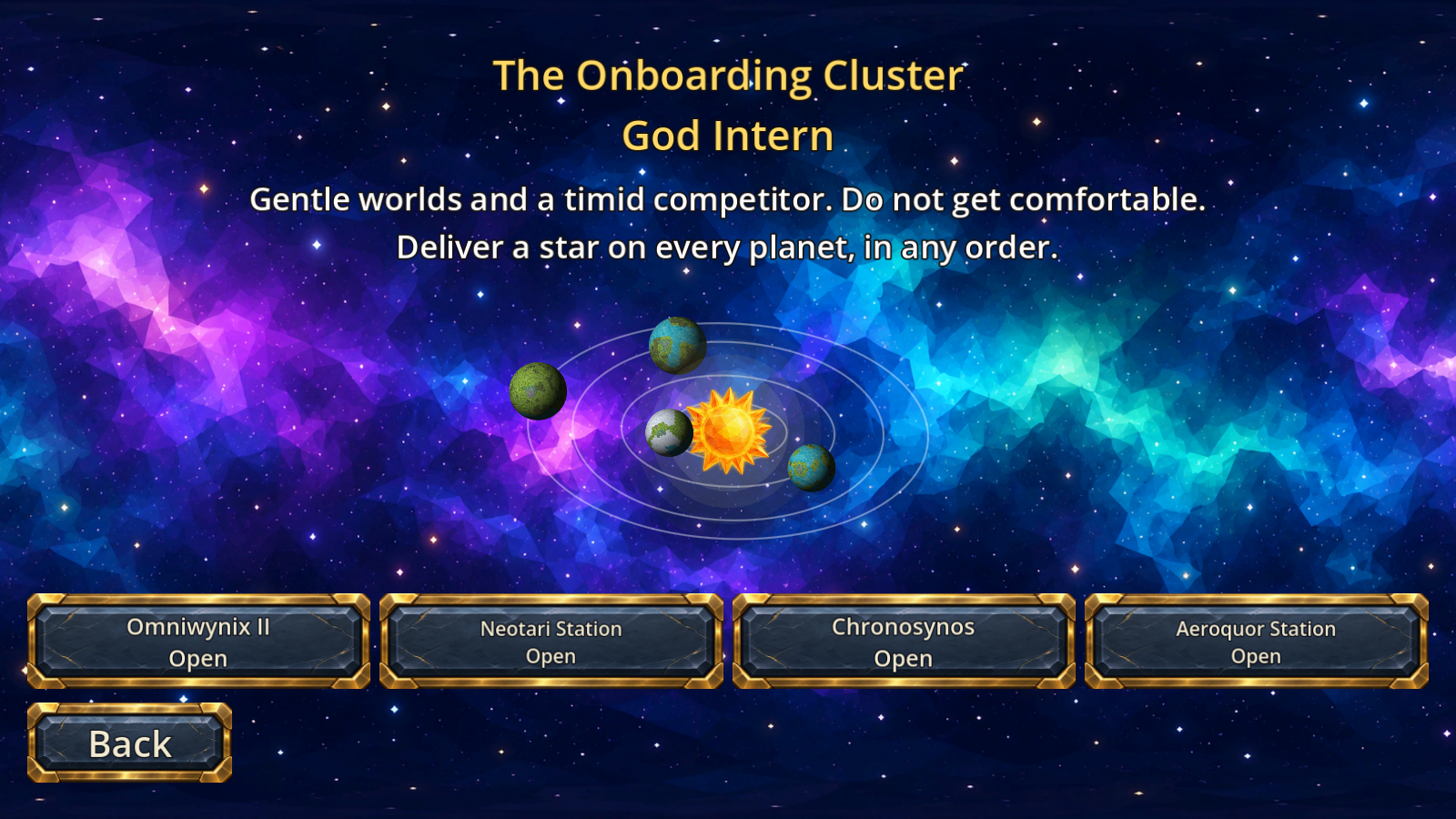
It is a singleplayer strategy sandbox with a satirical, office-comedy tone — divine omnipotence filed under unpaid overtime. Clearing every planet in a solar system earns a promotion along a ladder running from God Intern to Chief Executive Deity, and the targets climb again every quarter after that. The game runs in a browser and on Android, and it costs nothing to play.
How to play
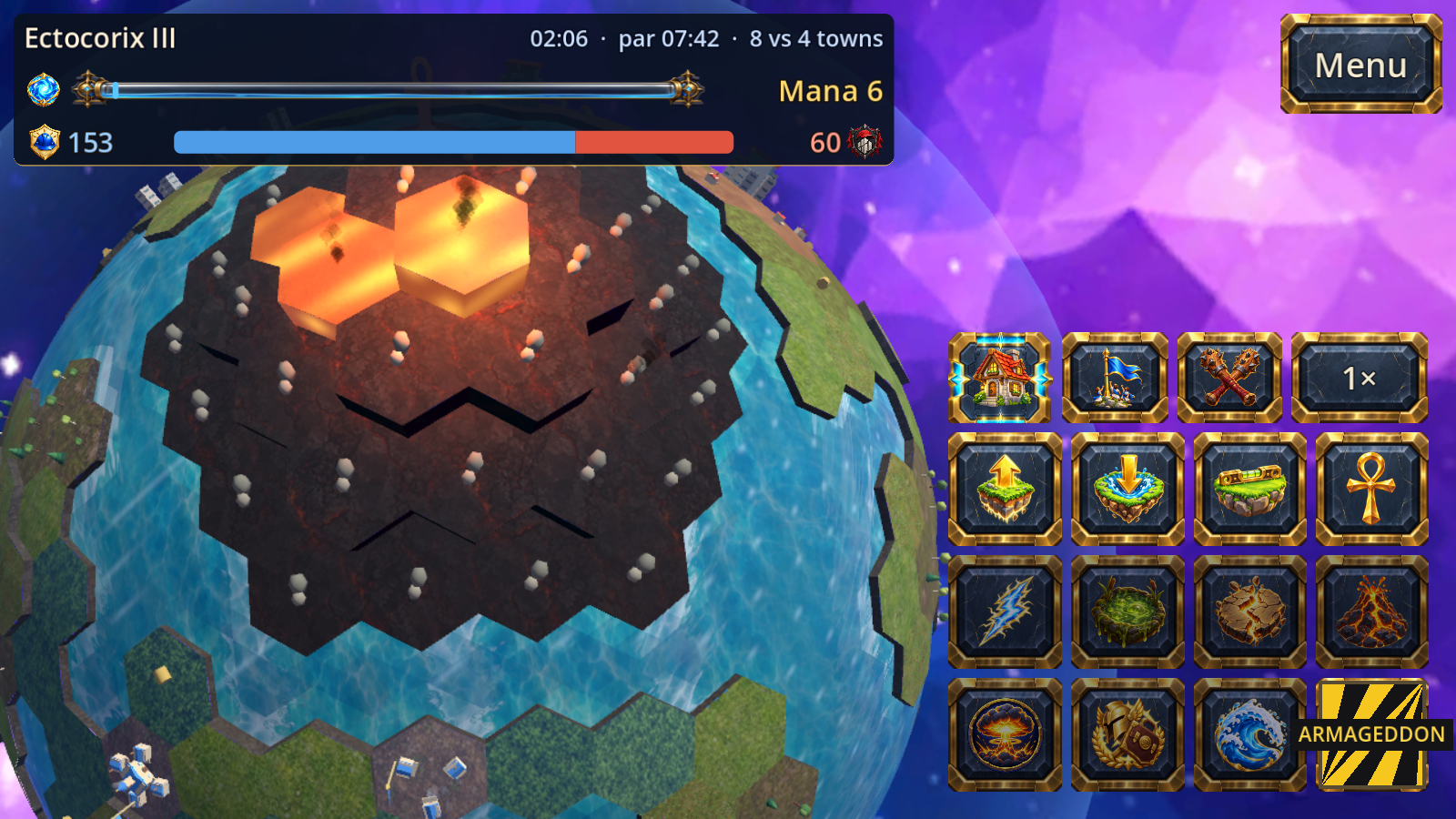
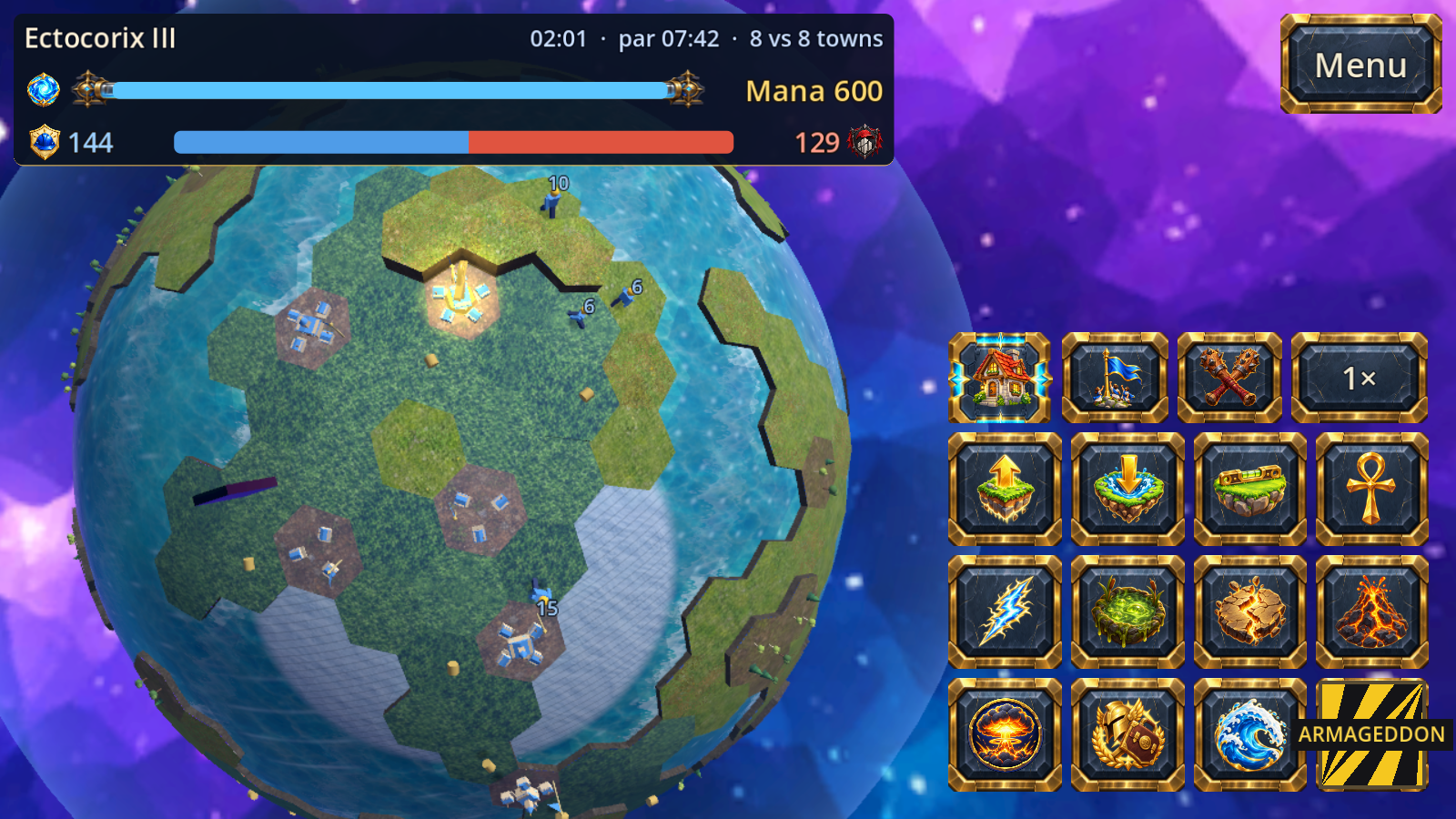
Everything begins with the ground. Terrain is edited one hex at a time: raise, lower or flatten the surface to stack mountain walls, cut gorges or open farmland. Settlers only occupy level land, and walkers haul themselves up cliffs slowly, so a ridge works as both a barrier and a delay. The shape of the planet is the strategy, not decoration around it.
Population comes second. Planting God's Mark gives the faithful a destination, and Rally points them at it. Whoever reaches the mark first becomes the leader, and leaders have a habit of finding things worth having.
Monoliths supply the fireworks. Black slabs are scattered across the systems, each holding a single spell: Lightning, a Champion, Armageddon, Swamp, Earthquake, Volcano, Flood and a Tactical Nuke. Anything discovered stays available for the rest of the career, which makes early exploration pay off later. Armageddon is the finisher — every soul on the planet is drafted into one of two armies, they form up, face off, charge, and the survivors take the world.
Controls
On mouse and keyboard, powers work in two steps: click the button, then click the planet. Dragging turns the world and the mouse wheel zooms. The letters R, L, F and M cover raise, lower, flatten and God's Mark, while 1, 2 and 3 handle settle, rally and fight. Space changes game speed, and Esc opens the menu or cancels the current action.
Touch swaps the same actions onto taps and gestures. Tap a power button, then tap the planet to fire it. Swiping rotates the planet and pinching zooms. A speed button replaces the space bar and a menu button replaces Esc.
Large spells require a second tap before they commit, so a misplaced finger is not automatically fatal. Armageddon adds one more step on top of that: it arrives with a cover, and the cover has to be lifted deliberately.
| Input | Action |
|---|---|
| Mouse | Click a power button, then click the planet to use that power |
| Mouse drag | Turn the planet |
| Mouse wheel | Zoom in and out |
| R / L / F / M | Raise, lower, flatten or place God's Mark |
| 1 / 2 / 3 | Settle, rally or fight |
| Space | Change game speed |
| Esc | Open the menu or cancel |
| Touch tap | Tap a power button, then tap the planet to use that power |
| Touch swipe | Turn the planet |
| Touch pinch | Zoom in and out |
| Speed button | Change game speed |
| Menu button | Open the menu or cancel |
Tips for your first run
The first minutes are best spent reading the ground rather than spending powers. Farmland that is already flat needs no work, and a ridge placed early shapes where both sides can expand for the rest of the contract.
Keep an eye on the par time as well. A tidy conversion that overruns the limit still loses the stars, so speed and neatness pull against each other from the first planet onward.
- Flatten a shelf before pushing Believers outward, since settlement only takes hold on level ground.
- Use mountain walls as slow-down tools: walkers climbing cliffs give the rival's expansion a problem to solve.
- Rally early to crown a leader, because leaders are the ones who find things.
- Chase monoliths while the map is still open — every spell found is kept for the rest of the career.
- Drop the game speed while terraforming and raise it while waiting on population.
- Treat the second-tap confirmation as a safety net, not a licence to fire Armageddon casually.
Content and replayability
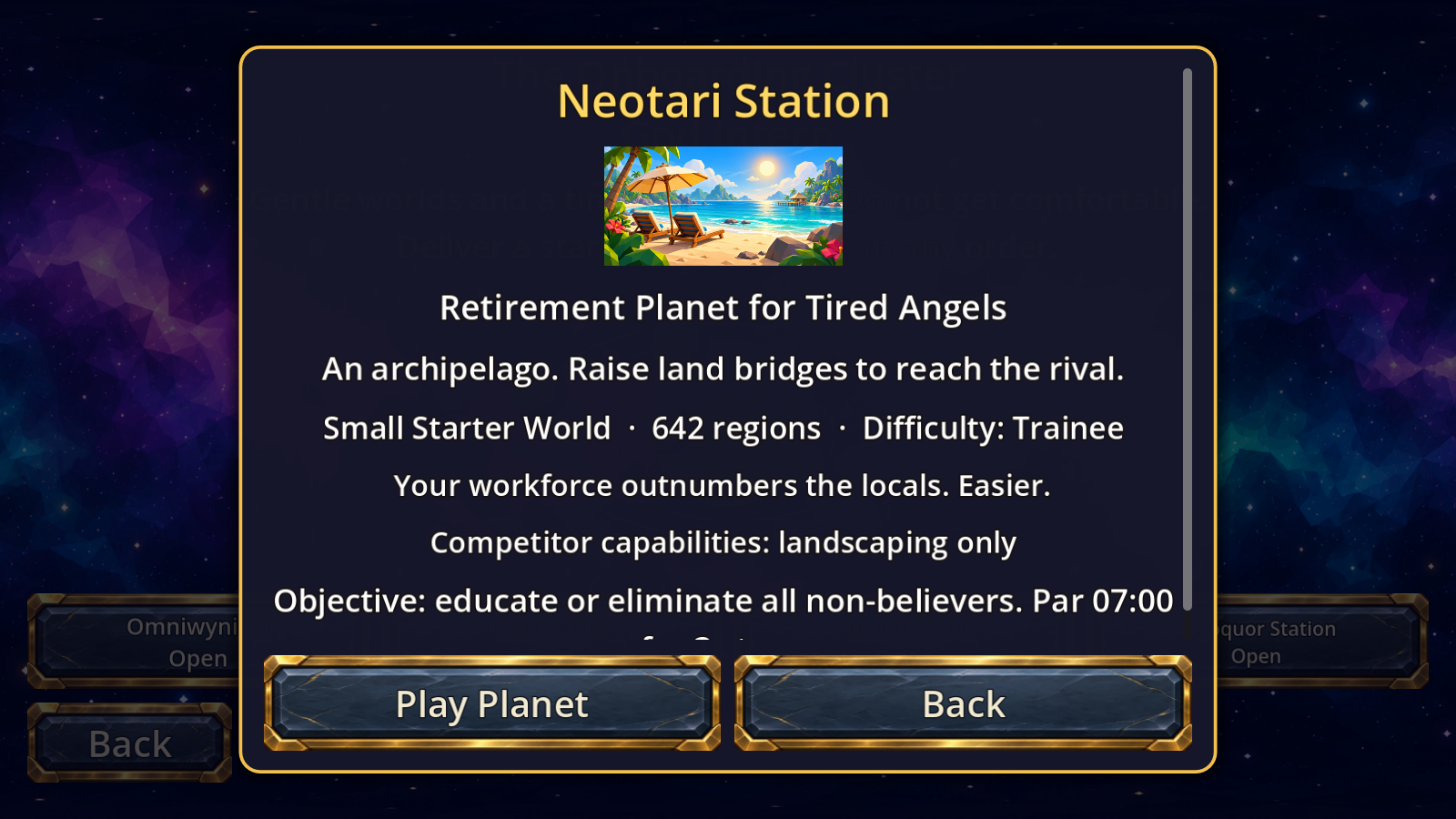
The campaign is built from dozens of procedurally named worlds, and they are not palette swaps: ice worlds, archipelagos, volcanic spas and toxic rocks all demand different terrain work. The rival god keeps pace, sculpting ground, planting settlements and smiting in return, so a plan that worked on frozen terrain rarely transfers intact to an archipelago.
Persistence does a lot of the long-term lifting. Spells pulled out of monoliths stay unlocked for the remainder of the career, which turns each system into a shopping trip as much as a battle. Promotions gate progress: clear a whole solar system and the ladder moves up, from God Intern through the ranks to Chief Executive Deity.
After the top title, the targets keep rising every quarter, indefinitely. There is no announced end point to that curve, and overtime, in keeping with the theme, is unpaid.
Presentation and performance
Planets are fully 3D and rotatable, built from hex tiles, which makes the terrain edits readable from any angle. The soundtrack is adaptive: a pastoral harp at the start of a civilisation, full war brass once it grows and starts fighting.
The layout adapts too. Phones play in portrait, desktops in landscape, and the same build runs in an HTML5 frame in the browser or as an Android app. The project is built on Godot Engine 4.7, with most graphics and sounds from GPT-SOL6, coding assistance from Claude Opus 5.5, and Gemini 3.1 Pro contributing scripting and ideas. Sarah Craswell developed, programmed and tested it in three days.
Sound work leans on CC0 recordings from OpenGameArt, including ocean waves, birds and wind ambience, a blacksmith's hammer, metal impacts and a click. Progress is saved in the browser, so a session can be closed and picked up later.
Who should play it
Anyone who remembers Populous-style god games will recognise the loop immediately: shape land, place followers, watch two civilisations grind against each other on terrain you drew. The terraforming tools are fine-grained enough for players who like optimizing a map before a single unit moves.
Real-time strategy players who prefer economy and positioning over build orders will find the par-time structure familiar, and sandbox players can treat the terrain editor as a toy in its own right. The satire gives the whole thing a tone that suits short sessions — a joke about unpaid overtime lands better in twenty minutes than in four hours.
Phone players matter here: portrait layout plus touch controls mean it fits a commute, and Android is supported alongside the browser version. It is singleplayer only and costs nothing, so curiosity is cheap. Those hunting competitive multiplayer should look elsewhere.
Screenshots
From the developer
Congratulations on your appointment as God Intern at God Inc., the galaxy's leading provider of worship. Your supervisor has four billion years of experience and no patience whatsoever. Each planet is a contract. A rival god's Non-Believers are already settling in. Your job: grow your Believers, out-build the competition, and educate every last non-believer — inside par time, for stars. **Sculpt the world.** Raise and lower the ground one hex at a time. Pile up mountain walls, carve gorges, flatten farmland. Your people settle on level land, and walkers climb cliffs slowly, so the shape of the planet is your strategy. **Lead your people.** Plant God's Mark and Rally your followers to it. The first to arrive becomes your leader, and leaders can find things... **Discover the monoliths.** Black monoliths are hidden across the systems. Each one holds a spell: Lightning, a Champion, Armageddon, Swamp, Earthquake, Volcano, Flood and a…
Read the full description on itch.io →Frequently asked questions
Does GOD Inc. cost anything?
The price is zero, so playing costs nothing. No paid extras or purchases are part of the announced content.
Where can it be played?
Two platforms are supported: HTML5 in a browser, where a playable frame is embedded, and Android. Desktop installers and other mobile systems are not part of the announced lineup.
Does progress carry over between sessions?
Yes. Progress is saved in the browser, so a run can be closed and resumed, and discovered spells are kept for the rest of the career.
Can two people play together?
No. It is built for singleplayer, and the only opposition is the rival god working each planet alongside the player.
How many spells can be found?
Eight are named: Lightning, Champion, Armageddon, Swamp, Earthquake, Volcano, Flood and a Tactical Nuke. Each waits inside a black monolith, and the Armageddon spell needs its cover lifted before it fires.
How does the phone version control?
Tap a power button and then the planet, swipe to spin the world, and pinch to zoom. On-screen speed and menu buttons replace the space bar and Esc, and phones play in portrait.
Something wrong or missing? Tell us.