Action · New game
Magnetic Chaos: Keep the Sphere
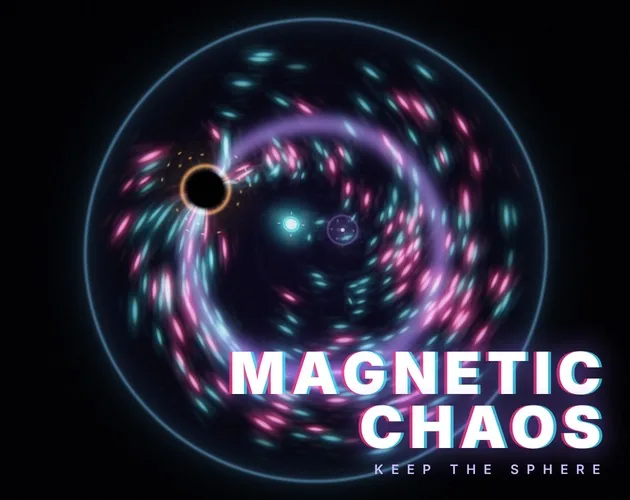
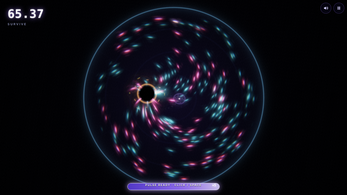
One gravity well, one volatile Spark, and hundreds of charged fragments that either ignore the core or end the run on contact.
#6 this week
The game runs in this tab. No install, no account.
The short answer
Magnetic Chaos: Keep the Sphere is a physics survival arcade game about steering a single gravity well while it drags a glowing core called the Spark. Same-charge debris bounces off harmlessly, opposite-charge debris kills on contact, and grazing the dangerous fragments charges a shockwave. Anomalies escalate the swirl the longer a run lasts.
What is Magnetic Chaos: Keep the Sphere?
Magnetic Chaos: Keep the Sphere is a physics-driven survival arcade game built around a single moving point of gravity. The player steers one gravity well, and a volatile glowing core called the Spark trails after it through a crowded arena. Hundreds of charged magnetic fragments drift and spin in the same space, and the only objective is to keep that core intact.
Charge decides everything. Fragments carrying the same charge as the Spark are shoved away on approach and cannot hurt it. Fragments with the opposite charge are pulled toward the core instead, and a single touch destroys it. Contact with the arena wall ends the attempt just as abruptly, so the danger is not only the swarm but the boundary containing it.
Runs are short by design, lasting anywhere from ten seconds to several minutes, and survival is graded through named ranks that climb from STATIC through FLOW STATE to BEYOND CHAOS. The game costs $2.00 and ships as an HTML5 build that runs in the browser alongside Windows, macOS and Linux versions.
How to play
Steering is the whole verb. Moving the gravity well drags the Spark along behind it, so the core's position is always a consequence of where the well has just been. Every decision is therefore a path decision: which lane to open, when to swing wide, and how much room to leave before the arena edge arrives.
The skill layer is the graze. Passing close to opposite-charge debris without touching it charges the PULSE, and a charged PULSE fires a shockwave that throws the surrounding swarm away from the Spark. That blast is the only breathing room on offer in a crowd that never thins on its own, so grazing is less a stunt than a resource to keep topping up.
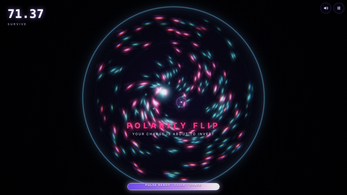
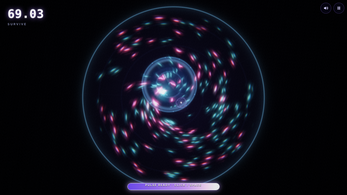
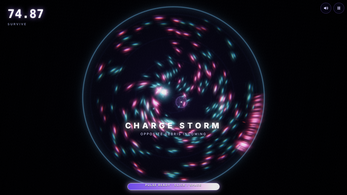
Pressure climbs with time. The Spark grows heavier, the swarm rotates faster, and a growing share of the fragments flips to the hostile charge. Anomalies then enter the arena: a blue ring that slows everything caught inside it, a polarity flip that inverts the Spark's charge so previously safe debris becomes the threat, a gravity warp that reverses the direction of the entire swirl, a charge storm that pours a fresh wave of opposite-charge debris in from the edge, and a singularity that opens a black hole pulling in everything nearby, the player included.
Controls
Three input schemes cover the entire game. With a mouse, moving the pointer steers the gravity well and a click fires the PULSE. On a keyboard, the WASD cluster or the arrow keys handle steering, with the spacebar as the PULSE trigger. On a phone or tablet, dragging a finger anywhere on the screen steers and a tap fires the PULSE, so the touch layout never asks for a precise on-screen button. Two utility keys round things out: P or Escape pauses the action, and M mutes the audio.
The scheme is deliberately thin, because steering and firing are the only two actions the game asks for. Desktop players can move between mouse and keyboard without losing anything, since both map to the same steering and the same PULSE trigger. The touch option mirrors that pair exactly: one continuous gesture for direction, one discrete tap for the shockwave.
| Input | Action |
|---|---|
| Mouse | Move to steer the gravity well; click to fire the PULSE |
| Keyboard | WASD or arrow keys to steer; Space to fire the PULSE |
| Touch | Drag anywhere to steer; tap to fire the PULSE |
| P or Escape | Pause |
| M | Mute the audio |
Tips for your first run
Opening attempts tend to end fast, usually because the well drifts into the wall or the Spark clips a fragment that looked further away than it was. A handful of habits flattens that learning curve considerably.
- Treat the arena wall as a second enemy. The boundary ends a run as cleanly as opposite-charge debris, so keep turning room in reserve before the edge arrives.
- Graze on the way past rather than on purpose. Near misses charge the PULSE, but committing to a deliberate close pass is how most early runs finish.
- Hold a charged PULSE for the moment the crowd tightens instead of firing it the instant it becomes available.
- Re-read the field after a polarity flip, because the fragments that were harmless become the ones that kill, and the reverse.
- Expect the swirl to reverse. A gravity warp turns the whole flow around, so a safe lane can become a head-on approach in an instant.
- Use the blue ring. Inside a time dilation field everything crawls, which is the cheapest window to cross a crowded stretch of the arena.
- Play with headphones, since the soundtrack's escalation works as an audible clock on how far into a run the Spark has travelled.
Content and replayability
The content model is the run rather than a campaign. Each attempt begins with a fresh swarm, and length is bounded only by survival: some attempts are over in ten seconds, others stretch out to several minutes. The named ranks mark the climb from STATIC to FLOW STATE to BEYOND CHAOS, giving a clear ladder to chase without an authored stage list in between.
Replayability comes from escalation instead. The Spark gains weight, the swarm spins faster, and more fragments convert to the hostile charge as time passes, so the same arena produces a different pressure curve on every attempt. The anomaly set adds further variation, swapping the rules mid-run rather than simply adding speed: charge inverts, direction reverses, time slows, a fresh wave pours in, or a singularity starts hauling everything toward a single point.
It is a single-player experience throughout, and the hook is openly the one-more-second kind, where a run ends before it feels finished. At $2.00, the value proposition rests on how often that feeling repeats.
Presentation and performance
The look is minimalist and neon: motion trails trail off the debris, bright elements carry bloom, the gravity well bends the space around it with lensing, and time-dilation fields announce themselves with ripples. The WebGL build pushes hundreds of physics-driven fragments at a smooth 60 frames per second, which matters when the difference between a graze and a fatal touch is a few pixels of clearance.
Audio is generated live rather than played back from a fixed track. An ambient drone opens a run, a heartbeat layer enters as pressure builds, and a frantic synth pulse takes over the longer the Spark survives. That makes the music a readable gauge of danger as well as atmosphere, and it is the reason headphones are worth the trouble.
The browser build needs no installation, and the desktop builds cover Windows, macOS and Linux. Touch play is supported on phones and tablets, with the same two actions mapped to drag and tap.
Who should play it
This suits players who like arcade survival with a physics toy underneath it: a game that asks for two actions, punishes sloppy routing, and rewards the nerve to shave past something lethal for a shockwave charge. The abstract neon presentation and the reactive score give the short runs a strong atmosphere, which helps when a session is a string of ten-second failures.
It also fits anyone who wants something running in a browser tab without an install, or a touch game that uses one thumb rather than an on-screen pad. Sessions are naturally short, so it slots into a coffee break as easily as a longer rank-chasing evening.
Look elsewhere if you want a story campaign, authored levels, or company. The appeal here is solitary, self-inflicted pressure that climbs until the Spark is heavy, the swirl is fast, and the arena has turned most of itself against you.
Screenshots
How we tested it
The build was loaded from games.debutplay.com in a headless Chromium session on ; the canvas started and no request was blocked. The guide was last checked on .
From the developer
A hypnotic physics survival game where everything goes wrong very quickly. You control a single gravity well. It drags a volatile, glowing core, the Spark, after it. Around you, hundreds of charged magnetic fragments swirl through the arena. Your only job is to keep the Spark alive. THE RULES • Debris with the SAME charge as the Spark is pushed away. Harmless. • Debris with the OPPOSITE charge is drawn toward it. One touch and the run is over. • So is the arena wall. • Brush past opposite-charge debris without touching it to GRAZE. Grazes charge your PULSE, a shockwave that blasts the swarm away from the Spark. IT GETS WORSE The longer you survive, the heavier the Spark gets, the faster the swarm spins and the more of it turns against you. Then the anomalies arrive: • TIME DILATION: everything inside the blue ring slows to a crawl • POLARITY FLIP: the Spark's charge inverts. Your shield becomes the threat. • GRAVITY WARP: the whole…
Frequently asked questions
How much does Magnetic Chaos: Keep the Sphere cost?
It is priced at $2.00. There is a browser build that runs in an HTML5 frame, plus Windows, macOS and Linux versions.
Can it be played on a phone or tablet?
Yes. Touch controls are supported: drag anywhere on the screen to steer the gravity well and tap to fire the PULSE.
What actually ends a run?
Two things. Touching opposite-charge debris destroys the Spark instantly, and so does contact with the arena wall. Same-charge debris is pushed away on approach and cannot harm the core.
How does the PULSE work?
Grazing opposite-charge debris without touching it charges the PULSE. Once charged, it releases a shockwave that blasts the surrounding swarm away from the Spark.
Does it support keyboard play?
Yes. WASD or the arrow keys steer and Space fires the PULSE, while P or Escape pauses and M mutes.
How long is a typical run?
Runs range from roughly ten seconds to several minutes, depending on how long the Spark survives the escalating swarm and the anomalies that arrive as time passes.
What games are similar to Magnetic Chaos: Keep the Sphere?
The closest matches on DebutPlay are Wild Dashers (Demo), Balitti, Kurenai Samurai. They share the same genre, so the controls and the pace carry over.
Something wrong or missing? Tell us. How we test games.