Action · New game
Rebound Reactor
A neon brick-breaker that gives the paddle real influence over the ball, then asks you to survive a reactor boss behind rotating shield plates.
#56 this week
The game runs in this tab. No install, no account.
The short answer
Rebound Reactor is a free browser brick-breaker with multiball, falling pickups and a reactor boss at the end of its first level, Crystal Current. You steer the ball by where it strikes the paddle, catch core rings to keep more balls alive, and slip shots through rotating shield plates. Nothing to install.
What is Rebound Reactor?
Rebound Reactor is a neon brick-breaker from developer ping127, released as a prototype and playable in the browser with nothing to install. The build is labelled v0.1.0 and contains one level, Crystal Current, which serves as the opening stage of a larger plan.
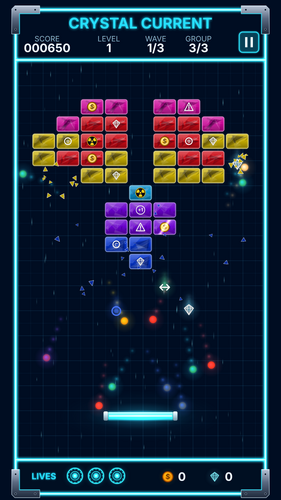
The level runs three waves of bricks, eight formations in total, and then hands you over to a reactor boss. Between you and the bricks sits a paddle; where the ball lands on that paddle decides the angle it leaves at, so every return is a small aiming decision rather than a passive bounce.
Multiball and falling pickups sit on top of that foundation. Core rings add balls, and up to 12 can be in play at once. Coins and gems score points, extenders widen the paddle, and extra lives buy forgiveness. Radiation bombs do the opposite and cost a life, which makes some bricks worth avoiding rather than clearing.
How to play
The goal is simple to state: clear the bricks and keep the ball off the floor. Bricks come in varieties. Some fall in a single hit, steel needs two, and hazard blocks never break at all, so the ball has to be routed around them.
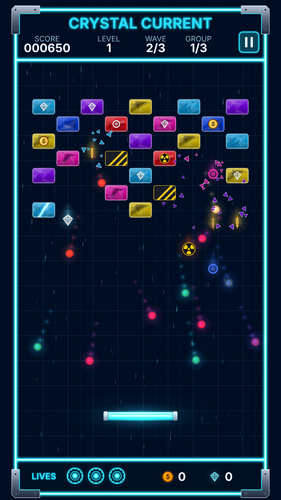
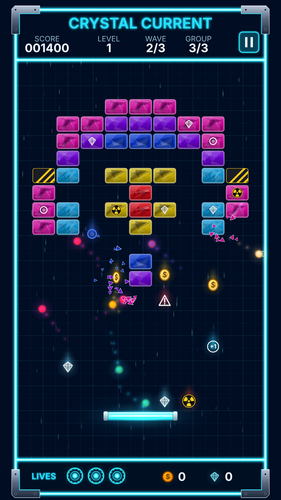
Every brick carries a symbol showing what it will release when it cracks, and catching that falling item is the main skill loop. Core rings add another ball to play, coins and gems convert into points, an extender widens the paddle, and extra lives add cushion. Radiation bombs should be left to fall past you.
Losing a ball is not the same as losing a life. A life is only spent when the last ball drops, so a wide multiball field works as a safety net as much as a scoring engine.
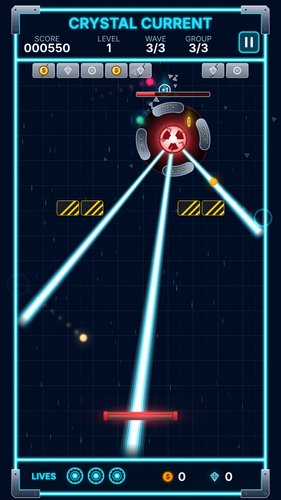
Then comes the reactor. Its glowing core hides behind rotating shield plates, and damage only lands when the ball passes through a gap. Beams slow the paddle, and the whole fight speeds up as the core takes punishment.
Controls
The game runs in a browser frame with no installation step. It is built for portrait play on phones and carries desktop controls as well, with four input schemes covering the same set of actions.
On touch, drag left or right anywhere below the paddle to slide it, and tap to launch. With a mouse, move sideways over the play area to steer and click to launch. Keyboard players use the left and right arrows or A and D to move, Space or Up to launch, and Escape or P to pause. A gamepad mirrors this with the D-pad or left stick for movement, A to launch and Start to pause.
Pausing matters more than usual in a brick-breaker with long multiball sequences, and all four schemes reach it. The angle comes from where the ball meets the paddle, so the skill you exercise is positioning rather than timing.
| Input | Action |
|---|---|
| Mouse | Move sideways over the game to steer the paddle; click to launch the ball |
| Touch | Drag left or right below the paddle to move it; tap to launch |
| Keyboard | Left and Right arrows or A and D to move, Space or Up to launch, Escape or P to pause |
| Gamepad | D-pad or left stick to move, A to launch, Start to pause |
Tips for your first run
The early waves are forgiving enough to learn the pickup symbols, but the reactor fight punishes a paddle that wanders. Get into the habit of returning the ball with the outer edge of the paddle when a steep angle helps, and nearer the centre when a straighter line does.
Catching core rings before you need them is the biggest single lever available. A life only disappears when the final ball drops, so stockpiling balls early turns a dangerous wave into a buffer. Extenders work the same way: a wider paddle covers more of the floor. Smaller habits matter too.
- Read the symbol inside a brick before you swing at it; the icon tells you what will drop.
- Let radiation bombs fall past the paddle, since catching one costs a life.
- Route the ball around hazard blocks instead of trying to clear them.
- Carry a couple of spare balls into the boss so a missed gap does not end the run.
- During the reactor fight, prioritise the gap in the rotating plates and accept slower returns; beams slow the paddle and the pace climbs as the core weakens.
- Use pause between waves to reset your hands and check the score.
Content and replayability
Crystal Current is the only playable stage in this build, and it went live on 25 October 2026 as a prototype. The stage holds eight brick formations spread across three waves before the reactor boss arrives. More content is planned for later versions.
Replay value comes from score chasing. The best score is saved in the browser, so runs carry over between sessions without an account, and coins and gems feed that number, which is a reason to chase pickups rather than simply survive. The boss's accelerating pace also changes how each attempt ends.
Prototype status is worth knowing before you click play. This is v0.1.0, and feedback is invited on two specific things: how the paddle feels and how the boss fight reads. Bug reports are most useful with the device and browser noted, which suggests a build still being shaken out rather than a finished product.
Presentation and performance
The look is neon, with bright bricks and pickup icons printed inside them so the drop table reads at a glance. The reactor boss is the visual centrepiece: a glowing core wrapped in rotating shield plates that show where the ball can slip through.
Performance options are unusually thorough for a prototype. Three quality levels let you trade visual fidelity for smoothness, and a reduced motion option is included. Music and effects have separate volume sliders, so the soundtrack can come down without losing audio cues.
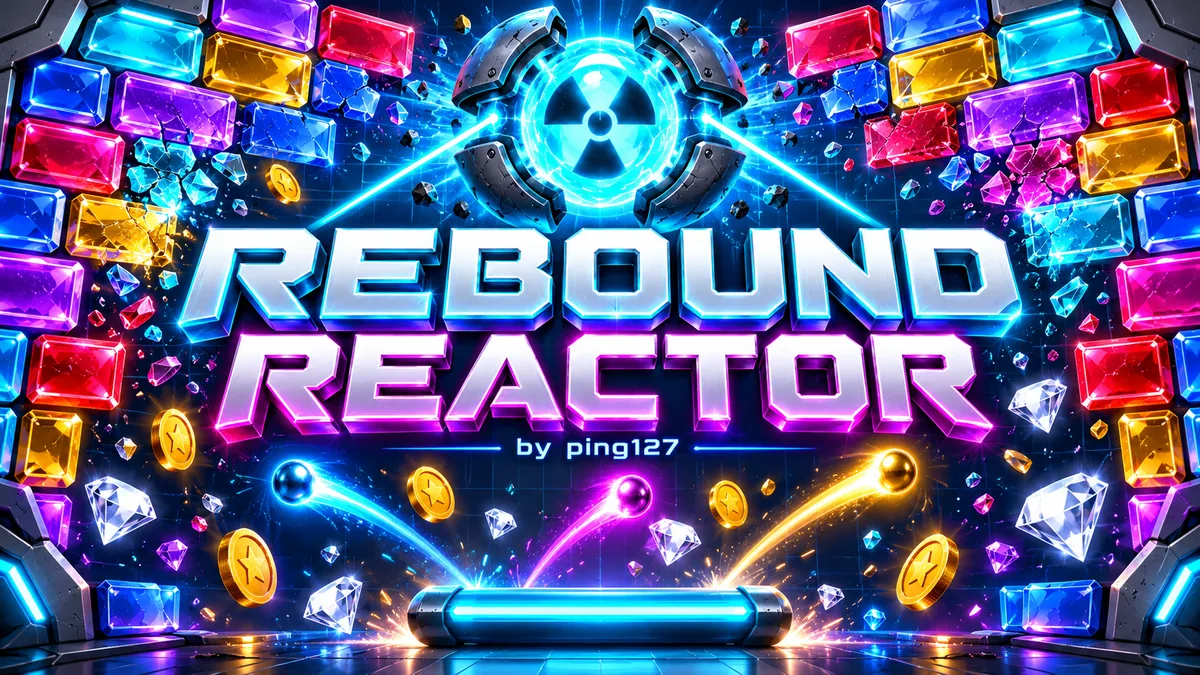
The promotional hero artwork is AI-generated, while the in-game screenshots show the actual game. The build runs on Phaser and needs no installation, arriving inside the browser frame. Four screenshots accompany the release, which is not much to judge by, but the demo loads directly on the page and is the better test.
Who should play it
Anyone who has spent time with a brick-breaker will recognise the loop immediately, and the paddle-angle control gives returning players something to chew on. The falling-pickup layer adds a second job, watching the floor while watching the drop, which suits players who like split attention.
The boss fight is the draw for anyone who finds endless brick clearing thin. Rotating shield plates turn the last stretch into a timing problem, and beams that slow the paddle punish a static hand.
Phone players get a portrait-first layout with drag-and-tap input, and desktop players get mouse, keyboard and gamepad without installing anything. The free price removes the risk of trying it.
One caveat: this is a prototype with a single level. Players who want a finished campaign should wait. Players who enjoy watching something develop, and who are willing to say how the paddle feels, are the audience this build is looking for.
Screenshots
How we tested it
The build was loaded from games.debutplay.com in a headless Chromium session on ; the canvas started and no request was blocked. The guide was last checked on .
From the developer
Break the bricks. Catch the cores. Keep the ball off the floor. I’ve got a working demo of Rebound Reactor ready to share. It’s a neon brick-breaker with multiball, falling pickups, and a reactor boss waiting at the end. The basics are familiar: move the paddle, keep the ball bouncing, and clear the bricks. Where the ball hits your paddle changes its angle, so you’ve got some say in where it goes next. Whether it goes where you intended is another matter. What you can play This demo includes Crystal Current, the first level: eight brick formations across three waves, followed by a boss fight. Some bricks break in one hit. Steel takes two. The hazard blocks stay put, so you’ll need to work around them. The symbols inside the bricks show what will drop when they break. Catch core rings to add balls, collect coins and gems for points, or grab an extender for a wider paddle. Extra lives help too. Radiation bombs take a life, so those are…
Frequently asked questions
Is Rebound Reactor free to play?
Yes. It is free in the browser and there is no installation step before you start playing.
How many levels does the demo include?
One. Crystal Current is the playable stage, built from three waves of bricks across eight formations and closed out by a reactor boss.
Can it be played on a phone?
Yes. The game is built for portrait play on phones with drag-to-move and tap-to-launch touch controls, and desktop input is supported too.
How many balls can be in play at once?
Up to 12. Core rings add balls, and a life is only lost when the final ball falls out of play.
Does the game save anything?
The best score is stored in the browser, so it carries over between sessions on the same device.
How do you damage the reactor boss?
Its glowing core sits behind rotating shield plates. A ball that passes through a gap damages it, beams slow the paddle, and the fight gets faster as the core weakens.
What games are similar to Rebound Reactor?
The closest matches on DebutPlay are OVERSTACK, Throne Trouble, Robomble. They share the same genre, so the controls and the pace carry over.
Something wrong or missing? Tell us. How we test games.