Action · New game
Robomble
A free browser arena game where flipping machines and kicking them away releases the gears that decide a round, while a rival waits to throw a vacuum into the works.
#50 this weekAI-assisted: Code, Graphics, Sound
The game runs in this tab. No install, no account.
The short answer
Robomble is a two-player, single-screen arcade game about tipping factory machines and harvesting the gears that fall out. It runs free in a browser, supports solo matches against the computer, shared-keyboard or gamepad local play, and online duels through a short code, and it packs three distinct modes into one small arena package.
What is Robomble?
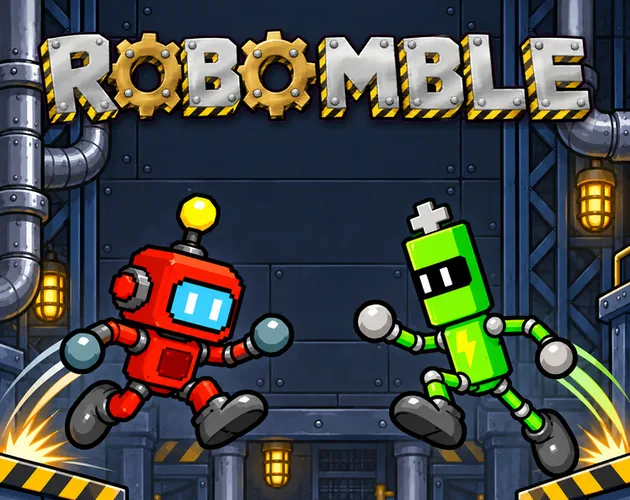
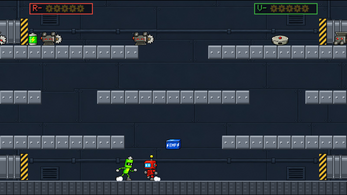
Robomble is a two-player, single-screen arcade game built around a shared arena and short, scrappy rounds. The setting is a factory that has been overrun, with grinders, shears, hopping drones, vacuums and oil cans spilling out of the pipes and turning the floor into a hazard course. Two robots work inside that chaos rather than trading attacks in an empty box.
The central idea is physical. Drop beneath a platform to flip whatever machine is standing on top of it, then touch the toppled machine to kick it clear and release a gear. Gather enough of those gears and the round is yours, unless the other player interferes first.
The game runs as a playable HTML5 build in the browser, so there is nothing to install before a first match. Robomble is free. Development is still in progress, which means the current build is a working version of an unfinished game rather than a final, locked release.
How to play
Everything in Robomble revolves around the flip and the kick. Position a robot underneath a platform, jump to tip the machine standing on it, then make contact with the fallen machine to boot it away. A gear pops out, and the round is a race to bank enough of them.
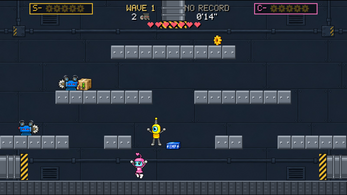
The factory does not cooperate. Shears absorb a first hit and need a second to clear, drones hop around the arena rather than sitting still, and oil cans leave slippery patches that change how a robot travels across the floor. Vacuums are different again: they can be squashed and then thrown, which makes them a weapon as much as an obstacle.
Interference is constant in a two-player round. A rival can steal a flipped machine before it is kicked, toss a vacuum across the arena, or set off the EMP block at the moment it hurts most. Learning to finish a flip quickly matters as much as landing the first jump.
Practice against the computer first. The solo opponent has four levels, so the pace can be raised gradually before another player is added to the same screen.
Controls
Input is split cleanly between the two players sharing one keyboard. Player one moves with W, A, S and D and uses Left Shift, while player two takes the arrow keys and Right Shift. Nothing about that layout is permanent: keys can be remapped.
Gamepads are supported as an alternative to the shared keyboard. Click the game once before using a pad, otherwise the browser will not pass input through to the arena.
Online play does not require an account or an invite system. One player shares a four-letter code and the two browsers connect directly to each other. That direct connection is also the weak point: on some networks, including corporate setups and certain mobile connections, the match may fail to establish.
Because the two local players sit at the same keyboard by default, agree on sides before the first round, and check the remap screen if the default layout feels cramped.
| Input | Action |
|---|---|
| W A S D | Move player one |
| Left Shift | Player one action key |
| Arrow keys | Move player two |
| Right Shift | Player two action key |
| Gamepad | Alternative input for either player; click the game once before use |
| Remap screen | Rebind keys to a preferred layout |
Tips for your first run
The first few rounds are about learning the rhythm of the arena rather than winning it. Watch which machine is standing on a platform before committing to a jump, and finish the kick immediately, because a flipped machine left sitting is an invitation for the other player.
Hazards are tools once they are understood. A vacuum that has been squashed can be picked up and thrown at a rival who is busy collecting gears, and the slippery floor left by an oil can is easier to cross deliberately than at full speed.
- Approach platforms from below and jump straight into the flip rather than circling for a better angle.
- Treat shears as a two-stage problem: the first hit only softens them, so plan the follow-up.
- Squash a vacuum before throwing it, and aim it at whoever is closest to completing a gear run.
- Slow down over fresh oil spills instead of running straight across them.
- In versus, take a rival's flipped machine when the chance appears; the kick and the gear matter more than who flipped it.
- Assume the EMP block will be triggered at the worst moment and keep gear runs short.
Content and replayability
Three modes cover very different moods. Versus is a straight fight in which every robot looks after itself, with stolen machines, thrown vacuums and EMP timing as the main ways to disrupt a rival. Co-op survival throws both players against waves that grow larger and faster, with a best time to beat on each wave. Hide and Seek inverts the format: one player disguises as a machine among the real ones while the other hunts for the impostor before the pipes are reached.
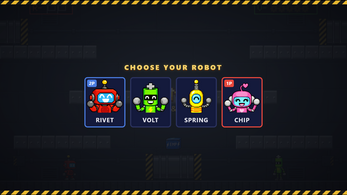
There are four robots to choose from and six arenas, or an option to rotate through a different one on each level. Solo play against the computer comes with four opponent levels, and a separate set of four difficulty settings shapes the overall challenge.
Online play uses a four-letter code to pair two browsers, and local play covers both shared-keyboard and gamepad setups. The interface is available in nine languages, with keys remappable for players who dislike the defaults.
Presentation and performance
The look is 2D and retro-minded, built around readable robots, machines and arenas rather than spectacle. Character, enemy and item sprites, along with the logo, were produced with AI image generation tools and then selected and edited by the developer. Level art, the interface, the music and the sound effects were made without AI, with the audio synthesized by the game's own code.
Keeping everything on a single screen is a design choice that pays off in play: both players can see the whole factory floor, every pipe and every hazard at once, so there is no camera to fight and no off-screen surprise.
Performance is tied to the browser rather than to a download. The one place the setup can stumble is the direct browser-to-browser online connection, which may fail on restrictive corporate networks and on some mobile connections. Local play on one machine avoids that entirely.
Who should play it
This is a natural fit for two people in the same room with one keyboard and a few minutes to spare. The flip-and-kick loop is quick to grasp, rounds are short, and the shared screen means nobody has to learn a second control scheme before the first match.
Solo players are not shut out. Playing against the computer at four opponent levels is a legitimate way to learn the arenas and the hazard behaviour before another person joins, and the difficulty settings give room to settle in.
Groups looking for a party game rather than a duel will find the most value in hide and seek, which turns the arena into a bluffing match, or in co-op survival, where the escalating waves reward coordination instead of betrayal. Players who want a fixed, finished product should note the game is still in development, while anyone curious about a free browser arcade game with local and coded online play has very little to lose by trying a round.
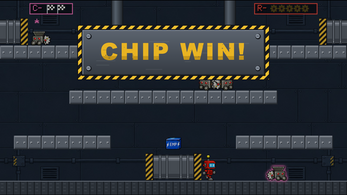
Screenshots
How we tested it
The build was loaded from games.debutplay.com in a headless Chromium session on ; the canvas started and no request was blocked. The guide was last checked on .
From the developer
Robomble is a two-player, single-screen arcade game inspired by the great arena games of the '80s. The factory has been overrun: grinders, shears, drones, vacuums and oil cans pour out of the pipes. Jump under a platform to flip the machine standing on it, then touch it to kick it out: a gear drops. Collect enough to win the round… unless your rival sends a vacuum your way. THREE WAYS TO PLAY • Versus — every robot for itself. Steal your rival's flipped machine, throw a vacuum at them, trigger the EMP block at the worst possible moment. • Co-op survival — together against waves that keep getting bigger and faster. Beat your best time on every wave. • Hide & Seek — one player disguises as a machine among the real ones; the other has to unmask them before they make it through the pipes. ALSO • 4 robots, 6 arenas (or a different one every level) • Shears that take two hits, hopping Drones, Vacuums you squash and throw, Oil cans that make…
Frequently asked questions
Is Robomble free to play?
Yes. The game is free to play, and a small voluntary donation is invited to support continued development.
Can two people play on one keyboard?
Yes. Player one uses W A S D with Left Shift, player two uses the arrow keys with Right Shift, and keys can be reassigned from the options.
Does Robomble have a single-player mode?
Yes. Solo play sets the player against the computer, which has four opponent levels, and overall difficulty can be adjusted separately.
How does online play work?
Two browsers connect directly after one player shares a four-letter code. The connection can fail on some networks, including corporate setups and certain mobile connections.
Which modes are included?
There are three: versus for head-to-head disruption, co-op survival against waves that grow larger and faster, and hide and seek with one player disguised as a machine.
How is a round won?
Jump under a platform to flip the machine on it, touch the fallen machine to kick it away and drop a gear, then collect enough gears to take the round.
What games are similar to Robomble?
The closest matches on DebutPlay are OVERSTACK, Rebound Reactor, Throne Trouble. They share the same genre, so the controls and the pace carry over.
Something wrong or missing? Tell us. How we test games.