Sports · New game
Scotogno Soccer
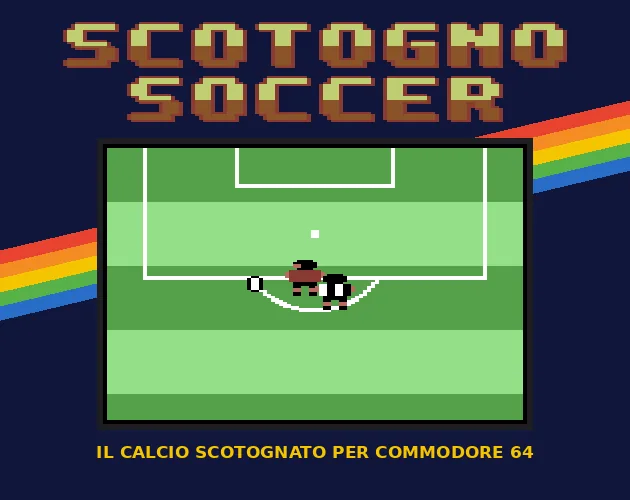
A free, top-down one-on-one football game for Commodore 64, Scotogno Soccer mixes eight national sides, nine CPU difficulty levels, optional power-ups and a cup run.
#42 this weekAI-assisted: Code, Graphics, Sound, Text
The game runs in this tab. No install, no account.
The short answer
Scotogno Soccer is a free Commodore 64 football game viewed from above, built for one player against the computer or two players on the same machine. Choose from eight national teams, work through nine CPU difficulty levels, enter the Scotogno Cup with golden-goal deciders, and switch optional power-ups on or off.
What is Scotogno Soccer?
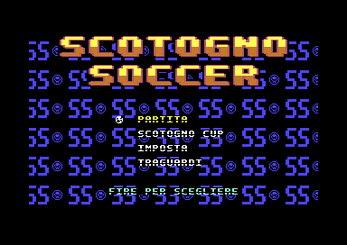
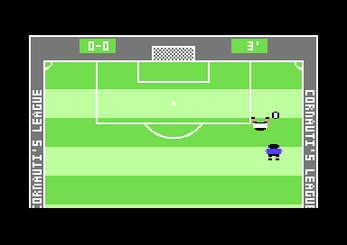
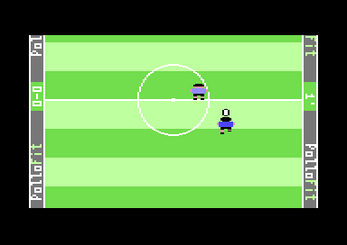
Scotogno Soccer is a top-down football game for the Commodore 64, built around one-on-one matches. The browser version runs inside a playable HTML5 frame, so the first match can begin without leaving the page. The tone is arcade football: direct, compact and focused on duels.
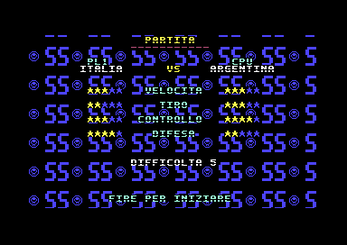
Eight national sides are included, and each is tuned toward a different strength: pace, technique, power or defensive solidity. Team choice is therefore not cosmetic; it changes how a player approaches a one-on-one match.
The solo route runs through nine CPU difficulty levels, starting at FLAFFOF. The Scotogno Cup adds a bracket of quarter-final, semi-final and final matches, settled with a golden goal. Optional power-ups can be turned on or off, including a speed boost, a shot-strength boost, a sticky effect, a barrier and a freezing effect. Achievements are saved with a password, menus are available in Italian and English, and extra surprises are left to unlock.
How to play
A match is one against one. In the solo mode, the computer controls the opposing side; in local play, two people share the same Commodore 64, each with a joystick. The browser build maps that same split to one keyboard, so player one and player two can play on a single computer.
Start with a national team, then choose a CPU difficulty if playing alone. Nine levels are available, beginning at FLAFFOF, so the ladder can be climbed gradually. In the Scotogno Cup, the route goes through the quarter-finals, semi-final and final, with a golden goal deciding the knockout ties.
Power-ups are optional. They can be left off for a cleaner duel or switched on to add a speed boost, a shot-strength boost, a sticky effect, a barrier and a freezing effect. Achievements are tracked and saved with a password. Menus can be read in Italian or English. For hardware play, the disk version loads with LOAD"*",8 followed by RUN; the EasyFlash cartridge is inserted while the computer is off, then the machine is switched on and fire or the space bar starts the game.
Controls
In the browser version, player one moves with the arrow keys and fires with Space. Player two uses W, A, S and D for movement and left Shift to fire. ESC works as RUN/STOP. These are keyboard mappings for the browser build.
On a real Commodore 64, player one uses the joystick in port two and player two uses the joystick in port one. The port order is part of the setup before a local match. Each player has a separate control set, which keeps local play readable.
For the disk release, type LOAD"*",8 and then RUN. For the EasyFlash cartridge, insert it with the computer switched off, power on, and press fire or the space bar. The browser route needs no disk commands, but the same two-player split applies through the keyboard.
| Input | Action |
|---|---|
| Arrow keys + Space | Player one movement and fire in the browser version |
| W A S D + left Shift | Player two movement and fire in the browser version |
| ESC | RUN/STOP |
| Joystick in port 2 | Player one control on Commodore 64 hardware |
| Joystick in port 1 | Player two control on Commodore 64 hardware |
Tips for your first run
The first match is easier to read if the focus stays on positioning. This is a one-on-one game, so every challenge is a direct duel; keep the ball between the opponent and the goal and look for the moment to fire.
Use the lower CPU levels to learn the pace before moving up the nine-step ladder. If the optional power-ups feel distracting, switch them off for a clean match, then bring them back once the basic duel is comfortable.
- Begin at the bottom of the nine CPU levels rather than jumping straight to a higher setting.
- Pick a national side whose strength fits the approach: pace, technique, power or defensive solidity.
- Try local two-player play to learn how a human opponent attacks in a one-on-one match.
- In the Scotogno Cup, treat the golden goal as the decisive moment and avoid loose chances.
- Keep the password for achievements somewhere safe if progress matters.
Content and replayability
The content is built around short, repeatable duels. Eight national teams give the roster different flavours, with pace, technique, power and defensive solidity represented. Nine CPU difficulty levels create a solo ladder from FLAFFOF upward, while local two-player sessions add a direct human challenge on the same Commodore 64.
The Scotogno Cup supplies a knockout structure: quarter-finals, semi-final and final, with a golden goal. Optional power-ups can change the texture of a match, and achievements give another reason to return. Progress in achievements is saved with a password. Menus in Italian and English make the game readable for two audiences, and there are surprises to unlock beyond the visible setup.
Replay value comes from the team and difficulty combinations rather than a large suite of separate modes. The cup bracket is the main solo objective, and the two-player option makes the same core match useful for local sessions. The password system matters for anyone chasing achievements over time.
Presentation and performance
Scotogno Soccer presents itself as a Commodore 64 football game with a 2D, 8-bit arcade look. The view is from above, which keeps the one-on-one duel readable: the ball, the two players and the immediate space around them are the focus. Menus are available in Italian and English.
The browser build runs through an emulator layer. Performance in Firefox is not ideal, so another browser or one of the downloadable versions is the better route if the match feels sluggish. On original hardware or an emulator, the disk and EasyFlash cartridge releases follow the usual C64 loading routines.
The game was conceived, directed and play-tested by Linobob, with code in machine language plus graphics, music and texts created with Claude. That production detail fits the homebrew C64 character of the release: a small, focused arcade football game rather than a modern simulation.
Who should play it
This is for players who want a compact, top-down football duel and like the idea of a Commodore 64 release that can be opened in a browser. Fans of 8-bit arcade sports games, local two-player sessions and solo difficulty ladders are the natural audience. The eight national teams and nine CPU levels give solo players a clear path, while the same-machine two-player mode gives a second use for the package.
It also suits homebrew and retro players who enjoy disk and cartridge releases, bilingual menus and password-saved achievements. The optional power-ups make it easy to tune the match toward a cleaner duel or a more chaotic arcade contest. Anyone looking for a quick one-on-one football game with a golden-goal cup should find the structure immediately understandable.
The control split is simple: keyboard in the browser, joysticks on C64 hardware. That makes it best approached as a local game, whether the opponent is the CPU or a friend in the same room.
Screenshots
How we tested it
The build was loaded from games.debutplay.com in a headless Chromium session on ; the canvas started and no request was blocked. The guide was last checked on .
From the developer
(English description below) SCOTOGNO SOCCER è una partita di calcio (scotognata) vista dall'alto, uno contro uno, per Commodore 64. Gioca da solo contro il computer o sfida un amico sullo stesso C64: un joystick a testa, un pallone, nessuna pietà. Cosa trovi Otto nazionali, ognuna con i suoi punti di forza: veloci, tecniche, potenti o solide in difesaNove livelli di difficoltà contro la CPU, da FLAFFOF in suLa SCOTOGNO CUP: quarti, semifinale e finale, con il golden golPower-up facoltativi: turbo, cannone, colla, muro e geloTraguardi da conquistare, salvati con una passwordMenu in italiano e in inglese…e qualche sorpresa da sbloccare, di cui non diciamo niente Gioca nel browser PL1: frecce + SPAZIO (fire)PL2: W A S D + SHIFT sinistro (fire)RUN/STOP: ESC Gioca su un C64 vero o in un emulatore Disco: LOAD"*",8 e poi RUNCartuccia EasyFlash: inseriscila a computer spento, accendi e premi FIRE o la barra spaziatriceJoystick: PL1 in porta…
Frequently asked questions
Is Scotogno Soccer free?
Yes. The game is free to play.
What platforms does it support?
The browser version is HTML5. It is also made for the Commodore 64, with disk and EasyFlash cartridge releases for real hardware or an emulator.
Can two players play locally?
Yes. Two players can share the same Commodore 64 with one joystick each; in the browser build, player one uses the arrow keys and Space while player two uses W, A, S, D and left Shift.
How many teams and difficulty levels are there?
There are eight national teams and nine CPU difficulty levels, starting at FLAFFOF.
What is the Scotogno Cup?
It is a knockout competition with quarter-finals, a semi-final and a final, and a golden goal is used.
Are there achievements and power-ups?
Yes. Achievements are saved with a password, and optional power-ups include a speed boost, a shot-strength boost, a sticky effect, a barrier and a freezing effect.
What games are similar to Scotogno Soccer?
The closest matches on DebutPlay are Jumping Ball, Machine Manager, Draft Him. They share the same genre, so the controls and the pace carry over.
Something wrong or missing? Tell us. How we test games.