Strategy · New game
THE VOTE
A free pixel-art card game about trading promises for votes, built around reading a room of characters and turning a fragile coalition into a majority.
#43 this weekAI-assisted: Code, Graphics, Sound, Text
The game runs in this tab. No install, no account.
The short answer
THE VOTE is a turn-based political strategy card game that runs in a browser, free to play. You inspect voter cards, investigate what each character cares about, then spend limited daily actions and funds on negotiation, policy, fundraising, and rallies. Three practice elections let you learn the room before starting a multi-stage career ladder.
What is THE VOTE?
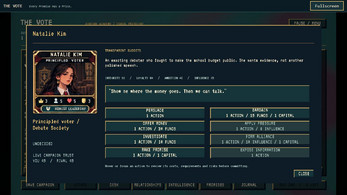
THE VOTE is a turn-based political strategy card game that plays inside a browser. Its premise is blunt: power is not handed over, it is negotiated. Built for a single player, it asks you to read a room of distinct characters, work out what each one cares about, and convert scattered support into a working majority before the count.
The currency is trust. You inspect voter cards, investigate priorities, and decide where your limited time goes, because not every character in the room can be courted. Promises harden into obligations, and reputation follows the career rather than resetting with each new contest.
The game is free and loads in a page frame, so a session opens with a click rather than an install. It is also openly unfinished: the current build is version 0.1.0, career stages 1–11 are playable, and the national stages above them are locked away as future content.
How to play
The first decision is between Political Career and Practice Elections. Practice offers three fixed contests: a School President race with 12 voters, a College President election with 18 voters, and a Governor campaign that spreads 36 public figures across six regions. Each is a different size of room to read.
Inside a run, you inspect cards and negotiate for support. Actions and funds are capped every day, so the work becomes triage: which voter gets attention, which promise gets made, which priority gets investigated first. Campaign desks are where promises, relationships, and regional outreach are managed, and the larger elections lean on canvassing and public voting blocs rather than a single conversation.
When the day's plans are in place, you choose End Day and face the final count. That rhythm repeats until the election resolves, with the relationships, obligations, and reputation built along the way carrying into whatever comes next.
Controls
Input is deliberately plain. Buttons and cards respond to a mouse or to touch, longer screens are explored by scrolling, and keyboard navigation is available for players who prefer it.
One detail is worth catching before anything else: after the game loads, choosing Enter the chamber enables sound. Skipping that step leaves the score silent, which matters in a game that leans on an ambient soundtrack for mood.
Saving runs through an in-game Save control rather than an account. Progress is held in the browser for this game page, so continuing means returning on the same browser and the same site. Clearing stored site data wipes the record, so hold off on tidying browser storage if a career is in progress.
| Input | Action |
|---|---|
| Mouse | Select buttons and cards |
| Touch | Select buttons and cards |
| Scroll | Explore longer screens |
| Keyboard | Navigate the interface without a mouse |
Tips for your first run
Start smaller than your ambition. The 12-voter School President contest is the tightest room on offer and the cheapest place to learn how priorities hide inside a character card before committing to a 36-figure Governor campaign.
The daily cap on actions and funds is the real puzzle. Every investigation, proposal, promise, or fundraising push spends something that cannot be recovered that day, so decide early which voters you are prepared to lose. Support has to be earned from characters with their own priorities, not assumed.
Regional outreach matters most in the widest contest, where six regions and three dozen figures make one-to-one courtship impractical on its own.
- Inspect voter cards and investigate priorities before spending a day's actions; an uninformed promise is a debt you carry forward.
- Treat promises as obligations rather than free support, since they follow the career instead of expiring at the count.
- Use canvassing and public voting blocs in the Governor campaign to reach 36 figures across six regions.
- Use the in-game Save control regularly; progress lives in this browser for this game page.
- Learn the daily rhythm in practice: plan the day, spend the actions, then End Day and face the count.
Content and replayability
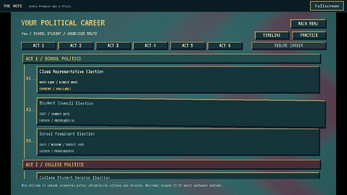
Three practice elections give immediate variety, but Political Career is the long structure. It links school, college, party, city, and state offices, and it spans executive and congressional branches, so the same politician can be traced across very different kinds of seat. Stages 1–11 are playable, including Governor, U.S. House, and U.S. Senate routes.
A timeline records offices, allies, and decisions as you climb, turning a run into a history rather than a single result. Because relationships, obligations, and reputation persist, a career is shaped by earlier choices instead of being reset by each new contest.
The national tier, stages 12–15, is marked as future content and stays locked, so the current ceiling is deliberate rather than a fault. Everything is singleplayer and turn-based, with no pressure beyond the daily limits on actions and funds.
Presentation and performance
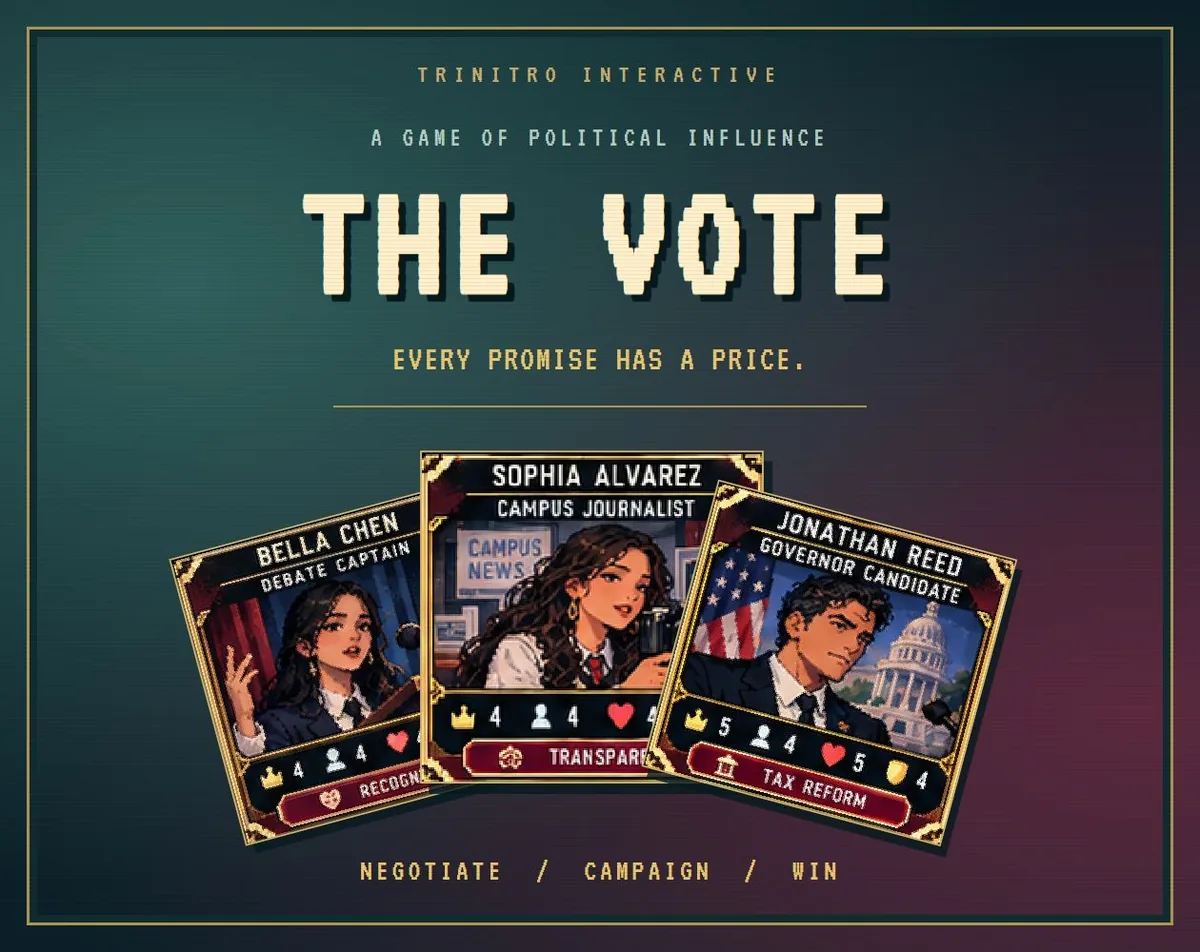
The look is pixel-card: character cards, bitmap typography, and a table that shifts between teal and burgundy as the room changes. An original ambient score sits underneath it all.
Settings cover sound, render detail, fullscreen, and Reduced Motion, the last of which helps if the shifting table or card motion is uncomfortable. Render detail is the first thing to lower if the frame stutters, since everything runs inside a browser page.
The build credit is modest but specific: original systems, owner-supplied character card sheets, and the VT323 typeface by Peter Hull. The current development build is version 0.1.0 and the game is in active development, so the presentation is likely to keep shifting.
Who should play it
THE VOTE suits players who like turn-based strategy with a negotiation layer, the sort who want to work out what an opponent cares about before making an offer. Card game players will recognise the hand-management pressure of limited daily actions and funds, though the cards here are voters and public figures rather than creatures or spells.
It also fits anyone who wants a political drama where consequences accumulate: promises become obligations, reputation sticks, and a timeline records what was traded away to climb.
Because it is singleplayer and turn-based, it rewards careful reading over reflexes. Players who want a finished product should weigh the version number and the locked national stages; those happy to watch a build grow have stages 1–11 to explore now. It is free and runs in a browser, so a first look costs a click.
Screenshots


How we tested it
The build was loaded from games.debutplay.com in a headless Chromium session on ; the canvas started and no request was blocked. The guide was last checked on .
From the developer
Power is not given. It is negotiated. THE VOTE is a political strategy card game about trust, influence, and the promises you make to win. Read a room full of distinct characters, discover their priorities, and turn a fragile coalition into a majority. Every vote has a price Negotiate support. Inspect voter cards, investigate priorities, and decide who deserves your limited time.Make your case. Propose policies, deliver promises, fundraise, and rally your supporters.Live with your decisions. Relationships, obligations, and reputation follow your political career.Take the campaign statewide. Regional canvassing and public voting blocs bring larger elections to life. Three practice elections. One political career. Try the 12-voter School President contest, the 18-voter College President election, or a Governor campaign with 36 public figures across six regions. Political Career connects school, college, party, city, and state offices,…
Frequently asked questions
Is THE VOTE free to play?
Yes. THE VOTE is free, and it runs as an HTML5 game inside a browser page rather than as a paid download.
What platforms does THE VOTE run on?
It is an HTML5 browser game. Buttons and cards respond to mouse or touch input, scrolling explores longer screens, and keyboard navigation is available as an alternative.
How many practice elections are included?
Three. A School President contest with 12 voters, a College President election with 18 voters, and a Governor campaign with 36 public figures spread over six regions.
Does the game save progress?
Yes, through an in-game Save control. Progress stays in this browser for this game page, so returning on the same browser and site continues the run. Clearing site data removes it.
Is THE VOTE finished?
No. It is in active development at version 0.1.0. Career stages 1–11 are playable, including Governor, U.S. House, and U.S. Senate routes, while national stages 12–15 remain locked as future content.
How do you turn on the sound?
After the game loads, choose Enter the chamber. That step enables audio, including the ambient score. Sound, render detail, fullscreen, and Reduced Motion are all adjustable in Settings.
What games are similar to THE VOTE?
The closest matches on DebutPlay are Diceheim: Roll for the World, Evolve!Pokemo Partner Expedition, Road to Sixty. They share the same genre, so the controls and the pace carry over.
Something wrong or missing? Tell us. How we test games.