Strategy · New game
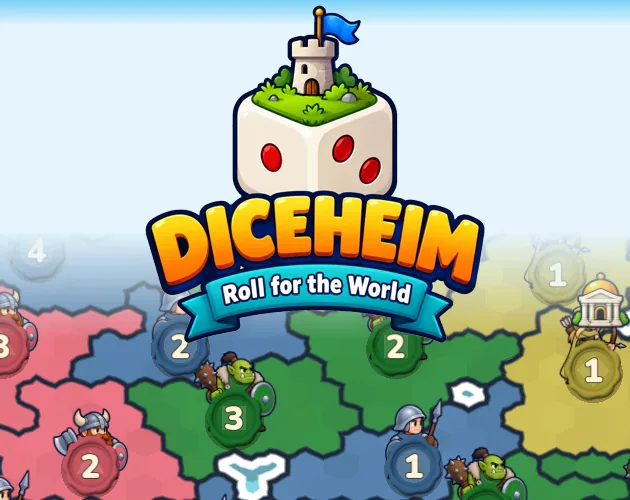
Diceheim: Roll for the World
A free browser strategy game where dice serve as armies, hex lands are prizes, and a three-act roguelite campaign sits beside quick skirmishes.
#28 this weekAI-assisted: Code, Graphics, Sound, Text
The game runs in this tab. No install, no account.
The short answer
Diceheim: Roll for the World is a turn-based fantasy strategy game played in a browser. Claim hexagonal lands by rolling warrior dice against neighbouring armies, then grow a connected realm for reinforcements. Skirmish offers quick random maps for two to eight realms, while the roguelite campaign spans three acts with heroes, blessings, curses and bosses. It is free and needs no account.
What is Diceheim: Roll for the World?
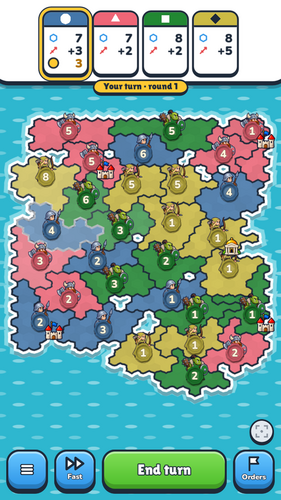
Diceheim: Roll for the World is a turn-based fantasy strategy game built for the browser. Eight gods contend over a map of hexagonal lands, and those lands are held by warriors who are themselves dice. The central idea is simple to grasp: expand across the hex map, challenge neighbouring territories, and use dice rolls to settle ownership. A stronger connected realm produces more new warriors at the end of a turn, so map shape matters as much as the result of any single roll.
The game is free and runs without advertisements, payments, or account registration. It is currently in development, with mouse and touch play supported in the browser; phone play uses portrait orientation, while computer play can use a fullscreen button. Two broad ways to play are available: Skirmish for quick random-map matches and a roguelite Campaign that runs through three acts. The tone is fantasy war strategy rather than abstract dice alone, with several peoples, hero deeds, blessings, curses, and act-ending bosses feeding into the campaign structure.
How to play
Start by choosing a realm colour and one of eight peoples, then pick a mode. In Skirmish, matches are quick, use random maps, and support two to eight realms across small, medium, and large map sizes; every game generates a fresh map. The map is divided into hexagonal lands. Each land contains warriors represented by dice. To take ground, attack a neighbouring land and compare dice totals: the higher sum claims the territory. At the end of a turn, fresh warriors arrive, with the number tied to the size of the connected realm.
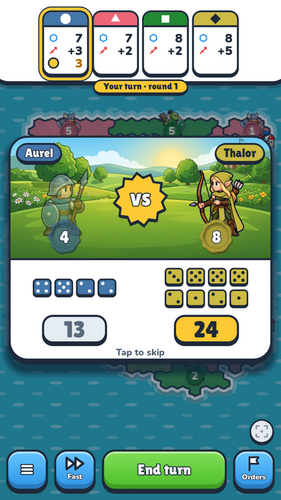
Rules can follow a Classic set or a Modern set. Modern play sends new warriors to the front first, introduces gold from castles, and allows a victory claim when one side is clearly ahead. Gold can buy orders such as mercenaries, a rampart, rain of fire, or regrouping. Computer opponents come in three difficulty levels, ranging from classic to hard. Duels can be watched as the two peoples face off, dice roll, and sums count up; a quick mode speeds things up for players who prefer less ceremony.
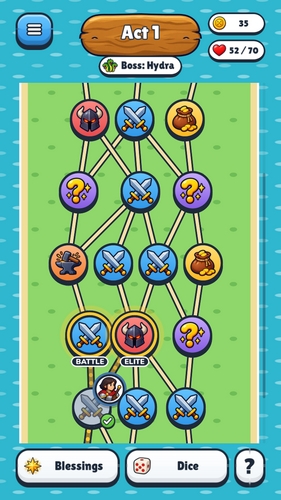
The Campaign is a roguelite run across three acts. Its branching map contains standard battles and tougher elite encounters, along with support stops such as events, markets, shrines, and a forge. Selecting a location reveals what waits there; before each battle the goal is shown, and each boss explains its rules. A people brings a gift, and one of five heroes adds a special deed. Gold and morale must both be managed: when morale is exhausted, the run ends.
Controls
Diceheim: Roll for the World runs in the browser and uses mouse or touch input. Phone play is arranged for portrait orientation, while on a computer the fullscreen button can expand the view. The campaign asks the player to tap a location to learn what waits there, and the Skirmish setup includes choosing a realm colour and a people before a match. Browser storage keeps progress, so a run can be resumed in the same browser.
The battle presentation can be followed duel by duel, with the two peoples facing each other and dice totals counting upward; a quick mode is available when that pacing is unwanted. Menus for Skirmish, Campaign, Trials, and the daily Oracle are all part of the browser experience.
| Input | Action |
|---|---|
| Mouse | Play the browser game on a computer |
| Touch | Play in portrait on a phone |
| Fullscreen button | Expand the computer view |
Tips for your first run
The first match should be treated as a lesson in tempo rather than a race for every border. Dice totals decide attacks, but the end-of-turn reinforcement rule rewards a compact, connected realm. Before committing to a campaign run, read the map and the battle conditions; the roguelite layer punishes ignored morale and careless spending.
- Use a small Skirmish map while learning how neighbouring attacks and dice sums behave.
- Check the connected shape of the realm before expanding; a larger linked territory means more new warriors at turn end.
- Under Modern rules, castles produce gold, so time orders such as mercenaries, Rampart, Rain of Fire, or Regroup around a key duel.
- In the Campaign, preview a location before choosing a route, whether it is a standard fight, an elite encounter, or a support stop such as a market, shrine, forge, or event.
- Spend at the forge to raise die faces and improve odds, and keep morale above zero because the run ends when morale is gone.
- Choose a hero deed to match the plan: the Marshal's charge, the Seer's turn of fate, the Architect's bulwark, the Merchant Prince's tribute, or the Dragon Rider's flight.
Content and replayability
Diceheim's content splits between short-form Skirmish and the longer Campaign. Skirmish supports two to eight realms, three map sizes, and a new random map each time, so the mode is built for repeated quick sessions. Players choose a realm colour and a people from eight options; Human, Dwarf, Orc, Triton, and Undead are among the named examples. The Campaign runs through three acts on a branching map with standard battles, tougher elite encounters, and support stops that include markets, shrines, forges, and events. A boss concludes each act: the Hydra, the Lich King, and the Dragon.
Campaign runs add a people gift and one of five heroes, each with a special deed. More than thirty blessings can be collected, while curses alter dice and armies and must be survived. The forge lets a player raise die faces and shift odds. Meta progression includes glory earned toward new heroes, peoples, and blessing packs in the Hall of Glory. Trials raise campaign difficulty, and the daily Oracle gives every player the same run. After matches, statistics show standings, how the game unfolded, and which realm had the best and worst luck.
Presentation and performance
Visually, Diceheim is organised around a map of hexagonal lands rather than a conventional square grid. The duel view is a presentation feature in its own right: two peoples face each other, dice are rolled, and the totals count upward so each contest can be followed. A quick mode exists for players who want the result without the full pacing.
The game runs as an HTML5 browser title with mouse and touch input; phone play uses portrait orientation, and computer play offers a fullscreen button. It is free, carries no advertisements or payments, and does not require an account. No game data is sent to an external service, and progress is stored in the browser. Interface text is available in German and English. Post-game statistics cover ranking, the course of the game, and which realm was luckiest or unluckiest.
Who should play it
Diceheim suits players who enjoy turn-based fantasy strategy with a strong element of chance. The core attack is a dice comparison, so every border clash can swing a match, yet the reinforcement rule tied to a connected realm gives planners something to shape. Skirmish is the natural entry point for short sessions, especially with two to eight realms and random maps.
The Campaign is aimed at roguelite players who enjoy route planning, hero powers, run-altering blessings and curses, forge upgrades, and boss encounters with stated rules. The Modern rule set adds gold, castle income, orders, and a victory claim for players who want a light economy around the dice battles. Because the game is free, browser-based, and account-free, it is easy to try without a commitment. The three computer difficulty levels and Trials give solo players room to scale the challenge.
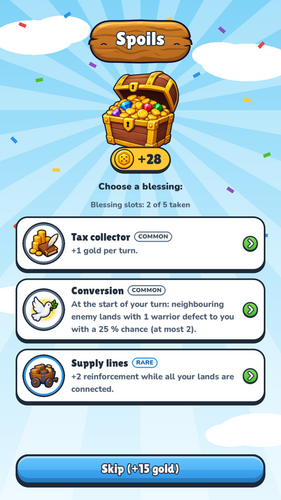
Screenshots
How we tested it
The build was loaded from games.debutplay.com in a headless Chromium session on ; the canvas started and no request was blocked. The guide was last checked on .
From the developer
Roll the dice, claim the map, rule Diceheim. Eight gods fight for a world of hexagonal lands. Every land holds warriors, every warrior is a die. Attack a neighbour and roll your dice against theirs: the higher sum wins the land. At the end of your turn new warriors join your armies, and the larger your connected realm, the more of them you get. Easy to learn, hard to master, and every roll can turn the game. Skirmish: quick games on random maps 2 to 8 realms, small, medium and large maps, a new map every game Pick your realm's colour and one of eight peoples, from Humans and Dwarves to Orcs, Tritons and the Undead Classic rules for purists, or Modern: new warriors go to the front first, you earn gold for orders, and you may accept victory when you are clearly ahead Three levels of AI, from classic to hard Follow every duel: the two peoples face each other, the dice roll and the sums count up, and a quick mode is there for the…
Frequently asked questions
Is Diceheim: Roll for the World free?
Yes. The game is free, with no advertisements, payments, or accounts required.
What platforms does it run on?
It runs as an HTML5 browser game. Mouse and touch are supported, with portrait play on a phone and a fullscreen button on a computer.
How do battles work?
Attack a neighbouring land and roll your dice against its dice; the higher total takes the land. At the end of a turn, new warriors join based on the size of the connected realm.
What is the difference between Classic and Modern rules?
Classic keeps the purist rule set. Modern sends new warriors to the front first, adds castle gold and orders, and lets a player accept victory when clearly ahead.
Does the Campaign have bosses?
Yes. Each of the three acts ends with a boss: the Hydra, the Lich King, and the Dragon. Boss rules are explained before the fight.
Is progress saved?
Progress is saved in the browser. The game does not require an account and does not send data to an external service.
What games are similar to Diceheim: Roll for the World?
The closest matches on DebutPlay are THE VOTE, Evolve!Pokemo Partner Expedition, Road to Sixty. They share the same genre, so the controls and the pace carry over.
Something wrong or missing? Tell us. How we test games.