Simulation · New game
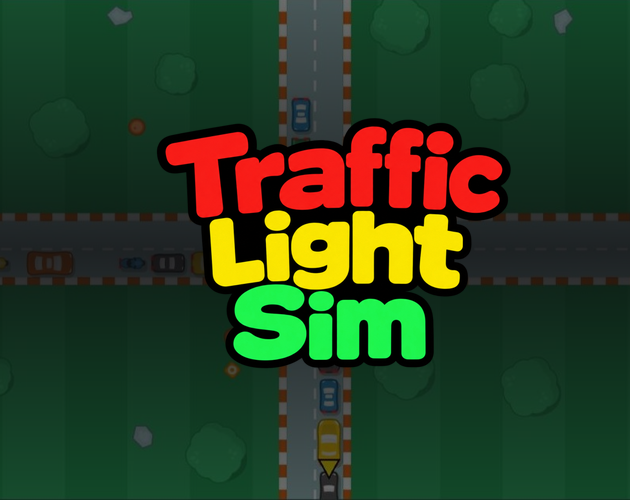
Traffic Light Sim
A calm-to-chaotic browser puzzler where every click flips a signal, queues pile up behind your decisions, and the stress meter decides how long you last.
Play on itch.io
Play Traffic Light Sim
Traffic Light Sim is a browser-based management puzzler about running signals instead of steering cars. One hundred levels across ten worlds ramp from a quiet T junction to nine junctions in rain and darkness, with boss stages every tenth…
Play on itch.io ↗itch.io blocks third-party embeds, so the game opens on the developer's page. No install, no account.
The short answer
Traffic Light Sim is a browser-based management puzzler about running signals instead of steering cars. One hundred levels across ten worlds ramp from a quiet T junction to nine junctions in rain and darkness, with boss stages every tenth level. Click a red light, clear the queue, and keep the stress meter under 100 percent.
What is Traffic Light Sim?
The premise is clear before the first click lands: you are the person deciding which lane gets to move. Traffic Light Sim is a 2D management simulation that runs in a browser, and it puts the signals in your hands rather than the steering wheel. Instead of driving vehicles, you watch queues build and pick the moment to open a lane.
The structure is generous. There are 100 levels split into 10 worlds, and the opening stages are deliberately gentle, with new complications arriving one at a time instead of all at once. Every tenth stage is a boss level, carrying heavier traffic and a larger goal than the stages before it.
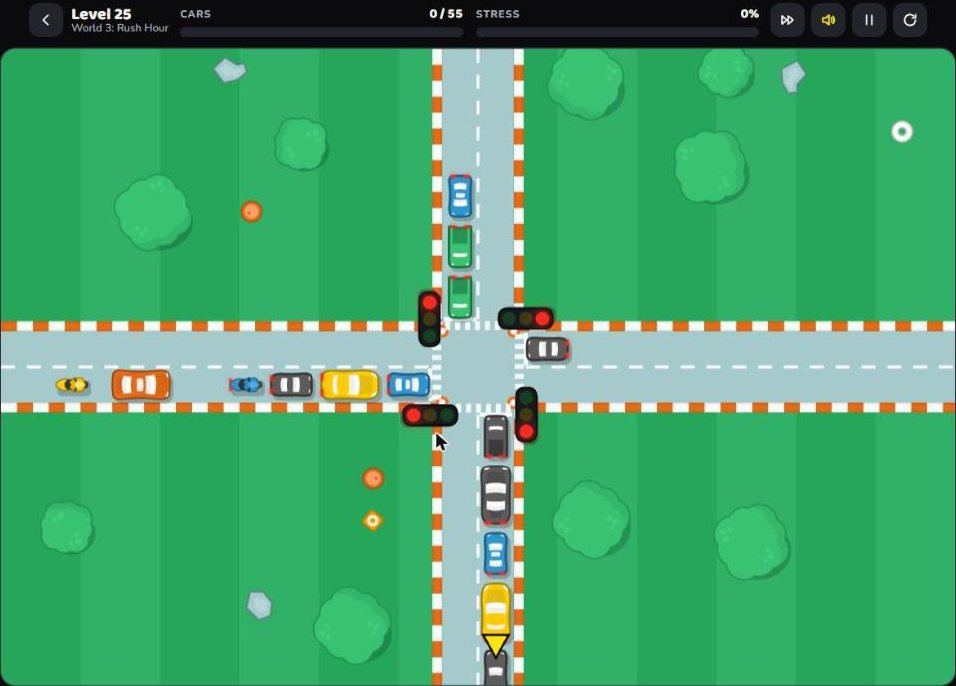
The failure state is what gives the game its teeth. Drivers who are kept waiting get angry, and that anger feeds a stress meter. Reach 100% and the level is lost. So the challenge is not simply making cars move, but making them move in the right order quickly enough that nobody boils over.
How to play
The core action is a single click or tap. Red lights are the things you can change; turn one green and the queue behind it begins to roll. The catch is timing. Conflicting traffic has to be stopped before your chosen direction gets the go-ahead, so a green light is only useful if the crossing flow is already halted.
Vehicles behave with more nuance than coloured dots. Cars brake, queue, turn left and yield to oncoming traffic, which means an opened lane does not always empty as quickly as expected. Trucks, motorbikes and ambulances share the road, and ambulances in particular need a clear path fast. Later worlds add rain, darkness and signals that flip to red on their own, so you are managing a system that keeps moving without you.
Each stage offers up to three lamps to earn, and they are not handed out for merely surviving. Across the full run there are 300 lamps available, which gives a reason to return to a level you cleared messily. Fill the stress meter to 100% and the attempt ends.
Controls
Everything maps to a small set of inputs. A red light responds to a tap or a click and turns green, and that is the move you will make hundreds of times. Mouse and touch both work, and a keyboard is supported as well.
Two keys are worth memorising before the traffic builds. P or Space pauses the action, which matters because a busy junction can swing from calm to critical in a couple of seconds. R restarts the level from the beginning, so a doomed run does not have to be played out to its end.
The interface is available in English and Dutch, and can be switched to Nederlands for players who prefer it. Progress is saved in your browser, so closing the tab does not wipe out the levels you have already cleared. There is no account to create and nothing to install, because the game loads directly in an HTML5 frame.
| Input | Action |
|---|---|
| Mouse or touch | Tap or click a red light to turn it green |
| P or Space | Pause the game |
| R | Restart the current level |
Tips for your first run
The earliest levels are forgiving on purpose, and the best use of that time is learning how long a queue takes to drain after a light changes, rather than chasing a fast finish.
- Watch the conflicting lane before switching. Opening your light before crossing traffic has stopped is how jams begin.
- Clear ambulances first once they appear. They are the vehicles that cannot afford to sit in a queue.
- Treat the stress meter as your real timer. It fills while drivers wait, so a slow, orderly junction often beats a fast, chaotic one.
- Collect lamps on the easy stages early, since the quiet maps are the cheapest place to pick them up on the way to 300.
- Use P or Space instead of clicking blindly when a junction gets busy; a second of thinking costs less than one wrong green.
- On stages where signals turn red automatically, plan around them rather than fighting the change.
Content and replayability
The level list is the main argument for sticking around. Ten worlds of ten levels each move through a fixed sequence of scenarios. Village Square, the first block, is a quiet T junction. Crossroads brings four directions and right turns. Rush Hour adds busy waves and heavy trucks, and Left Turns makes you decide who goes first. Double Junction is about queues that spill back into one another.
Then the weather and the city arrive. Rain Shower introduces wet roads and ambulances. Green Wave hands you four junctions, some of them with lights that turn red by themselves. Downtown runs at night with trucks and ambulances. Metropolis puts six junctions on screen at once, and Traffic Chaos closes the run with nine junctions in rain and darkness.
Boss levels sit at every tenth stage with more traffic and a bigger target, breaking the steady ramp with a genuine test. Three lamps per level and 300 in total add a completion layer on top of simple survival, so a stage you scraped through is not necessarily a stage you have finished with.
Presentation and performance
Traffic Light Sim is a 2D game built for the browser, and its artwork comes from the Racing Pack asset set by Kenney.nl, released under CC0. That means clean, readable vehicle sprites rather than gritty realism, which suits a game where the important information is which lane is blocked and which vehicle is an ambulance.
The look shifts as the worlds progress. Rain and darkness are part of the level design rather than decoration, and the later stages layer weather on top of multi-junction layouts. Signals that change without input add motion to the scene even when you are not touching anything.
Because it runs in an HTML5 frame, there is nothing to download and no launcher between you and the first junction. The flat, high-contrast art style also holds up at the scale of the largest maps, where six or nine junctions have to stay readable at once.
Who should play it
Anyone who prefers untangling a system to driving through one is the audience here. The tags point to casual, management and singleplayer play, and the design backs that up: short levels, one clear failure state, and a difficulty curve that introduces a single new trick at a time.
It suits players who like a puzzle they can pause. Space and P exist precisely because the situation can become overwhelming, and the stress meter turns patience into a mechanic rather than a virtue. Anyone hoping for reflex-heavy driving will find something different here, since the cars handle themselves and your job is purely the lights.
Completionists get a long tail. Three lamps per level rewards a tidy junction over a lucky one, and the full set of 300 is a goal worth chasing. A quiet T junction at level one and nine junctions in the rain at level one hundred are effectively two different games, which makes the gentle opening worth pushing through.
Screenshots
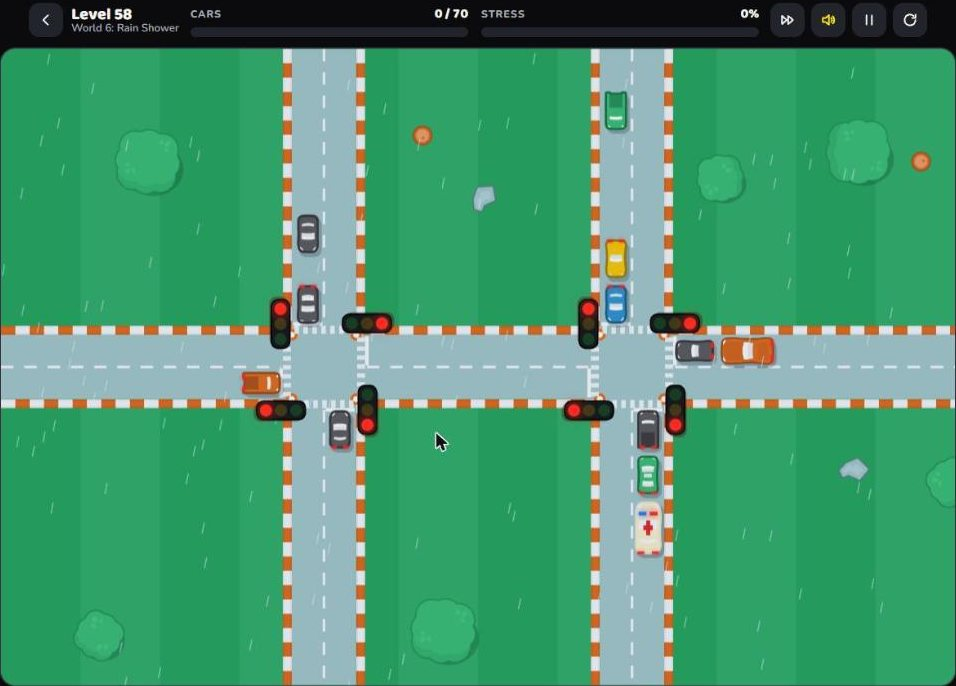
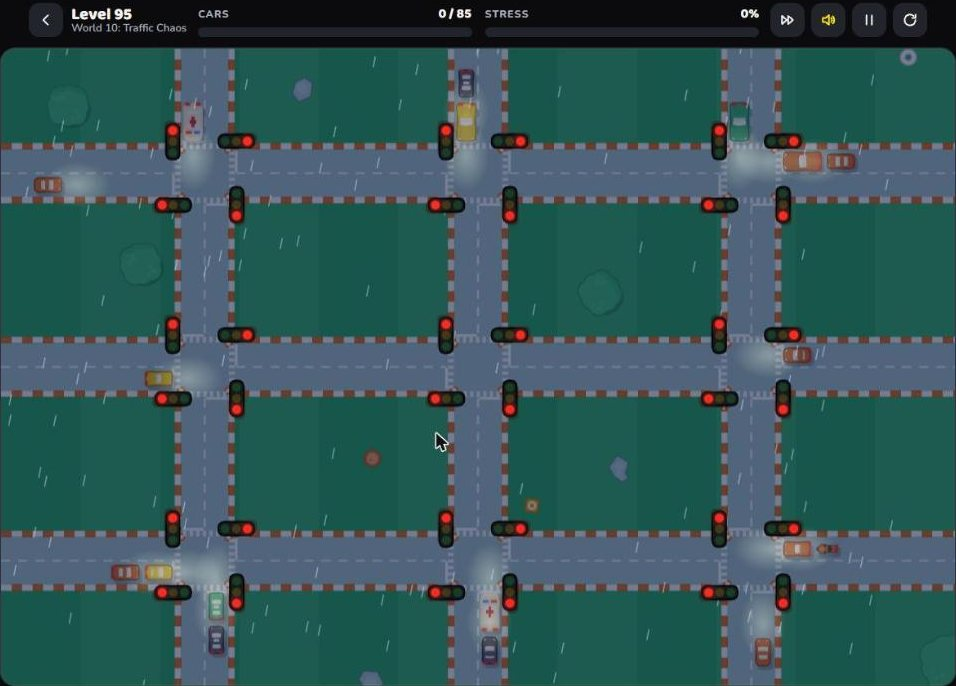
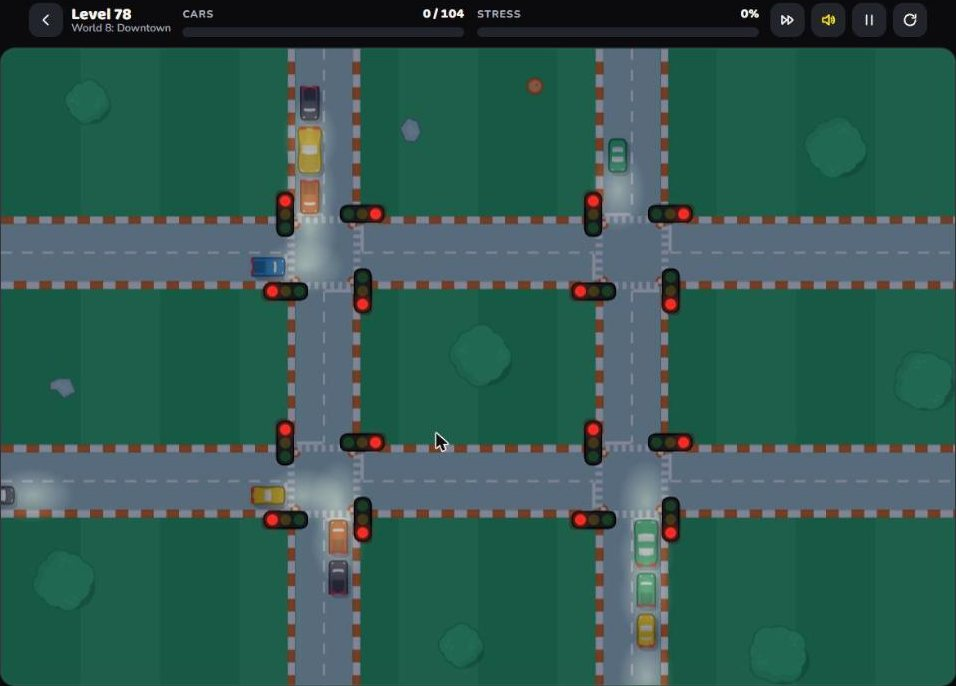
From the developer
Keep the traffic flowing! You control the traffic lights. Tap or click a red light to turn it green and watch the queues move. But be careful: the crossing traffic has to stop first, and angry drivers push your stress meter up. Hit 100% stress and the level is lost. 100 levels, 10 worlds The first levels are very easy and the difficulty grows slowly, one new trick at a time. Every tenth level is a boss level with more traffic and a bigger goal. 1 to 10 Village Square: a quiet T junction11 to 20 Crossroads: four directions and right turns21 to 30 Rush Hour: busy waves and heavy trucks31 to 40 Left Turns: you decide who goes first41 to 50 Double Junction: queues spill back51 to 60 Rain Shower: wet roads and ambulances61 to 70 Green Wave: four junctions, lights that turn red by themselves71 to 80 Downtown: night, trucks and ambulances81 to 90 Metropolis: six junctions at once91 to 100 Traffic Chaos: nine junctions, rain and darkness…
Read the full description on itch.io →Frequently asked questions
Is Traffic Light Sim free to play?
Yes. The game is free, and it runs in a browser rather than through a paid download or launcher.
How many levels does it have?
There are 100 levels arranged in 10 worlds of 10, with a boss stage at every tenth level featuring more traffic and a larger goal.
What do you actually control?
The traffic lights. Turning a red light green releases the queue behind it, but crossing traffic has to be stopped first or the junction jams.
Can you lose a level?
Yes. Waiting drivers push up a stress meter, and reaching 100% ends the attempt and loses that level.
Which languages are supported?
English and Dutch, with the interface playable in Nederlands as well as English.
Does progress carry over between sessions?
Progress is saved in your browser, so cleared levels survive closing the tab as long as that browser data is kept.
Something wrong or missing? Tell us.