Action · New game
Zig-Worm: Neon Pulse
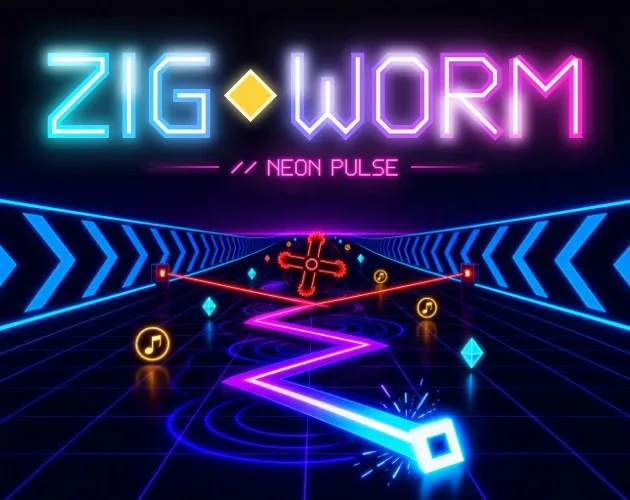
A free browser arcade game where a single press snaps your glowing worm around hard corners while neon hazards, synthwave beats and Firewall bosses keep the pressure on.
#27 this weekAI-assisted: Code
The game runs in this tab. No install, no account.
The short answer
Zig-Worm: Neon Pulse is a free browser arcade game about snapping a glowing worm around hard corners with one button while neon hazards fire on the beat. Twenty levels, four worlds and four Firewall bosses sit on top of a beat-matching pulse lane and a star system that unlocks skins and trails.
What is Zig-Worm: Neon Pulse?
Zig-Worm: Neon Pulse is an arcade action game built on a single input. A glowing worm climbs a neon grid along a fixed diagonal, and every press snaps it into a hard 90-degree corner. The body follows the head's exact path and carries its own hitbox, so a gate that closes just after the head slips through can still clip the tail trailing behind it.
The project comes from Coyotelikes and was made for the LittleJS Jam 2026, whose theme was zigzag, running on the LittleJS engine. The release holds twenty hand-built levels split across four worlds, each world closing with a Firewall boss. Rhythm sits under everything: every level is built on its own BPM grid and the synthwave soundtrack is generated in code at runtime, slowing and speeding with the pace of play.
It runs in a browser with nothing to install and nothing to pay, and a Wavedash version is also available.
How to play
The core loop is one button against a beat that never waits. Press to snap a corner, use the left and right inputs to turn, and keep the worm alive as gates and hazards fire on the music's timing. Because the tail is a hitbox too, surviving a hazard with the head is only half the job, since the trailing body has to clear it as well.
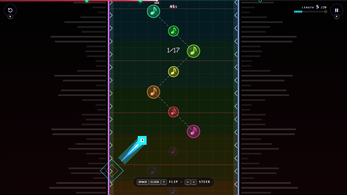
Halfway through every level the hazards stop and the Beat Drop begins: a lane of seventeen pulse notes zig-zags on the beat, and catching all of them earns a perfect drop. Boss fights change the demand, asking for all five Strike Nodes to be hit while telegraphed laser columns sweep the arena.
Mastery stars set the longer-term goals: clear the level, collect all three Data Rings and finish with a tail of at least twenty segments. Orbs add a tail segment each, so the tail target and the survival target pull in the same direction rather than competing.
Controls
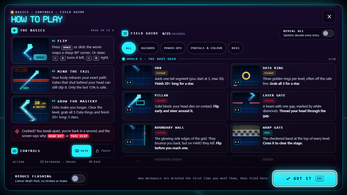
Keyboard players can flip with Space, the up arrow or W, and mouse users get the same result by clicking anywhere on screen; touch players tap. The left and right arrows or A and D turn the worm left or right. That is the entire movement set, which is why the challenge lives in timing rather than input combinations.
R restarts the current level and P or Esc pauses. Practice mode adds two keys of its own: Z drops a checkpoint and X removes it, so a stubborn section can be broken into pieces instead of replayed from the start.
A gamepad is supported alongside keyboard, mouse and touch. Difficulty is picked from Chill, Normal or Hard, which use the same levels with different forgiveness, and no preset plays the level for the player.
| Input | Action |
|---|---|
| Space, Up arrow, W, click or tap | Flip: snaps the worm into a hard 90-degree corner |
| Left arrow, Right arrow, A, D | Turn the worm left or right |
| R | Restart the level |
| P or Esc | Pause |
| Z | Place a checkpoint in practice mode |
| X | Delete a checkpoint in practice mode |
| Gamepad | Supported alongside keyboard, mouse and touch |
Tips for your first run
The first attempts tend to end quickly, and the worm never slows down, so the only real fix is to flip earlier than feels comfortable. The tail is a hazard to the worm itself, and only the last fifteen percent of it is safe, which means the trailing body has to be planned around as carefully as the head.
Practice mode is the fastest way to learn a pattern. Drop a checkpoint with Z, rehearse the segment, then delete it with X once the route is clean. Each hazard also gets a short in-game guide the first time it appears, so the opening encounter is explained rather than guesswork.
- Flip before the gap rather than at it; speed stays constant no matter what.
- Only the final 15 percent of the tail is safe, so swing the rest wide of closing gates.
- Collect orbs when the route allows, since each one adds a segment toward the 20+ mastery target.
- Bank all 17 pulse notes during the Beat Drop to land a perfect drop.
- In boss fights, work through the five Strike Nodes while reading the telegraphed laser columns.
- Use the Reduce flashing switch if the neon pulsing becomes uncomfortable.
- Drop to Chill if the timing window feels punishing; the level layouts stay the same.
Content and replayability
Twenty levels across four worlds is a deliberately compact package. Every level runs on its own BPM grid, so pacing shifts from stage to stage instead of repeating a single tempo, and each world finishes with one of the four Firewall bosses.
Replay value sits in the star system and the Garage. A level only counts as mastered once it is cleared, all three Data Rings are collected and the tail finishes at twenty segments or more. Stars unlock worm skins, sparks and trails, which gives a reason to return to levels already survived once.
Chill, Normal and Hard reuse the same levels with different forgiveness, so harder runs stay available after the layouts settle into memory. Practice checkpoints and a death screen that names exactly what hit the worm turn failure into information rather than a mystery. The whole package is singleplayer.
Presentation and performance
The look is neon on a grid: a glowing worm, sharp 90-degree corners and a synthwave score generated at runtime rather than streamed. Music and sound effects are produced in code, which keeps the entire experience inside a browser tab with no install step and lets the soundtrack follow the pace of play.
Readability matters more than spectacle in a game about a tail hitbox, and the fixed diagonal grid keeps the worm's path legible even when hazards stack up. A Reduce flashing switch is included for players who need the neon pulses dialled down, and a short in-game guide explains each hazard the first time it appears.
Input coverage is broad, with keyboard, mouse, touch and gamepad all working, and the build is HTML5, so it plays in the browser. A Wavedash version exists as well for players who prefer that route.
Who should play it
One-button arcade games live or die on whether a single input can carry tension, and this one leans on a tail that counts as a hitbox and hazards locked to a beat. Players who like the idea of precision play but bounce off twitchy execution have Chill mode and practice checkpoints as a way in.
Rhythm players get the Beat Drop: seventeen pulse notes on the beat and a perfect-drop target to chase. Completionists get three Data Rings and a twenty-segment tail per level, with skins, sparks and trails waiting behind the stars. Anyone after a short, free browser session gets a game that loads in a tab and asks for one button.
Players hunting a long campaign, multiplayer or deep progression trees should look elsewhere. This is a compact, hand-built set of neon levels with a boss closing out each of the four worlds.
Screenshots
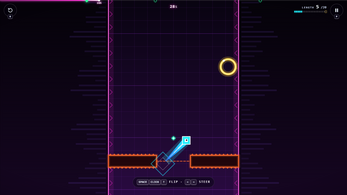
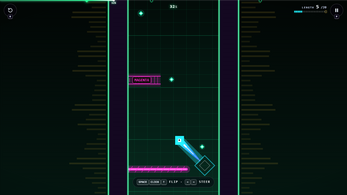
How we tested it
The build was loaded from games.debutplay.com in a headless Chromium session on ; the canvas started and no request was blocked. The guide was last checked on .
From the developer
ONE BUTTON. SHARP CORNERS. MIND THE TAIL. A glowing worm climbs a neon grid on a fixed diagonal. Every press snaps a hard 90° corner, and the beat never waits for you. Your body follows your head's exact path and has a hitbox of its own, so a gate that closes after your head slips through can still clip your tail. Twenty hand-built levels. Four worlds. Four Firewall bosses. One button. How to play Flip: press Space, ↑, W or click / tap anywhere. The worm snaps a corner.Steer: ← → or A D turn left or right.Restart: R · Pause: P or EscPractice mode: Z places a checkpoint, X deletes it. Works with keyboard, mouse, touch and gamepad. A short in-game guide explains every hazard the first time you meet it. What's inside 4 worlds, 20 levels, every one built on its own BPM grid with original synthwave that slows and speeds with the pace.Beat Drop: halfway through every level the hazards stop and a lane of 17 pulse notes zig-zags on the beat.…
Frequently asked questions
Is Zig-Worm: Neon Pulse free?
Yes. It is free to play in the browser and needs no installation, so a session can start without a download or an account.
What platforms does it run on?
It is an HTML5 browser game. Keyboard, mouse, touch and gamepad inputs are all supported, and a Wavedash version is also available.
How many levels and worlds are there?
Twenty hand-built levels across four worlds, with each world ending in a Firewall boss, for four bosses in total.
Is there a practice mode?
Yes. Practice mode uses safe checkpoints: Z places one and X deletes it, so a difficult segment can be rehearsed on its own.
What are mastery stars?
A star requires clearing the level, collecting all three Data Rings and finishing with a tail of at least 20 segments. Stars unlock skins, sparks and trails in the Garage.
Does difficulty change the levels?
No. Chill, Normal and Hard use the same levels with different forgiveness, and no preset plays the game for the player.
What games are similar to Zig-Worm: Neon Pulse?
The closest matches on DebutPlay are Starport Express, Furious Street, Procrastinando Run. They share the same genre, so the controls and the pace carry over.
Something wrong or missing? Tell us. How we test games.