Action · New game
Zolo’s Rest: Jungle Guardian
A first-person jungle defence game in which a hunter named Zolo guards a village from waves of wolves and tigers, with sixteen waves, sixteen weapons and four centuries of escalation.
#11 this weekAI-assisted: Code, Graphics, Sound, Text
The game runs in this tab. No install, no account.
The short answer
Zolo’s Rest: Jungle Guardian is a browser-based, first-person wave defence game. Players take the role of Zolo, the hunter tasked with protecting a 1900 jungle village whose children and livestock are being taken by wolves and tigers. Sixteen waves, sixteen weapons, three difficulty levels and a free two-wave demo make the $7.99 asking price easy to test before committing.
What is Zolo’s Rest: Jungle Guardian?
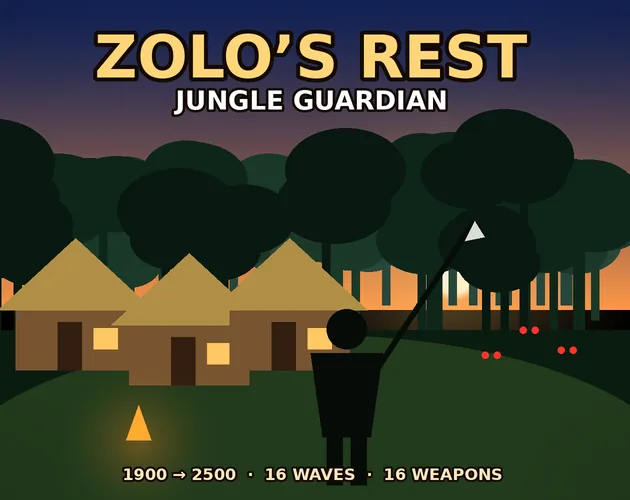
Zolo’s Rest: Jungle Guardian is a first-person action survival game set in a jungle village in the year 1900. The surrounding beasts no longer stay in the trees: wolves and tigers cross the fence after dark, take livestock first, and have already carried off three children from the fields. The elders answer by putting a spear in the hands of Zolo, the village’s fastest hunter, and the settlement becomes his responsibility.
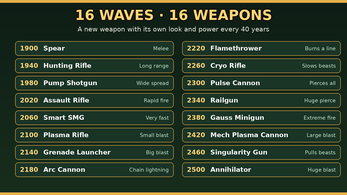
Everything is framed through Zolo’s eyes, which keeps the threat in front of the player instead of on a distant map. Beasts arrive in waves rather than as one long siege, and every cleared wave pushes the calendar forward 40 years while placing a new weapon in Zolo’s hands. By 2500 the arsenal has moved well past anything the villagers of 1900 could picture. Sixteen waves and sixteen weapons make up the whole campaign, and each weapon is built to look and behave differently from the last.
It is a single-player release priced at $7.99 and delivered as an HTML5 game in the browser. A free demo covering the opening two waves exists for anyone who wants to test the defence loop before buying.
How to play
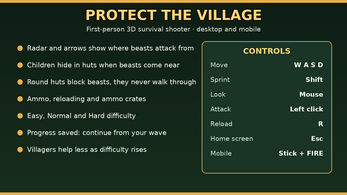
Each wave is a defence problem with two priorities: the village’s children and its animals. Beasts head for them first, so standing still and firing from one spot does not work. The radar shows where trouble is forming, red arrows at the edges of the screen point to off-screen threats, and alerts call out arrivals. Combining those cues and running toward the trouble is the basic loop of a wave.
Children react to danger by running for the huts once beasts get close, which means a late response turns into a chase across the settlement. Ammunition is finite and has to be managed: weapons need reloading, and crates dropped by downed beasts restock the supply. The villagers themselves fight alongside Zolo depending on difficulty, offering heavy support on Easy, modest help on Normal and nothing at all on Hard.
Clearing a wave advances the clock 40 years and hands over the next weapon, so the rhythm alternates between holding a line and learning a new tool mid-fight. A loss does not wipe the run: saved progress allows a restart from the same wave.
Controls
Two input schemes exist. On a computer the game is played with keyboard and mouse; on a phone it switches to touch controls, so the same browser build covers both desk and handheld sessions. The split matters because the core activity is movement under pressure: threats are flagged at the edges of the screen, and the answer is to run toward them while keeping the target in view.
Nothing about the specific keys, sensitivity, remapping or the exact touch layout is spelled out, so expect to feel out the scheme during the opening wave. The free two-wave demo is the most sensible way to check whether the aiming and running suit the device already in hand before paying the $7.99 price.
| Input | Action |
|---|---|
| Keyboard and mouse | Play on a computer |
| Touch controls | Play on a phone |
Tips for your first run
Difficulty is the first real decision. Easy gives the most help from villagers, which leaves room to learn how the radar, the edge arrows and the alerts work together before the tougher settings take that safety net away. Normal trims the support, and Hard removes it entirely.
Because beasts target children and livestock first, the instinct to hold a position and clear whatever is closest is the wrong one. Priority goes to anything running at the huts. Ammo discipline matters too, with reloads to plan and crates from downed beasts to collect between pushes. Losing a wave is survivable thanks to saved progress, so a failed attempt is a chance to relearn the wave rather than a reason to stop.
- Watch the radar and the red edge arrows together, since the arrows point to threats that are off screen.
- Move toward whichever beast is heading for the children or the animals rather than the one nearest the centre of the view.
- Reload during quiet moments and pick up crates dropped by beasts before the next group arrives.
- Start on Easy to see how much villagers contribute, then move up once the cues are familiar.
- Expect a fresh weapon every 40 years and take a moment to learn how it handles.
- Treat a loss as a checkpoint, because progress resumes from the wave that ended.
Content and replayability
Sixteen waves carry the campaign from 1900 to 2500, with the clock jumping 40 years each time and a new weapon arriving alongside it. Each of the sixteen weapons is built to look and act differently, so the roster is meant to change how a wave plays rather than simply reskin the previous one. Waves mix several pressures at once: beasts with a preference for children and animals, children who flee to the huts, ammunition that runs down, and crates that have to be collected.
Replay value sits mostly in the three difficulty levels. Villagers are a major asset on Easy, a modest one on Normal and absent on Hard, which changes how much of the defence falls to the player alone. Saved progress also encourages retrying a single wave instead of restarting a campaign from the beginning.
The game is single-player, and the sixteen-wave run is the structure it is built around. A free demo of the first two waves previews the opening before the $7.99 purchase.
Presentation and performance
Visually this is a 3D jungle village rendered in first person: a fenced settlement, huts that children run to, wolves and tigers pushing in from the treeline, and weapons that change decade by decade as the years roll forward. The whole thing runs in a modern browser through HTML5, with the Three.js library pulled from the internet at load time. That last detail is the practical catch, since a live connection is required to get the game started.
A playable frame is embedded for instant sessions, so nothing has to be downloaded first. Generative AI tools were part of the development process. The full game costs $7.99, while the two-wave demo costs nothing to try.
Who should play it
This suits players who like defence games where the job is to keep something alive rather than simply clear a room. The children-and-livestock priority, the radar-and-arrows reading and the ammunition management push toward constant repositioning, which will appeal to anyone who finds static tower defence too passive. The forty-year jumps and the sixteen-weapon roster give the campaign a steady drip of novelty.
It also suits players who want a first-person action game they can open in a browser tab, and phone players get touch controls instead of an unusable desktop layout. The Easy setting and the free two-wave demo lower the entry barrier, while Hard, with no villager support, is for players who want the defence entirely on their own shoulders.
At $7.99 this is a paid game rather than a freebie, so the demo is the sensible first stop. The structure is a solo one, and the wave-defence run is the whole of it.
Screenshots
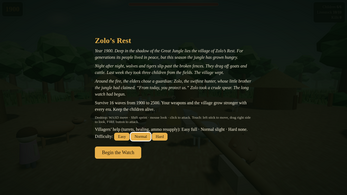
How we tested it
The build was loaded from games.debutplay.com in a headless Chromium session on ; the canvas started and no request was blocked. The guide was last checked on .
From the developer
The jungle has gone hungry. In the village of Zolo’s Rest, the beasts have stopped staying in the trees. Wolves and tigers cross the fence at night, and they take livestock first. Last week they took three children from the fields. So the elders pick their fastest hunter, Zolo, and give him a spear. From now on, the village is his to protect. That’s where your game starts, in the year 1900. What it’s like to play You see everything through Zolo’s eyes. Beasts come in waves, and they go for the children and animals first, which means you can’t just stand still and shoot. You have to read the radar, watch the red arrows at the screen edge and run toward the trouble. Every wave moves the clock 40 years forward, and you get a new weapon each time. By 2500 you’re holding things the villagers of 1900 couldn’t imagine. What you’ll find 16 waves and 16 weapons, each one looking and acting differentlyA radar, edge arrows and alerts, so you…
Frequently asked questions
How much does Zolo’s Rest: Jungle Guardian cost?
The full game is $7.99. A free demo containing the first two waves is available, so the defence loop can be tested before buying.
What can it run on?
Any modern browser, as an HTML5 game. Play on a computer uses keyboard and mouse, while phones use touch controls.
How many waves and weapons are there?
Sixteen of each. Every wave advances the year by 40, running from 1900 to 2500, and each arrives with a weapon that looks and behaves differently.
Does difficulty change the game?
Yes. Villagers help a great deal on Easy, a little on Normal and not at all on Hard, which shifts the defence onto the player.
What happens after a loss?
Progress is saved, so a failed wave can be replayed from the same point rather than restarting the campaign from the first night.
Is an internet connection needed?
Yes. The game runs in a browser but loads the Three.js library from the internet, so it needs a live connection to start.
What games are similar to Zolo’s Rest: Jungle Guardian?
The closest matches on DebutPlay are TORCH, TORCH!, Flipper Duel, Lanternfall. They share the same genre, so the controls and the pace carry over.
Something wrong or missing? Tell us. How we test games.