Action · New game
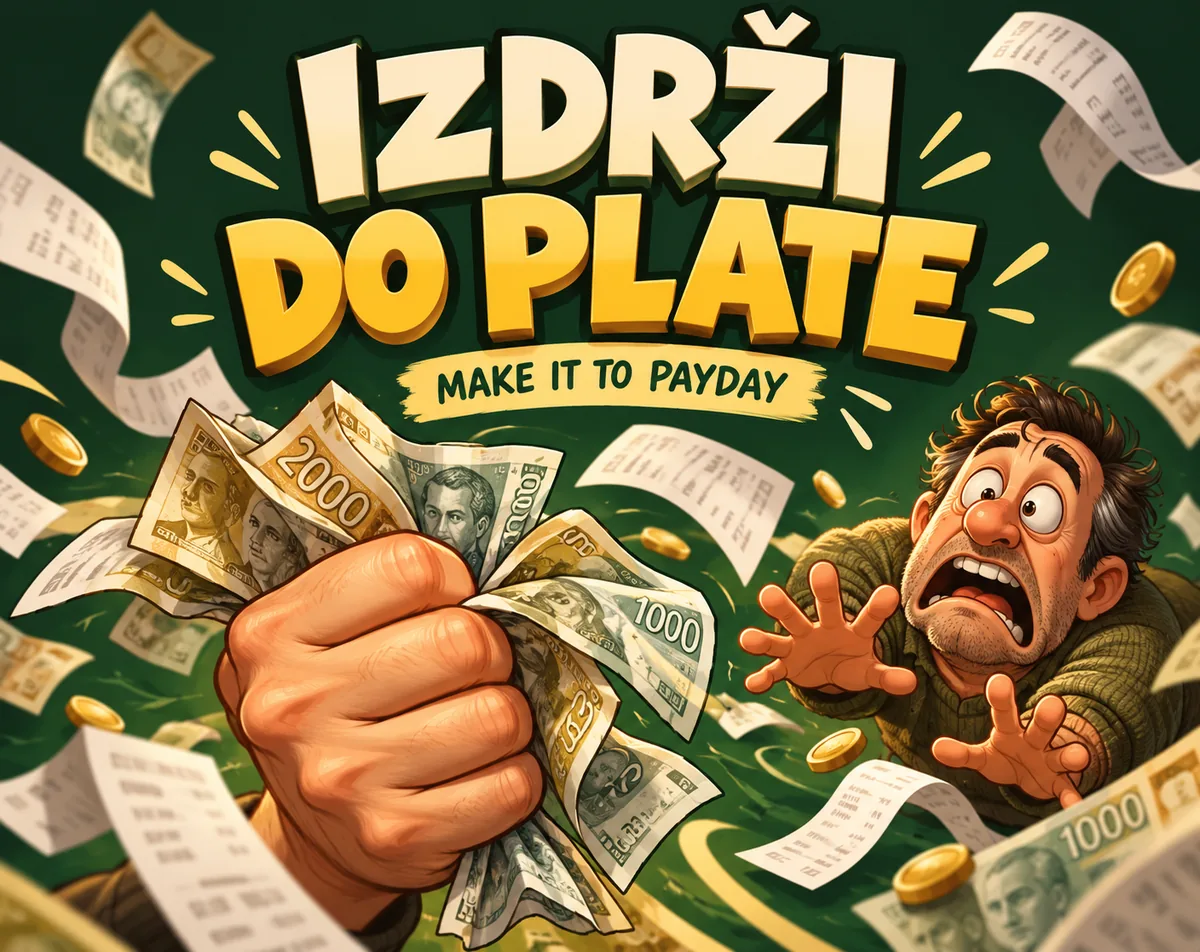
Izdrži do plate / Make It to Payday
A grabbing hand, a short paycheck, and twelve months of bills: this HTML5 action game turns household budgeting into a fast, funny survival challenge.
#34 this weekAI-assisted: Code, Graphics, Sound, Text
The game runs in this tab. No install, no account.
The short answer
Make It to Payday is a free HTML5 action game in development about steering a grabbing hand to catch cash and pay bills across 12 months. Choose Scandinavia, Central Europe, or the Balkans for easier or harder pressure, then chase a printable annual report. Play it now for a quick, funny budget-survival run.
What is Make It to Payday?
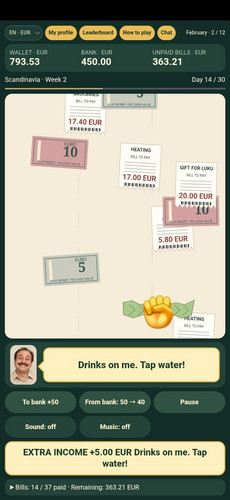
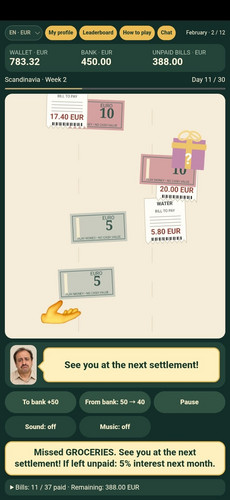
Make It to Payday, also titled Izdrži do plate, is a casual action game built for HTML5 and still in development. The premise is a household budget under pressure: a short paycheck, a long month, and a fridge that picks the worst possible moment to fail. The player controls a grabbing hand, catches cash, and pays bills while life sends gifts, breakdowns, fines, and sometimes a lucky windfall. The goal is to last all 12 months without bankruptcy and end with as much money as possible. Three difficulty choices set the pressure: Scandinavia is easy, Central Europe is medium, and the Balkans is hard. The action is singleplayer, the tone is funny, and the game supports Serbian with dinars and English with euros. Every amount shown is a fictional game value; there is no real-money gambling or cash prize. The game is still in development, so the current build is an evolving version rather than a finished product.
How to play
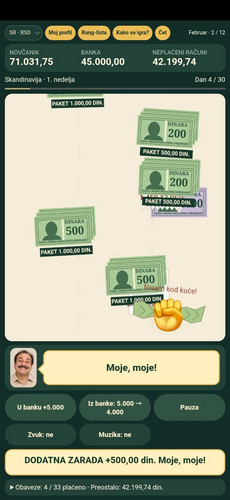
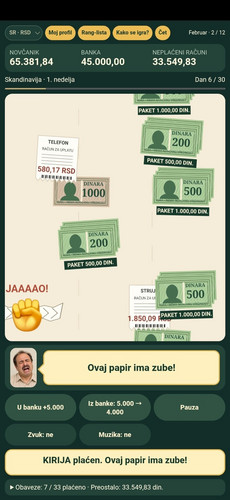
The core loop is about catching money and covering obligations. Move the hand to intercept cash, then use the funds to pay bills. Each month increases the pace, so the same task becomes less forgiving. From March onward, the hand can move in every direction; bills still track the player. Missed bills do not vanish: they carry over with interest, which makes a skipped payment a future problem. Money can be placed in the bank, investments can be considered, and debts need attention. Unexpected winnings can rescue a run, while surprise expenses can arrive right after. After each month, a slow-motion replay shows where the money went. Finish the year and the game produces a printable annual report with a chart. The 12-month target and the bankruptcy limit give every decision a clear consequence.
Controls
Phone controls use a finger to move the hand. Computer controls use the arrow keys or A/D for horizontal movement. From March, vertical movement joins the scheme, using the up and down arrows or W/S. That change matters because the hand can then move in all directions while monthly speed continues to rise. Each audio layer has its own toggle, so effects and music can be switched independently. The control scheme is deliberately small, matching a casual action game built around a single grabbing hand. The game can be played in Serbian using dinars or in English using euros, though those are language and currency choices rather than controls. Because the hand changes from horizontal-only to full directional movement in March, the keyboard scheme gains a new role partway through the year.
| Input | Action |
|---|---|
| Phone | Move the hand with a finger. |
| Computer | Use arrow keys or A/D to move; from March, up/down or W/S also work. |
| Sound effects | Toggle on or off separately. |
| Music | Toggle on or off separately. |
Tips for your first run
Start on Scandinavia if the goal is to learn the rhythm without the tighter pressure of Central Europe or the Balkans. Protect the bill-paying routine first, because missed payments carry over with interest and turn one bad month into a longer debt problem. Use the bank as a buffer when cash is available, and treat investments as a considered option rather than an automatic choice. Watch the March transition closely: the hand gains up/down movement, and the monthly pace keeps increasing. After each month, study the slow-motion replay to see where money went before the next round begins. A lucky windfall can create room to recover, but an unexpected expense can erase that room quickly.
- Choose Scandinavia for a first run; it is the easy setting.
- Pay bills before optional moves; missed bills carry interest.
- Keep a bank buffer and review investments with care.
- Expect the hand to gain vertical movement in March.
- Use the monthly slow-motion replay to audit spending.
- Aim for the printable annual report by reaching month 12.
Content and replayability
The campaign is measured in 12 months, with the pace rising as the year advances. Three difficulty settings alter the pressure: Scandinavia is easy, Central Europe is medium, and the Balkans is hard. Replay value comes from the mix of gifts, breakdowns, fines, and occasional windfalls, plus the March shift that expands hand movement to every direction. Banking, investments, and interest-bearing debt add decisions beyond catching cash. Each month ends with a slow-motion replay, and a completed year yields a printable report with a chart. The game is singleplayer and built for HTML5. Serbian with dinars and English with euros broaden the audience. Because the game is in development, the current content should be treated as a working version. There is no real-money gambling or cash prize; every amount is fictional.
Presentation and performance
Presentation leans on the joke of a budget in crisis: a short paycheck, a long month, a failed fridge, and a hand scrambling for cash while bills keep coming. The action is framed as casual and funny rather than realistic financial planning. Feedback arrives through monthly slow-motion replays and a final printable annual report with a chart, giving the run a visible record. Sound effects and music can be switched on or off separately. The game runs as an HTML5 title, and it is playable in an HTML5 frame. Language and currency presentation split between Serbian with dinars and English with euros. Every amount is fictional, and the game includes no real-money gambling or cash prizes. The build is in development, so the presentation is best judged as an in-progress HTML5 game.
Who should play it
This suits players who like a casual action loop with a comic household-budget theme. The grabbing hand and bill-paying goal are easy to understand, while the 12-month survival target and bankruptcy limit give the run a clear finish line. Players who enjoy choosing their own pressure can pick Scandinavia, Central Europe, or the Balkans. The March change, which adds vertical hand movement while monthly speed keeps climbing, gives the middle of a run a distinct shift. Anyone who likes end-of-run summaries will find the slow-motion monthly replay and printable annual report useful. Serbian-speaking players can use dinars, and English-speaking players can use euros. The game is singleplayer, so it is not a social or competitive pick. It is also in development, which makes it a better fit for players comfortable with an evolving build than for anyone seeking a finished, fixed product.
Screenshots
How we tested it
The build was loaded from games.debutplay.com in a headless Chromium session on ; the canvas started and no request was blocked. The guide was last checked on .
From the developer
🇷🇸 IZDRŽI DO PLATE Plata kratka. Mesec dug. A frižider baš sad odlučio da crkne. Upravljaj šakom, grabi novac i plaćaj račune dok ti život šalje poklone, kvarove, kazne i poneki neočekivani dobitak. Cilj je jednostavan: izguraj svih 12 meseci bez bankrota i sačuvaj što više novca. Izaberi koliko želiš da se preznojavaš: • Skandinavija — lagano. • Srednja Evropa — srednje. • Balkan — teško. Srećno, domaćine! Svaki mesec donosi brži tempo. Od marta šaka može da se kreće u svim pravcima — računi, nažalost, i dalje znaju gde si. Štedi u banci, razmisli o investicijama i pazi na dugove: propušteni računi prenose se uz kamatu. Iznenadni dobici mogu da te izvuku, a iznenadni troškovi da ti objasne zašto se zovu iznenadni. Posle meseca pogledaj usporeni snimak i otkrij gde su otišle pare. Posle cele godine dobijaš izveštaj sa grafikonom koji možeš da odštampaš. Da bar negde imaš dokaz da si se trudio. KONTROLE Telefon: pomeraj šaku prstom.…
Frequently asked questions
Is Make It to Payday free?
Yes. The game is free to play, and no real-money gambling or cash prizes are involved.
What platforms are supported?
It is an HTML5 game with a playable frame, plus phone and computer control schemes.
How long is a run?
A run covers 12 months. The goal is to avoid bankruptcy through the full year and finish with as much money as possible.
What difficulty settings are available?
Three: Scandinavia on easy, Central Europe on medium, and the Balkans on hard.
What are the controls?
On a phone, a finger moves the hand. On a computer, use arrow keys or A/D; from March, up/down or W/S also work.
Can the game be played in Serbian?
Yes. Serbian uses dinars, and English uses euros. Every amount is a fictional game value.
What games are similar to Izdrži do plate / Make It to Payday?
The closest matches on DebutPlay are TORCH, TORCH!, Lanternfall, Ringflip: Circus Pinball. They share the same genre, so the controls and the pace carry over.
Something wrong or missing? Tell us. How we test games.