Action · New game
Accretion
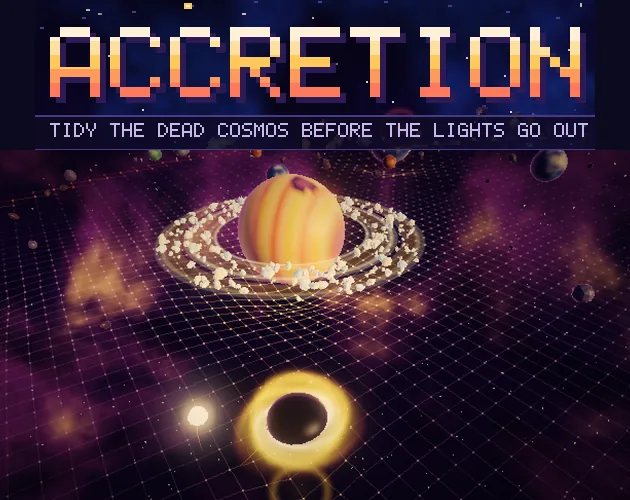
A newborn gravity well tidies a dying universe into one new world, swallowing debris on real orbits while a bored cosmic janitor watches the clock.
#48 this weekAI-assisted: Code, Graphics, Sound, Text
The game runs in this tab. No install, no account.
The short answer
Accretion is a free arcade game about growing a gravity well from a speck of dust into something that can swallow the last star, across thirteen seamless bins. Plunge into debris for an instant meal or graze it to double the value, then survive comets, pulsar beams and rival wells before the cosmos closes.
What is Accretion?
Accretion hands the player a newborn gravity well and a temp job. The universe is ending, and the Custodian of the Last Shift — a cosmic janitor on a timesheet — wants the dead cosmos swept into a single new world before the lights go out. It is a singleplayer action game framed as arcade score chasing, built on gravity and physics rather than gunfire.
The whole climb happens on one continuous scale. Thirteen bins stretch from a one-metre speck of dust to swallowing the last star at roughly 150,000 kilometres, with no loading cuts between them. Outgrow a bin and the world shrinks around the well, while whatever is left over becomes dust for the next bin.
Accretion is free and in development, running in HTML5 as well as on Windows, macOS and Linux. The browser build can be played directly and progress saves in the browser. The tone is cheerfully apocalyptic: a bored janitor, a timesheet, and a rival well wearing a crown of teeth.
How to play
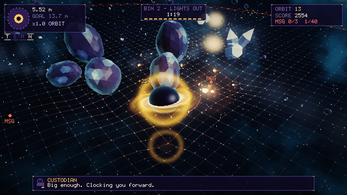
Growth is a choice between speed and value. Drive straight into an object and the well swallows it at once. Skim past instead and the object drops into orbit, trailing a glowing ring as it spirals inward, and an orbiting catch is worth up to double. That captured cloud is not decoration: it serves as armour, as extra reach and as ammunition, so a player who only ever plunges in loses the buffer that keeps the well alive.
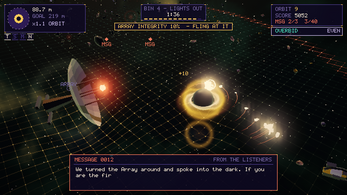
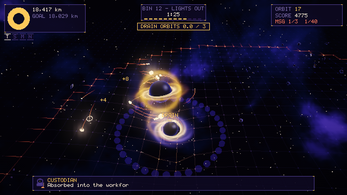
Each bin ends in an exam rather than a bare countdown. The tasks include cracking the Listening Array, unspooling a ringed giant, slipping between a pulsar's beams, circling the Drain three times without falling in, and finally eating a rival and the last star. The clock applies pressure, but the exam is the thing that gates progress.
The cosmos pushes back. Comets, black holes that can be slingshotted around, pulsar beams, and solar wind that peels away the orbiting cloud unless the well tucks behind something larger all share the space. Subcontractors steal whatever is in orbit, the Shepherd siphons the cloud, and Overbid — the rival well with the crown of teeth — has a reason to want nothing finished.
Controls
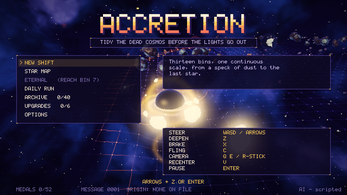
Accretion plays with keyboard or gamepad, and the keyboard bindings can be remapped. Steering uses WASD or the arrow keys, while a pad's left stick or d-pad does the same job. Holding Z or Space on the keyboard, or A on a gamepad, deepens the well; X or Shift and the B button apply the brake.
Flinging the orbiting cloud sits on C for keyboard players and X on a pad, which matters because the cloud doubles as ammunition. The camera turns with Q and E, the right stick, or the LB and RB bumpers, and V or Y snaps it back to centre. Pause is Enter or Start.
The options menu covers camera speed and distance, invert, volume, reduced motion and colour-safe markers, so the view can be tuned before the first bin. Deepening the well is a hold rather than a tap, and that input shape is worth practising early: it is the one action that stays constant while the world shrinks and grows around the player.
| Input | Action |
|---|---|
| WASD or arrow keys | Steer the well |
| Left stick or d-pad | Steer with a gamepad |
| Z or Space (hold), gamepad A | Deepen the well |
| X or Shift, gamepad B | Brake |
| C, gamepad X | Fling the cloud |
| Q or E, right stick, LB or RB | Turn the camera |
| V, gamepad Y | Recentre the camera |
| Enter, gamepad Start | Pause |
Tips for your first run
Learn the difference between a plunge and a graze in the opening bin. A direct hit is instant food, but a glancing pass builds the orbiting cloud and pays up to double, and that cloud is armour, reach and ammunition at once. Braking before an approach makes a clean graze far easier to line up than a full-speed collision.
Camera recentring is worth turning into a habit, since the scale shifts constantly and the threats arrive from every side. Treat each bin's exam as the real objective rather than the timer alone.
- Graze rather than swallow whenever the clock allows, because orbiting catches are worth up to double.
- Treat the orbiting cloud as both protection and ammunition, never as scenery.
- Brake before lining up a pass instead of diving in at full speed.
- Duck behind a larger body when solar wind starts peeling the cloud away.
- Slingshot around black holes instead of steering clear of them.
- Expect Subcontractors and the Shepherd to attack the cloud itself, not the well.
Content and replayability
There is a story told in junk. Forty messages from a dozen dead civilisations drift through the bins, written by comet swimmers, listeners, accountants and a church of the teeth. Message 0001 has no origin, and tracking where it came from is the thread running through the debris.
Reaching the credits is not the end. Fifty-two medals sit alongside six upgrades, two of which can be equipped at a time, so a run can be tuned rather than simply endured. Eternal is an endless mode for anyone who wants the growth curve without a finish line, and Daily is a seeded run with a local top ten, turning score attack into a repeatable habit.
A generative score sinks in pitch as the well grows, tying the audio to progress instead of looping a fixed track. Because progression saves in the browser, the message hunt, the medal count and the daily results carry over between sessions.
Presentation and performance
The look is PS2-era 3D drawn entirely in code, with bloom, gravitational lensing and a gravity sheet that dimples under every mass. That last effect suits the premise best: the world visibly bends around anything heavy, including the player's own well. Retro geometry and modern rendering tricks sit side by side, so the game reads as deliberately low-poly rather than merely dated.
Comfort and accessibility choices live in the options menu: camera speed and distance, invert, volume, reduced motion and colour-safe markers. Reduced motion and colour-safe markers matter in a game where pulsar beams and glowing orbit rings carry information the player has to act on quickly.
The browser build needs WebGL2 and is recommended in Chrome, Firefox or Edge on a desktop. Accretion is listed for HTML5, Windows, macOS and Linux, with desktop browser play the headline route, and progress saves in the browser so a session can be resumed on the same machine later.
Who should play it
Accretion suits anyone who likes a physics toy with a score attached. The pull is the same one that makes orbit games compulsive: a small set of inputs, a scale that keeps doubling, and a value decision behind every approach. Score chasers get medals, a seeded daily run with a local top ten and an endless mode, while players who want a reason for the climbing get forty messages and a mystery numbered 0001.
The tone will appeal to anyone tired of solemn space games. A bored cosmic janitor, a timesheet at the end of the universe and a rival well wearing a crown of teeth set expectations: funny, atmospheric and a little mean, with enemies that target the cloud a player has been hoarding.
Keyboard and gamepad players on desktop are the intended audience, since the game runs in the browser with WebGL2. Anyone wary of twitchy action should note the brake, the remappable keys and the exam structure, which reward a planned approach over constant mashing.
Screenshots
How we tested it
The build was loaded from games.debutplay.com in a headless Chromium session on ; the canvas started and no request was blocked. The guide was last checked on .
From the developer
The universe is ending. You are a newborn gravity well, hired by the Custodian of the Last Shift (a bored cosmic janitor on a timesheet) to tidy the dead cosmos into one new world before the lights go out. Grow against the clock, on real orbits. Whatever you catch doesn't stick to you. Plunge straight into something and you swallow it at once. Graze past it and it falls into orbit, trails a glowing ring and spirals in, worth up to double. Your orbiting cloud is your armour, your reach and your ammo. One continuous scale. Thirteen bins run from a 1 m speck of dust to swallowing the last star at about 150,000 km, with no loading cuts. When you outgrow a bin, the whole world shrinks around you and what's left becomes the next bin's dust. Exams, not just timers. Crack the Listening Array.Unspool a ringed giant.Slip between a pulsar's beams.Circle the Drain three times without falling in.Then eat your rival, and the last star. Things that…
Frequently asked questions
Is Accretion free to play?
Yes. It is free, and the browser build can be played directly without any purchase step.
Do you need a controller?
No. Keyboard bindings are remappable, and every action has a gamepad equivalent: stick or d-pad to steer, A to deepen the well, B to brake, X to fling the cloud, bumpers or right stick to turn the camera, Y to recentre and Start to pause.
What is the difference between plunging in and grazing?
A direct plunge swallows an object immediately. A grazing pass drops it into orbit trailing a glowing ring, where it spirals inward and is worth up to double, while feeding the cloud that acts as armour, reach and ammunition.
How do the bins work?
Thirteen bins run from a one-metre speck of dust to swallowing the last star at about 150,000 kilometres, with no loading cuts. Outgrowing a bin shrinks the world around the well and turns the remainder into the next bin's dust.
What is there to do after the credits?
There are 52 medals, six upgrades with two equipped at a time, Eternal as an endless mode, and Daily as a seeded run with a local top ten. Forty messages from dead civilisations can still be hunted down.
What does the browser version need?
WebGL2 is required, and Chrome, Firefox or Edge on a desktop is the recommended setup. Progress saves in the browser.
What games are similar to Accretion?
The closest matches on DebutPlay are SNOWBANK, Goblin And Glory, OVERSTACK. They share the same genre, so the controls and the pace carry over.
Something wrong or missing? Tell us. How we test games.