Action · New game
SNOWBANK
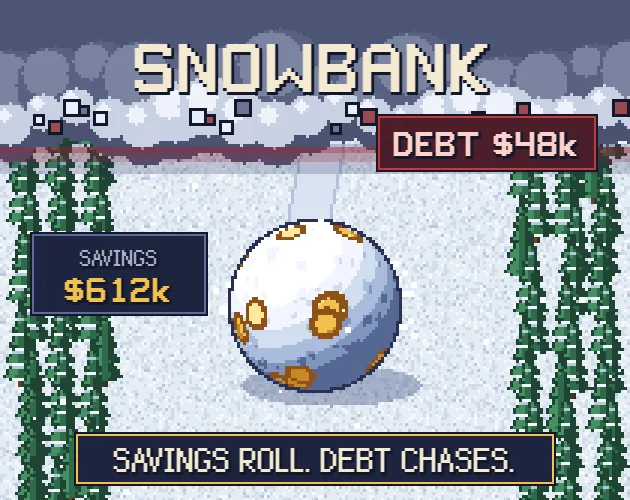
A three-minute arcade life where savings roll up like a snowball, card debt builds into an avalanche overhead, and every stall you touch costs or pays.
#11 this weekAI-assisted: Code, Graphics, Text
The game runs in this tab. No install, no account.
The short answer
SNOWBANK is a free browser arcade game made for Zoud GameLab's Make FinLit Fun theme. Steer a snowball downhill from age 22 to 67, gathering side income and memories while a 24 percent debt avalanche swells above. A life takes about three minutes, and the lodge receipt at the end shows where every dollar went.
What is SNOWBANK?
SNOWBANK is a short action-arcade interpretation of a working life, developed by CSAF — Core Systems Asset Factory for Zoud GameLab under the Make FinLit Fun theme. It runs as an HTML5 game in the browser and costs nothing to open. The premise is a mountain descent: the player steers one snowball from age 22 down to 67, and that ball stands for savings. It swells by itself through compound interest, receives a yearly addition on payday, and loses whatever gets spent.
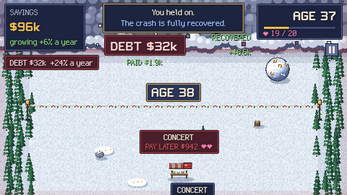
Above the ball hangs a second mass — card debt compounding at 24 percent a year. When that avalanche grows large relative to your pay, it catches you. One full life runs about three minutes and finishes at a lodge, where a receipt breaks down what paychecks contributed, what compounding added, what the card cost, and how many memories were collected. Those lines sum to a net worth figure. The rates are deliberately round illustrations of how compounding and borrowing behave rather than financial advice.
How to play
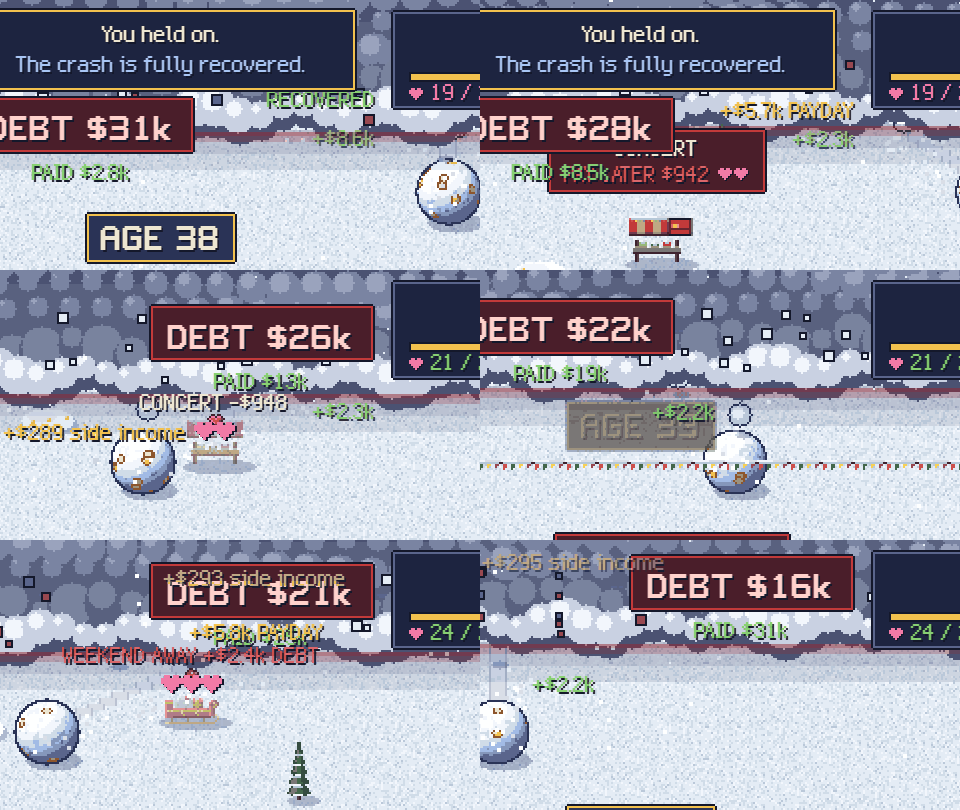
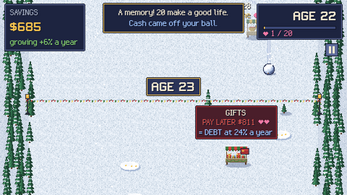
The core skill is steering and choosing. The slope is dotted with features that only matter if the ball rolls into them. Fresh powder delivers side income. Stalls sell memories, and their prices work two ways: some take cash straight off the ball, while others are pay-later purchases that land on the card and feed the avalanche overhead. Surprise bills arrive as a car repair, a hospital stay, or a lost job; savings cover what they can, and any shortfall joins the card balance.
Courses cost a little in the moment and raise your pay for the rest of the run, so early purchases pay back across decades of descent. Golden 10x ramps are scams that pull the ball toward them, and red SELL gates tug as well — roll through one and a paper loss becomes real. Market crashes shrink the snowball on paper, and it recovers if you keep holding instead of bailing out. At 67 the lodge ends the run with its receipt. The strongest ending requires a nest egg worth ten times a typical final salary plus twenty memories gathered, a combination a cautious saver who never buys anything cannot reach.
Controls
Steering accepts the mouse, the arrow keys, A and D, a finger drag on a touchscreen, or a gamepad stick. To fight the debt, hold the throw input — Space, a mouse button, the on-screen THROW button in touch play, or A on a gamepad — and snow is flung back up the mountain to knock the avalanche down. Pausing uses Esc, P, or the pause button, and M mutes the sound.
The bindings are few and immediate, which suits a run of roughly three minutes: one hand steers while the other holds throw whenever the mass above needs attention. Touch play pairs drag steering with a dedicated THROW button, so touchscreens are covered by their own scheme. That is the whole input set, and it is worth learning before the first descent begins.
| Input | Action |
|---|---|
| Mouse | Steer the snowball |
| Arrow keys | Steer the snowball |
| A / D keys | Steer the snowball |
| Touch drag | Steer the snowball |
| Gamepad stick | Steer the snowball |
| Space (hold) | Throw snow uphill to pay down debt |
| Mouse button (hold) | Throw snow uphill to pay down debt |
| A on a gamepad (hold) | Throw snow uphill to pay down debt |
| THROW button on touch (hold) | Throw snow uphill to pay down debt |
| Esc, P, or pause button | Pause |
| M | Mute audio |
Tips for your first run
Treat the avalanche as a running cost rather than a distant threat. Every year it compounds at 24 percent, so a few early throws are cheaper than a large catch-up later, and pay-later stalls quietly add to it at the worst moment. Courses are the opposite trade: a small cost now buys a permanently higher pay, which means the yearly payday addition is larger for every year that follows.
The other half of the problem is memory collection, since the best ending needs twenty of them alongside a nest egg of ten times a typical final salary. Spending on memories pulls money off the ball; hoarding money leaves the life bare. Balance is the actual game.
- Throw early and often so the avalanche never gets the chance to close the gap with your pay.
- Buy courses early, when there are still years left to benefit from the raise in pay.
- Read stall prices carefully: pay-later tags go on the card and grow at the debt rate.
- Steer wide of the golden 10x ramps, which are scams that drag the ball inward.
- Sit through market crashes instead of steering into a red SELL gate, where the loss stops being hypothetical.
- Budget for memories from the first minute, because twenty are needed for the strongest receipt.
Content and replayability
A life is a single descent of about three minutes, so the game is built for repeated short runs instead of length. Variety comes from what the ball touches: paying cash at a stall, deferring the price to the card, buying a course early, or refusing a scam ramp each push the final numbers in different directions. The receipt separates paychecks in, compounding added, card costs, and memories made, so a poor result is legible — you can see which line caused the damage and take another route.
Two targets sit behind the ending: a nest egg of ten times a typical final salary and a collection of twenty memories. Hitting both at once forces a working compromise between saving hard and living well, and that tension is what brings players back down the mountain. The game is singleplayer and presents one mountain rather than a set of chapters or modes.
Presentation and performance
The look is pixel art assembled from the studio's own asset packs. Snow, spruces, and the lodge come from one set; stalls, gifts, lamps, and bunting from another; coin, heart, and sparkle bursts from a third. That shared authorship keeps the slope visually consistent even though the artwork is generated by procedural code rather than drawn by hand.
The game discloses AI-generated content openly: the code and all text were written with AI tools, the pixel art comes from AI-written procedural code without an image model, and the score was composed and sequenced by AI-written code, then played through sampled instruments. There is no installed client to manage — it runs as an HTML5 frame in the browser, so pressing play is the whole setup, and a weak run costs only the three minutes it takes to finish.
Who should play it
SNOWBANK suits players who want a compact arcade loop with a point: a short run, a visible goal, and a number at the end that carries meaning. Anyone teaching or learning basic personal finance will recognise the shape of the lesson — savings compounding upward, card debt compounding faster, the cost of deferring payment, and the long payoff of raising income early. The inputs are simple enough for a curious beginner and the run is far too brief to feel like homework.
Players after a deep life simulator, a long campaign, or detailed financial modelling should look elsewhere; the figures are rounded illustrations of behaviour, not advice, and one descent is the entire structure. It also works as a conversation piece, since it was built for a financial-literacy jam theme, opens free in a browser, and ends with a receipt that gives a discussion something concrete to point at.
Screenshots
How we tested it
The build was loaded from games.debutplay.com in a headless Chromium session on ; the canvas started and no request was blocked. The guide was last checked on .
From the developer
Your savings are a snowball. Your debt is an avalanche. Steer one working life, from 22 to 67, down one mountain. The snowball is your savings, and it grows on its own as it rolls: that is compound interest, and you can watch it happen. Payday adds to it once a year. Everything you spend comes off it. Above you, your debt is an avalanche growing at 24% a year, and when it gets big next to your pay, it catches you. Hold THROW to fling your own snow back up the mountain and pay it down. Made for Zoud GameLab (theme: Make FinLit Fun). One life takes about three minutes. What you roll through Fresh powder: side income. Stalls: memories for sale. Some take cash, which comes off your ball. Others are PAY LATER: the price goes on the card and feeds the avalanche. You choose which ones you roll through. Surprise bills: a car repair, a hospital stay, a lost job. Your savings cover them if they can. If they cannot, the rest goes on the card.…
Frequently asked questions
Does SNOWBANK cost anything?
No. It is free to play and runs as an HTML5 game inside a browser, so there is no purchase step before pressing play.
How long does one run take?
A single life, from age 22 to 67, takes roughly three minutes, ending at the lodge with a receipt that totals your net worth.
Can it be played on a phone or tablet?
Touch drag steering and an on-screen THROW button are among the listed inputs, but the game is published as an HTML5 build, with no Android or iOS version listed.
Is SNOWBANK financial advice?
No. The 6 percent growth, 24 percent card interest, and 12 percent of pay saved are rounded, illustrative figures chosen to show how compounding and debt behave, not guidance for real money decisions.
What does the best ending require?
Two things together: a nest egg worth ten times a typical final salary and twenty memories collected. Saving without ever spending on memories will not produce it.
Does the game contain AI-generated content?
Yes, and it says so. Code and text were written with AI tools, pixel art comes from AI-written procedural code with no image model, and the score was composed and sequenced by AI-written code using sampled instruments.
What games are similar to SNOWBANK?
The closest matches on DebutPlay are Goblin And Glory, OVERSTACK, Accretion. They share the same genre, so the controls and the pace carry over.
Something wrong or missing? Tell us. How we test games.