Simulation · New game
Baba Records
A pixel-art shop sim about turning an unknown Istanbul record dealer into a name worth inviting to Utrecht in 60 days.
#21 this weekAI-assisted: Code, Graphics, Sound
The game runs in this tab. No install, no account.
The short answer
Baba Records is a retro pixel-art record store simulation. The player guides Aziz Üsküdar through 60 days of buying, pricing, and selling records in Istanbul, aiming for an invitation to Utrecht. A free browser demo covers the first five days, and the full game costs $1.99.
What is Baba Records?
Baba Records is a single-player simulation about a small Istanbul record shop and the dealer who runs it. Aziz Üsküdar has one aim: make the shop famous enough to earn a place at the biggest record fair in Utrecht. The calendar gives him 60 days, so every purchase, price, and display choice feeds a countdown toward that invitation.
The shop sits in a city with centuries of musical history, and the stock is built around records from many genres, pressings, and conditions. The work is commercial rather than abstract: buy records carefully, work out what they are worth, set prices, and keep shelves full for the customers who walk in. A free browser demo covers the first five days; the full game costs $1.99.
How to play
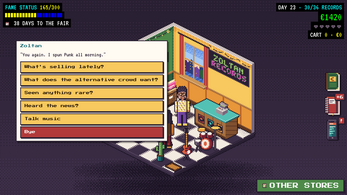
Play begins with the shop's survival. Records come from dealers around Istanbul, and each purchase needs a judgment about genre, pressing, and condition before it can be priced for the shelf. Collectors look for rarities, while casual shoppers chase familiar hits; punks, rap fans, metalheads, and goths each want something different, so the stock mix matters as much as the asking price.
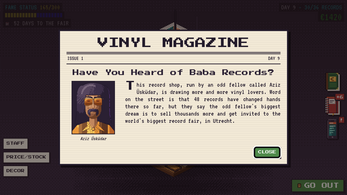
The buying network expands to auctions and travel. Auction lots arrive from Athens, London, Mumbai, Saigon, Ankara, and Izmir, and their outcomes are unpredictable. A Dead Man's Crate sends Aziz to a collector's home to grab up to six records within a 30-second window, then haggle with the family. The Record Mafia, the landlord, a stand at the town square Records Sale, artist signings, and Vinyl Magazine coverage all push the 60-day race forward.
Controls
Shop control is expressed through commercial decisions. The player sets prices, decides which records stay on the shelves, and chooses how to respond to the customers who arrive. Those choices connect directly to the 60-day goal: a shop that fills shelves with the wrong records or prices them badly will struggle to build fame for Utrecht.
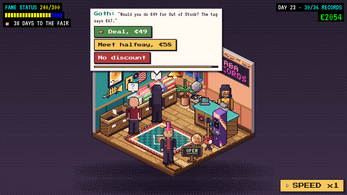
Several situations add tighter decision windows. A Dead Man's Crate allows up to six records to be gathered in 30 seconds before the haggling begins with the family. Auction lots require bids, and dealers, family members, and other shop visitors create negotiations around the stock. Decoration is another form of control because different décor attracts different kinds of customers. A stand at the town square Records Sale is another chance to put stock in front of buyers, and the shop's direction is shaped by pricing, stocking, bidding, haggling, and presentation.
The game page does not list its controls. Check the in-game tutorial or pause menu for the current scheme.
Tips for your first run
The 60-day limit rewards a clear routine. Start with the shop's cash flow: buy records at prices that leave room for profit, then price them for the customers most likely to want them. Rarities suit collectors, while hits suit casual shoppers, and the subcultural groups each have their own preferences. A shelf full of one type of record limits the shop's appeal.
Use the city's dealers for gossip and stock, but treat auctions as a separate risk. Lots from Athens, London, Mumbai, Saigon, Ankara, and Izmir can be unpredictable, so bidding needs discipline. The Dead Man's Crate is a short, sharp opportunity: six records in 30 seconds, followed by a haggle with the family. Keep the landlord satisfied and watch for the Record Mafia while building fame.
- Protect the 60-day deadline by tracking how each purchase supports the Utrecht invitation.
- Stock for collectors, casual shoppers, punks, rap fans, metalheads, and goths rather than one audience.
- Use décor deliberately; different decoration attracts different customer types.
- Sell enough records by an artist to open the chance of a signing and Vinyl Magazine coverage.
- Take the town square Records Sale stand when it can move stock and raise the shop's profile.
Content and replayability
Baba Records packs a lot of shop life into a 60-day frame. The record pool spans genres, pressings, and conditions, so pricing is not a single formula. Customers divide into collectors, casual shoppers, punks, rap fans, metalheads, and goths, and each group gives the shelves a different purpose. The buying side stretches beyond Istanbul through auctions in Athens, London, Mumbai, Saigon, Ankara, and Izmir.
Events keep the routine from becoming static. A Dead Man's Crate creates a 30-second collection dash and a family negotiation. The Record Mafia and the landlord add pressure, while a town square Records Sale stand offers another way to reach buyers. Artist signings and Vinyl Magazine coverage turn strong sales into reputation. Decoration changes which customers the shop attracts, so two shops can develop different identities within the same 60-day structure. The artist names, albums, records, and brands are fictional parodies, which keeps the collecting theme intact without relying on real catalogues.
Presentation and performance
Baba Records uses retro pixel art to frame an Istanbul shop full of records, customers, and street-level dealings. The setting leans on the city's centuries of musical history, with hidden gems and a dealer culture built around gossip, auctions, and the search for the right pressing. The opening jingle is an 8-bit arrangement of Üsküdar'a Gider İken, a traditional Istanbul folk tune, and the background music was made with Suno.
The release covers HTML5, Windows, and macOS. A free browser demo runs the first five days, while one purchase includes the Windows 10/11 64-bit installer or portable build and a macOS 13 or later version for Apple Silicon or Intel. The HTML edition opens locally in a browser, with Chrome or Edge recommended, and saves are kept in browser storage; clearing browser data deletes them. The build is unsigned, so the first launch may show a system warning. The small indie team credits Panic with game design, Peach with art direction, and notes the use of AI tools in code and asset work from its own creative direction.
Who should play it
Baba Records is aimed at players who enjoy shop management, pricing decisions, and collecting records. The 60-day race to Utrecht gives the simulation a clear goal, while the mix of collectors, casual shoppers, and subcultural customers gives each sale a bit of character. The retro pixel-art look and music theme strengthen that appeal.
The free browser demo is the natural starting point because it covers the first five days and asks for no purchase. Players who want the full run can buy the game for $1.99 and continue toward the Utrecht invitation. The game is single-player and built around buying, pricing, haggling, decorating, and reputation. Anyone intrigued by record dealers, Istanbul's musical history, auctions, or the Dead Man's Crate mechanic has a clear reason to try the demo first.
Screenshots

How we tested it
The build was loaded from games.debutplay.com in a headless Chromium session on ; the canvas started and no request was blocked. The guide was last checked on .
From the developer
Aziz Üsküdar has one dream: to take his little Istanbul record shop, Baba Records, to the world’s biggest record fair in Utrecht. The trouble is, nobody has heard of Baba Records yet, and he has just 60 days to make a name for himself. In this retro pixel-art record store game, you are Aziz Üsküdar: a record dealer in Istanbul, a city with centuries of musical history and plenty of hidden gems waiting to be found. What awaits you at Baba Records? Buy low, sell high! Dig for records of every genre, pressing and condition, find out what they’re worth, set your prices and keep your shelves full.Know your customers. Collectors want rarities and casual shoppers want the hits, while punks, rap heads, metalheads and goths are always digging for something different.Chase records around the world. Make the rounds of the city’s record dealers and pick up their gossip, or bid on unpredictable auction lots from Ankara and Izmir to Athens, London,…
Frequently asked questions
What is the goal in Baba Records?
Aziz Üsküdar needs to build enough fame for Baba Records to earn an invitation to the biggest record fair in Utrecht within 60 days. Buying, pricing, stocking, and reputation-building all feed that deadline.
Is there a free demo?
A free browser demo covers the first five days and runs without a purchase; the full game costs $1.99.
Which platforms are supported?
The listed platforms are HTML5, Windows, and macOS. The Windows build is for Windows 10/11 64-bit, and macOS support starts at macOS 13 for Apple Silicon or Intel.
How long is the main challenge?
The shop has 60 days to earn the Utrecht invitation. The demo covers the first five of those days.
What happens in a Dead Man's Crate?
It sends Aziz to a collector's home to gather up to six records in 30 seconds, then haggle with the family for the best price.
Which customers visit the shop?
Collectors seek rarities, casual shoppers want hits, and punks, rap fans, metalheads, and goths look for different records. Décor choices also attract different customer types.
What games are similar to Baba Records?
The closest matches on DebutPlay are Attract Mode, Rooftop, Piastland. They share the same genre, so the controls and the pace carry over.
Something wrong or missing? Tell us. How we test games.