Browser games · New game
Beachside café
A sunset merge puzzler where beachgoers order dishes built from scratch, with 220 recipes hidden behind fourteen-level ingredient chains.
#35 this weekAI-assisted: Code, Graphics, Sound, Text
The game runs in this tab. No install, no account.
The short answer
Beachside Café is a free pixel-art merge game set at a seaside serving window, where matching ingredients across four families builds dishes for waiting customers. Two hundred and twenty recipes hide behind fourteen-level chains, coins feed a gem-and-energy loop, and the whole thing runs in a browser with no ads or in-app purchases.
What is Beachside Café?
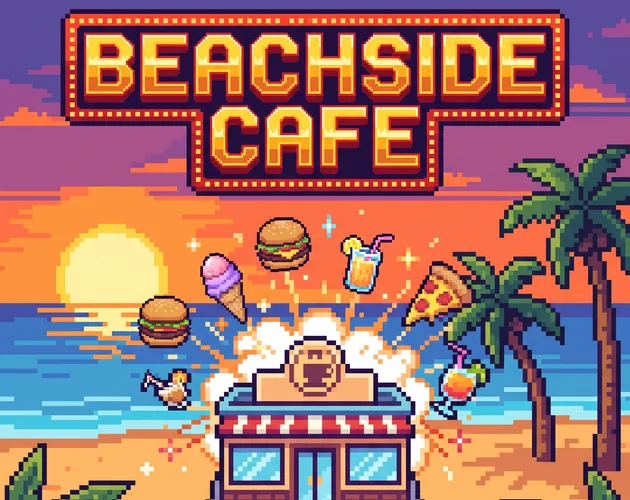
Beachside Café opens as the sun drops toward the water. Waves roll in, a serving window faces the sand, and hungry beachgoers queue up outside it. Every arrival wants something specific, and the kitchen's job is to build that dish from raw ingredients rather than pick it off a menu.
The work happens on a merge board. Matching ingredients combine and climb through fourteen tiers, starting from a single seed and topping out at a Prismatic Rainbow Basket. Four families sit on that board, produce, bread, dairy and protein, and each of them feeds into the plates customers are waiting for.
It costs nothing to start. There are no ads and no in-app purchases inside the game, and the developer asks only that anyone who enjoys it consider a voluntary $2.99 contribution toward future projects. That combination, a full merge loop with nothing locked behind a payment, is the entire pitch.
How to play
A session begins by dragging matching items together. Two of the same ingredient become one of the next tier, and that ladder runs fourteen steps deep, from a seed up through the ranks to the Prismatic Rainbow Basket at the top of a chain.
Ingredients alone do not finish an order. The customer's request goes onto the cutting board, a tap serves it, and only then does the finished dish appear. A tomato, a burger bun, cheese and a beef patty resolve into a cheeseburger, which is the cleanest demonstration of how board output turns into food.
Food sources matter as much as the food itself. A source starts as a humble basket and grows into things such as floating orchards and crystal creameries, and charging one pulls ingredients from higher up its chain instead of the bottom.
Served customers celebrate before the next arrival takes their place at the window. A tutorial covers the first visit, and ten save slots are available if more than one person shares the same browser.
Controls
The board runs on three gestures, and between them they cover merging, charging and serving. Dragging one item onto a match combines the pair into the tier above, which is the move repeated most often in any session.
Holding on a food source charges it. The ingredients that come out after a charge sit higher up that source's chain, so the length of the press changes what the kitchen receives.
Tapping finishes an order. Once the requested item rests on the cutting board, a tap on the waiting customer serves it and the dish is revealed.
The tutorial walks through those gestures on the opening board, so the effort goes into learning which families to merge and which sources to charge rather than into the input itself.
| Input | Action |
|---|---|
| Drag | Combine matching ingredients into the next tier |
| Press and hold | Charge a food source so it releases higher-level ingredients |
| Tap | Serve the item on the cutting board to the waiting customer |
Tips for your first run
The biggest shortcut on any board is the charge. A source left to charge hands over ingredients from higher up its chain, which saves a stack of low-tier merges that would otherwise be spent climbing to the same place.
The currency side is a closed loop rather than a one-way spend. Coin stacks combine into gems, gems combine into energy, and energy can be turned back into coins, so nothing is wasted as long as it keeps moving. Known combinations are worth memorising early, because the same logic carries across families.
- Charge a food source before pulling from it, and the ingredients arrive several tiers higher than a fresh pull.
- Keep the coin, gem and energy chain circulating in both directions instead of hoarding one tier.
- Rebuild familiar recipes such as tomato, burger bun, cheese and beef patty to learn how the cutting board reads a set of ingredients.
- Follow the tutorial on the first board, since the fourteen-level climb is easier once the merge rule is automatic.
- Open separate save slots when more than one person uses the same browser.
Content and replayability
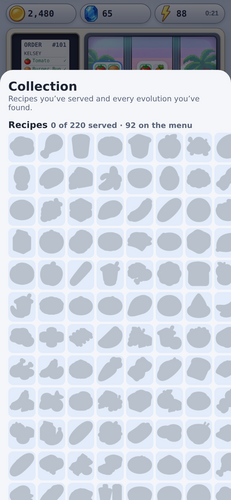
The headline number is 220 recipes, forty-five of which are marked as premium dishes. The range runs from something as plain as fried eggs all the way to the legendary Prismatic Mastery Feast, and the collection is the long game: each plate only appears once a customer has been served.
Behind that list sit four ingredient chains and four food source chains, each one reaching fourteen levels. That symmetry means a player is always working two ladders at once, growing the source that produces an ingredient and growing the ingredient that completes a dish.
Ten save slots stretch the game further than a single household would need, and because there are no ads or in-app purchases, the pace is set entirely by how the board is played. Anyone who likes filling a collection will find plenty left to uncover after the first few dishes.
Presentation and performance
The look is pixel art, backed by an original soundtrack built to stay calm while the board fills up. Haptics, sparkle effects and rainbow explosions sit on top of the merges and the dish reveals, giving the bigger combinations a bit of weight.
An HTML5 build plays in the browser without an install, and downloads exist for Linux and Android for anyone who would rather keep the game off a tab.
The beach setting does a lot of work for the mood. Sunset light, rolling waves and celebrating customers keep the screen from feeling like a spreadsheet of ingredients, which matters in a genre where the loop itself is repetition.
Who should play it
This is for players who already know the pull of a merge board and want one without the interruptions. No ads, no in-app purchases and no paywall sit between a player and the next tier, which is the whole reason the developer built it.
It also suits anyone who wants something gentle in a browser tab. The soundtrack is deliberately chill, the setting is a sunset beach, and the goal is a filled menu rather than a score or a timer.
Players chasing reflex-driven action should look elsewhere, because the challenge here is planning which source to charge and which family to push next. Dedicated collectors are the best fit: with 220 dishes and forty-five premium plates, the menu is long enough to keep returning to.
Screenshots
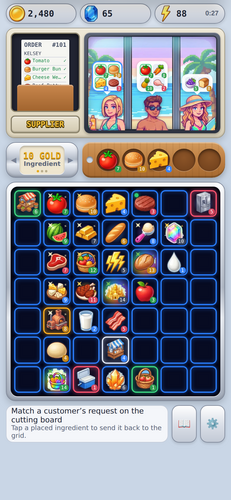
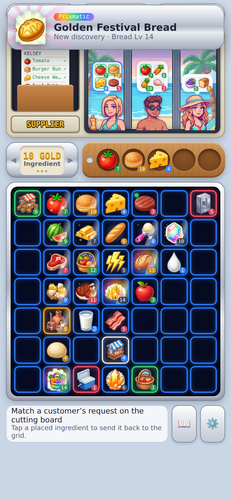
How we tested it
The build was loaded from games.debutplay.com in a headless Chromium session on ; the canvas started and no request was blocked. The guide was last checked on .
From the developer
Welcome to Beachside Café! 🌴🍔 The sun is setting, the waves are rolling in, and hungry beachgoers are lining up at your window. Each one wants something special, but you won't know what dish they're dreaming of until you serve it! Merge your way to the perfect order Drag matching ingredients together to evolve them through 14 levels, from a single seed to a Prismatic Rainbow Basket. Four ingredient families (produce, bread, dairy and protein) all build toward something amazing. Fill the board, reveal the dish Place what your customer asks for on the cutting board, tap them to serve, and watch the dish revealed. Tomato + burger bun + cheese + beef patty? Cheeseburger! With 220 recipes to uncover, from fried eggs to the legendary Prismatic Mastery Feast, there's always something new on the menu. Power up your kitchen Grow your food sources from a humble basket into floating orchards and crystal creameries. Press and hold a source to…
Frequently asked questions
Is Beachside Café free to play?
Yes. It costs nothing to start, and there are no ads or in-app purchases inside the game itself. The developer invites anyone who enjoys it to consider a voluntary $2.99 contribution that supports further development.
Where can Beachside Café be played?
In a browser, through an HTML5 build that needs no install. Downloads are also available for Linux and Android.
How many recipes are there?
Two hundred and twenty, and forty-five of them are premium dishes. The list runs from simple fried eggs to the legendary Prismatic Mastery Feast, and each plate only appears once a customer has been served.
How do you serve a customer?
Place the requested item on the cutting board and tap the customer at the window. The dish is revealed at that point, which is how the recipe list fills in over time.
How many save slots are there?
Ten. Separate slots make it straightforward for more than one person to keep their own board running in the same browser.
Is there a tutorial?
Yes. A tutorial covers the opening board, which helps because the merge ladder runs fourteen levels deep and the first food source begins as a plain basket.
What games are similar to Beachside café?
The closest matches on DebutPlay are Blue and Gray Command: Battles of the American Civil War 1861-1865, DEEPCORE, Pixel Descent. They share the same genre, so the controls and the pace carry over.
Something wrong or missing? Tell us. How we test games.