Strategy · New game
Bloodline: Vampire Dynasty
A turn-based vampire dynasty sim that starts in 1350 and runs one decade at a time to 2030, with a family tree of individual undead and eight possible endings.
#1 this weekAI-assisted: Code, Text
The game runs in this tab. No install, no account.
The short answer
Bloodline: Vampire Dynasty is a single-player, turn-based strategy and management game about steering a vampire house from plague-era villages to the modern world. Each turn covers a decade, and every relative on the tree is a tracked individual with attributes, traits and a history. Play it for the long game: careful Embraces, guarded secrecy and one of eight endings.
What is Bloodline: Vampire Dynasty?
Bloodline: Vampire Dynasty is a turn-based strategy and simulation game about one vampire house. It opens in 1350 with your character's Embrace and runs to 2030, advancing a single decade per turn for a total of 68 turns. It is priced at $4.99 and plays as an HTML5 game inside a browser.
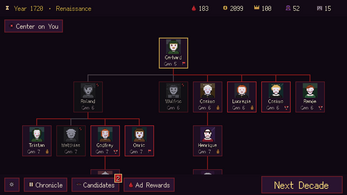
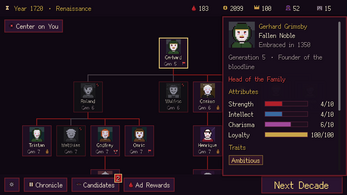
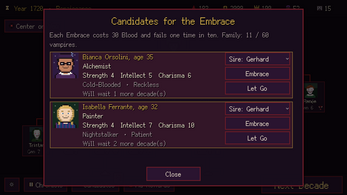
The centre of the game is the family tree. Every vampire on it is an individual with a procedurally generated pixel-art portrait, attributes, traits and a personal history of their own. You decide which mortals are Embraced and which of your childer takes on the role of sire, so the shape of the tree comes from your choices rather than from a script. Loyalty is not fixed: some relatives drift, and the tree shows you whose commitment is starting to slip.
Each decade you send family members out to hunt, trade, spy, guard your domains, expand your territory or study forbidden arts. Five concerns pull against each other — blood, wealth, renown, secrecy and land. A family that goes hungry starts making mistakes, while one that becomes famous draws the attention of hunters.
How to play
The loop is simple to describe and tense to play. You pick a vampire from the tree, look at who they are, and give them a job for the coming decade. Six decade tasks are available, covering hunting for blood, trading, spying, guarding what you already hold, pushing into new territory, and studying forbidden arts. When every assignment is set, the decade resolves and ten years pass.
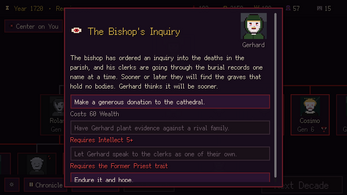
Which vampire you send matters beyond raw numbers, because events are written to depend on the person you dispatch. More than 120 hand-written events are spread across four eras, from the Black Death through the industrial age to the modern world, and the same situation can play out differently depending on the envoy standing in front of it.
Resources are the other half of the puzzle. Blood keeps the family fed, wealth buys room to manoeuvre, land extends your reach, secrecy keeps hunters off your trail, and renown is a double-edged measure of standing. Old enemies carry grudges for generations, so a mistake made in one century can return in another.
Failure is not always the end. If your head of house falls, an heir can take the throne and continue the dynasty, which keeps a bad decade from erasing a long lineage.
Controls
Input is entirely pointer-based. Click a vampire to open their details and hand them a task for the current decade; that single click covers both inspection and assignment. Dragging moves the family tree around the screen, and the mouse wheel zooms in and out, which matters once the branches grow deep.
The whole system is mouse and touch friendly and needs no keyboard at all. On a touch screen, tapping stands in for clicking, and a pinch replaces the wheel for zooming. Time does not run on its own: the Next Decade button is what pushes the dynasty forward ten years, so you can read every portrait and history entry before committing.
A short guided tutorial runs on your first game, which is the fastest way to learn where tasks are assigned and how the decade resolves. Progress is auto-saved, so closing the tab and coming back later picks the same dynasty up again.
| Input | Action |
|---|---|
| Mouse click on a vampire | Open details and assign a task for the decade |
| Mouse drag | Move the family tree around the screen |
| Mouse wheel | Zoom the family tree in and out |
| Touch tap | Select a vampire and assign a decade task |
| Touch pinch | Zoom the family tree |
| Next Decade button | Advance time by one decade |
Tips for your first run
Treat the first few decades as a lesson in restraint. Blood is the resource that punishes neglect fastest, since a hungry family makes mistakes you did not plan for, so keep a hunt scheduled rather than letting the household run dry while you chase territory.
Secrecy and renown work against each other, and the early game is a bad time to be interesting. A famous house attracts hunters, while a quiet one keeps its options open. Expansion and study are worth pursuing, but they are easier to fund once the blood supply is steady.
Pay attention to the envoys rather than only the assignment. Events respond to who you send, so a spy with the wrong temperament is a risk even when the task itself looks routine. The loyalty column on the tree deserves the same attention: a relative whose commitment is slipping is a problem that will not fix itself.
- Schedule hunting before blood runs short; hunger causes mistakes.
- Keep renown low early, because fame brings hunters.
- Match envoys to events rather than filling tasks mechanically.
- Watch relatives whose loyalty is visibly slipping.
- Use an heir to absorb the loss when a head of house falls.
- Play the guided tutorial once to learn how a decade resolves.
- Zoom in on the tree regularly to catch new details on older vampires.
Content and replayability
The game ships with four bloodlines and five origins, and each bloodline is meant to offer its own strengths and its own way of playing. Legacy points earned in any run unlock further bloodlines, so a finished dynasty feeds the next one rather than being thrown away.
The event set is the backbone of the replay value: more than 120 hand-written events split across four historical eras, with outcomes that shift depending on the family member you send. Because the tree itself is generated — every vampire and every candidate gets a procedural pixel-art portrait — no two houses look alike even when the beats of history repeat.
There are eight endings to find, ranging from a hidden dynasty that rules the night to a world that learns vampires are real. Since a campaign spans 68 decades from 1350 to 2030, the endings are the product of accumulated decisions about who was Embraced, who was trusted and how much was spent on staying unseen.
The whole thing is a single-player experience, and the interface is available in seven languages: English, Simplified Chinese, Spanish, Brazilian Portuguese, German, French and Russian.
Presentation and performance
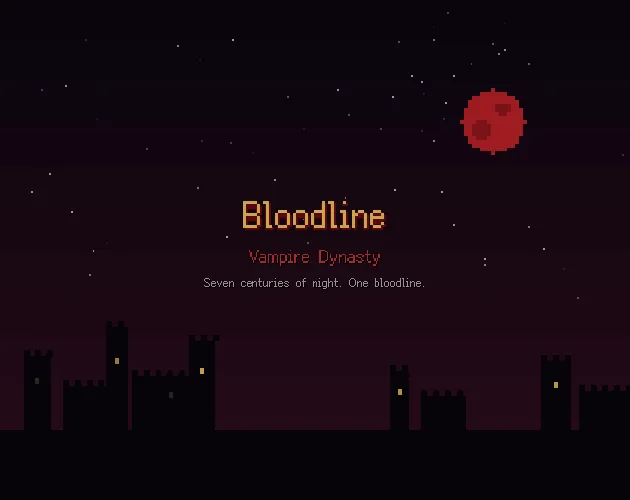
The look is pixel art, with a gothic mood across the centuries and procedurally generated portraits giving every vampire and every Embrace candidate a face of their own. Four screenshots accompany the release, showing the family-tree view where most of the game happens.
Audio is credited to two OpenGameArt pieces released under CC0: Dark Forest Theme by cynicmusic and Dungeon Ambience by yd. The text uses the Fusion Pixel Font under the SIL Open Font License, and the project is built in the Godot Engine and delivered as an HTML5 build, so nothing needs installing to start playing.
Auto-save is the practical detail that matters most for a browser game of this length. With 68 turns to get through, being able to close the tab and continue the same dynasty later removes the pressure to finish a run in one sitting. The camera work is handled by dragging and zooming the tree, which keeps the growing diagram navigable without any keyboard input.
Who should play it
This is a game for people who like management systems with long horizons. Sixty-eight turns from 1350 to 2030 means the payoff is gradual: a carefully placed Embrace in one century can be the thing that saves the house in another, and events that depend on individual envoys reward players who track personalities rather than just numbers.
Fans of gothic and historical settings will find the four-era structure doing real work, moving from plague-ridden villages to industrial cities and on to the modern world. Players who enjoy choice-driven consequences — hunters remembering your name across generations, loyalty that can quietly rot — are the target audience here.
It suits patient, turn-based play rather than anything reactive. Time only moves when the Next Decade button is pressed, so there is no clock running against you while you read a portrait or compare two candidates for an Embrace. Anyone who wants a single-player dynasty project they can return to across several sessions will find the auto-save and the legacy unlocks pulling in the same direction.
Screenshots
How we tested it
The build was loaded from games.debutplay.com in a headless Chromium session on ; the canvas started and no request was blocked. The guide was last checked on .
From the developer
Seven centuries of night. One bloodline. It is 1350, and you have just been Embraced. Lead your vampire house through 68 decades of history, from plague-ridden villages to neon cities, and decide who joins the family, who rules it, and how far you will go to keep it hidden. Build a dynasty. Every vampire in your family tree is a person, with a portrait, attributes, traits and a history of their own. Choose which mortals to Embrace and which of your childer sires them. Watch the tree grow deep, and watch for the ones whose loyalty is slipping. Every decade counts. Send your family to hunt, trade, spy, guard your domains, expand your territory or study forbidden arts. Balance blood, wealth, renown, secrecy and land: a hungry family makes mistakes, and a famous one attracts hunters. Live through history. More than 120 hand-written events across four eras, from the Black Death to the industrial age and the modern world, with choices that…
Frequently asked questions
How much does Bloodline: Vampire Dynasty cost?
It is priced at $4.99. It runs as an HTML5 game in a browser, so play starts from the page rather than from an installed client.
How long is a campaign?
A full run covers 68 decades, one per turn, from 1350 to 2030. Time only moves forward when the Next Decade button is pressed.
What happens if the head of the house dies?
An heir can take the throne and carry the dynasty on. A fallen leader does not automatically end the run, which softens the cost of a bad decade.
Does the game save progress?
Yes. It auto-saves, so you can close the tab and return later to continue the same dynasty rather than restarting from the beginning.
Which languages are supported?
Seven: English, Simplified Chinese, Spanish, Brazilian Portuguese, German, French and Russian. The interface is mouse and touch friendly and requires no keyboard.
How many endings are there?
Eight, ranging from a hidden dynasty that rules the night to a world that discovers vampires are real. Which one you reach depends on how the house is run.
What games are similar to Bloodline: Vampire Dynasty?
The closest matches on DebutPlay are Riviera Rivals, Ahead of the Lines – Vor den Linien, Deuce Agency (Demo). They share the same genre, so the controls and the pace carry over.
Something wrong or missing? Tell us. How we test games.