Strategy · New game
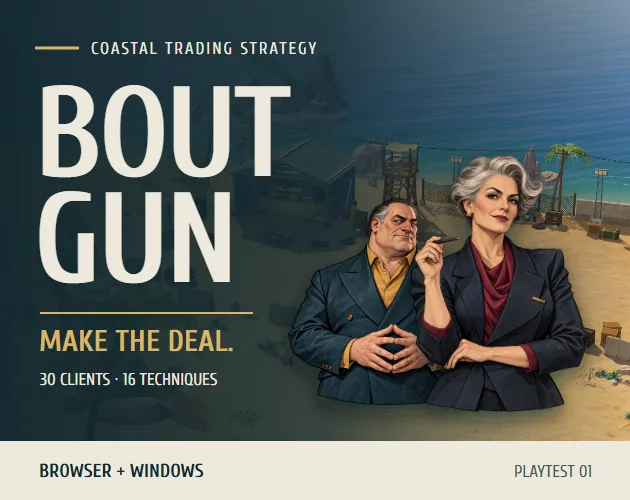
BOUT GUN
A coastal trading hub, thirty clients and a signature that decides every deal: here is what to expect before the first offer lands.
#52 this weekAI-assisted: Code, Graphics
The game runs in this tab. No install, no account.
The short answer
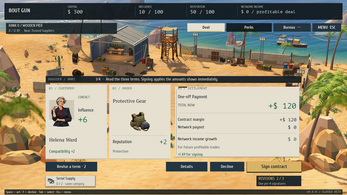
BOUT GUN is a single-player incremental trading strategy set at a fictional coastal arms-trading hub. Customers bring offers made of three parts: who they are, what the order contains and the price that follows. Read the terms, revise awkward clauses with limited revisions, then sign or decline. Deals settle immediately and network income follows profitable trades.
What is BOUT GUN?
BOUT GUN is a single-player incremental trading strategy built around a signature. The setting is a fictional coastal arms-trading hub, and the job is to read offers carefully enough to judge what each one is really worth. Every customer arrives with three things attached: their identity, the order itself and the price that follows it.
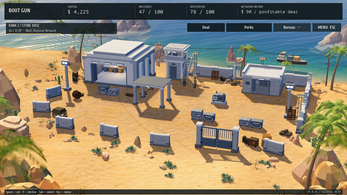
The long game is growth rather than a single windfall. Capital, influence, reputation and a network all build over time, and a stronger network makes the next profitable deal count for more. Clients are the raw material: thirty of them exist to be met, each with a dossier that opens up through encounters. Trading ranks track the climb from a modest outpost toward an established hub.
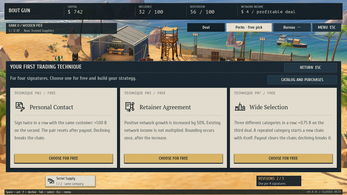
Mechanically it leans on combination rather than reflex. Sixteen trading techniques can be unlocked and then arranged together, so the interesting question is which ones reinforce each other on a given offer. Deals settle immediately, which keeps the loop tight: read, decide, move on. The current build is a first-chapter beta still in development, and it is free to play.
How to play
Each negotiation starts with a customer, moves to an order and only then arrives at a price. Read the terms in that sequence instead of jumping to the number, because the consequences of signing are laid out before the signature is given. That is the whole game in miniature: a decision made with the information in front of you.
Awkward offers are not automatically refusals. A revision can be spent to replace one part of a deal that does not sit right, turning a bad-looking contract into a workable one. Revisions are a resource, so the judgment call is whether an offer deserves one or whether a flat decline is the cleaner answer.
Progress is decision-driven. Deals settle immediately, and network income arrives alongside profitable trades, so earnings follow good judgment rather than patience alone. There is no requirement to rush a difficult offer; reading slowly is allowed, and so is signing quickly when the numbers are obvious. Play happens in a browser or on Windows.
Controls
Input is mouse and keyboard on desktop. Moving the mouse selects and inspects elements on screen, Space reveals an offer or signs it, F declines, Tab navigates between parts of the interface, and Esc opens the menu or steps back. Those five bindings cover the whole negotiation loop.
Browser play needs a desktop browser with WebGL 2 support. The Windows build arrives as a ZIP that should be extracted in full before launching BOUT-GUN.exe, so running the executable from inside the archive is not the intended route. Progress is saved locally, and browser and Windows saves are kept separate from one another.
Because an offer is inspected rather than skimmed, it helps to use Tab deliberately when comparing the parts of a contract, and to keep Esc in mind as the way back out of any menu. Inspecting an element costs nothing, so there is no reason to sign before the terms have been read.
| Input | Action |
|---|---|
| Mouse | Select and inspect interface elements |
| Space | Reveal an offer or sign it |
| F | Decline an offer |
| Tab | Navigate the interface |
| Esc | Open the menu or go back |
Tips for your first run
The opening chapter is deliberately short and practical, and the earliest deals teach the reading habit that everything later depends on. Treat those first offers as practice in the sequence rather than as profit opportunities to be maximised.
- Read the customer, then the order, then the price. Skipping to the number hides what the signature actually commits to.
- Save revisions for offers where one part is genuinely awkward, since a revision replaces a single part rather than the whole deal.
- Check the dossier of every new client you meet; thirty of them exist and encounters are how those details surface.
- Favour profitable settlements over sheer volume, because network income arrives with profitable trades rather than with signatures alone.
- Pair techniques on purpose: sixteen are unlockable, and the value lies in which ones work together on a given offer.
- Remember that browser progress lives in that browser, and clearing site data removes it.
Content and replayability
Content is organised around people and combinations. Thirty clients each carry a dossier revealed through encounters, so meeting them is itself a form of progress. Sixteen trading techniques form the build space, and choosing which of them work together is where runs start to diverge.
Structure comes from rank. Climbing the trading ranks turns a modest outpost into an established hub, and the coast grows alongside it. Because deals settle immediately and income ties to profitable trades, the loop rewards sharper decisions rather than longer sessions.
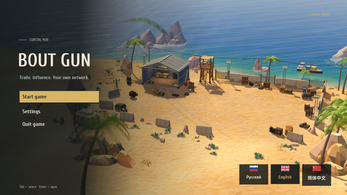
The current release is the first-chapter beta, a playtest build still in development, so the fair framing is that this is an opening slice rather than a finished campaign. It ships with a short practical introduction, local saving, instrumental lo-fi music and interface text in English, Russian and Simplified Chinese. Feedback on early deals, readability and trading combinations is explicitly invited.
Presentation and performance
The look is low-poly and the setting is a coastal trading hub, which suits a game about growing an outpost into something established. Menus and offers do the heavy lifting, so readability matters more than spectacle, and readability is one of the areas testers are asked to comment on.
Sound is instrumental lo-fi: Keeping Cool, Laundry On The Wire and Windows Down by HoliznaCC0, released under CC0. Interface sounds come from Kenney, also CC0, and third-party notices are bundled with the game. The engine is Godot.
Performance notes are narrow but specific. Browser play requires a desktop browser that supports WebGL 2, and the Windows download needs extracting before BOUT-GUN.exe behaves as intended. Saves are local and split between browser and Windows, and browser progress disappears if site data is cleared.
Who should play it
This is a game for players who enjoy reading a contract more than clicking through a fight. The pleasure sits in weighing a customer, an order and a price, then deciding whether the deal deserves a signature, a revision or a decline. Anyone drawn to incremental management, trading and slow-burn reputation building is the audience here.
It also suits players who like systems with edges. Sixteen techniques and the puzzle of which ones combine well give tinkerers something to pull apart, while thirty client dossiers give completionists a reason to keep meeting people. Patience is rewarded; reflex is not.
Two caveats belong up front. It is a beta in development, so the content on offer is the first chapter, and it is built for desktop browsers with WebGL 2 alongside the desktop builds. Players who want a finished, lengthy campaign should weigh that. Players who enjoy shaping an early build and reporting what works about the deals should not.
Screenshots
How we tested it
The build was loaded from games.debutplay.com in a headless Chromium session on ; the canvas started and no request was blocked. The guide was last checked on .
From the developer
Thirty clients. Three terms. Your signature. A customer walks in. An order lands on your desk. The price follows. Read the terms, find the combination, and decide what your signature is worth. BOUT GUN is a single-player incremental trading strategy set at a fictional coastal arms-trading hub. Build capital, influence, reputation, and a network that makes your next profitable deal matter more. Make the deal your way Read every offer: customer, order, then price. See the consequences before signing.Change a term: spend a revision to replace one part of an awkward offer.Build combinations: unlock 16 trading techniques and choose which ones work together.Meet 30 clients: discover their dossiers through encounters.Watch the coast grow: climb the trading ranks and turn a modest outpost into an established hub. Deals settle immediately. Network income arrives with profitable trades, so progress comes from your decisions. Take your time…
Frequently asked questions
Is BOUT GUN free to play?
Yes, it is free. The build on offer is the first-chapter beta, which is still in development and described as playtest 01.
What does spending a revision do?
A revision replaces one part of an awkward offer before signing. It does not rewrite the whole contract, so the decision is whether a single awkward term is worth a revision or a decline.
How much content is in the current build?
There are thirty clients to meet with dossiers unlocked through encounters, sixteen trading techniques to combine, and trading ranks that track growth from a modest outpost to an established hub.
How are saves handled?
Saving is local. Browser and Windows saves are separate, browser progress stays inside that browser, and clearing site data removes it.
What is needed to play in a browser?
A desktop browser with WebGL 2 support. The Windows version arrives as a ZIP that must be fully extracted before BOUT-GUN.exe is launched.
Which languages are supported?
Interface text is available in English, Russian and Simplified Chinese.
What games are similar to BOUT GUN?
The closest matches on DebutPlay are Deuce Agency (Demo), Pax Libera, Wardens Of Eryndor. They share the same genre, so the controls and the pace carry over.
Something wrong or missing? Tell us. How we test games.