Puzzle · New game
Checkmate Protocol 2076
A free 3D browser chess game set over a neon skyline, with four AI strengths, local duels, 85 mate puzzles, a daily challenge, and an opening trainer.
#2 this weekAI-assisted: Code
The game runs in this tab. No install, no account.
The short answer
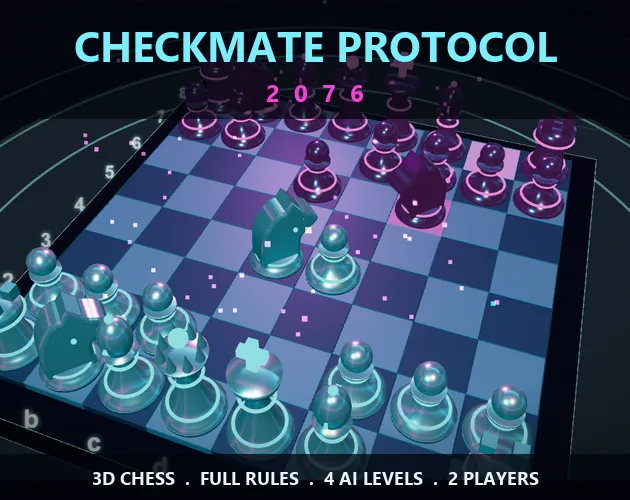
Checkmate Protocol 2076 is a free 3D chess game that runs in the browser. Players can face an AI at four strengths, share one screen in a local duel, solve 85 mate puzzles, take a daily challenge, and practise 26 named openings. The holographic board, chrome and glass pieces, and glowing megacity skyline make it a striking launch-day pick.
What is Checkmate Protocol 2076?
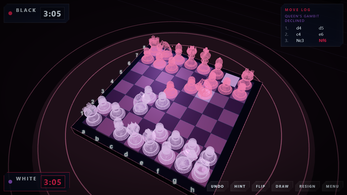
Checkmate Protocol 2076 is a 3D chess game played on a holographic board suspended above a glowing megacity. The pieces are rendered in chrome and glass, and the skyline stays visible while matches unfold. It runs in an HTML5 browser and is free to play, with an optional tip for players who want to support it.
The rules follow chess rather than a loose variation. Players can meet an AI opponent at four named strengths — Cadet, Pilot, Commander, and Admiral — or set up a local duel for two people on one screen. A side and a clock can be chosen before play: bullet, blitz, rapid, or no clock. Beyond matches, there are 85 checkmate puzzles, a daily challenge with a streak counter, and an opening trainer covering 26 named openings. The look can be changed with four themes, three piece sets, and three piece styles, while move hints and board labels add practical display options.
How to play
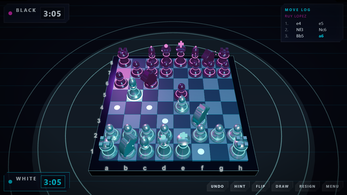
Start by choosing a match setup: play against the AI at Cadet, Pilot, Commander, or Admiral strength, or choose a local duel for two players sharing one screen. Pick a side and a clock type — bullet, blitz, rapid, or none. During a game, the full rule set is in force: castling, en passant, promotion with a chosen piece, check, checkmate, stalemate, the 50-move rule, threefold repetition, and draws for insufficient material. Clocks support increments, and the game provides undo, hints, a flip-view option, resign, and draw tools.
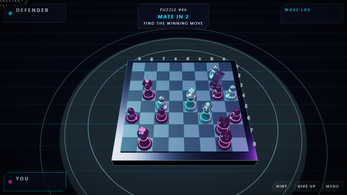
The puzzle mode contains 85 checkmate problems limited to mate in one and mate in two. Each puzzle was checked by brute force, and wrong moves are refused, so a player can think through a position and try again without losing the attempt. A daily challenge adds one new mate puzzle each day and tracks a streak. In the opening trainer, the book plays the opposing side across 26 named openings and warns when play leaves the line. The game also identifies the opening as a match proceeds. Against the AI, a rating and rank from Rookie to Grandmaster move up or down after each game; puzzles carry a separate rating.
Controls
Mouse, keyboard, and touch are all supported. To move, click a piece and then select the glowing square where it should go. Dragging rotates the camera around the board, the wheel or a pinch zooms in and out, and the view can be reset from the keyboard. The free camera makes it possible to inspect the holographic board from different angles above the megacity.
Keyboard shortcuts cover the most common actions: Z undoes a move, H shows a hint, F flips the board, R resets the camera, and Esc opens the menu. Touch input is supported alongside the mouse and keyboard. Board labels and move hints can be turned on in settings for extra guidance, while volume and graphics quality are also adjustable. The controls are simple enough that a first match can begin from the play button, but the shortcuts reward players who want to move through games and puzzles quickly.
| Input | Action |
|---|---|
| Mouse | Click a piece, then the glowing destination square; drag to orbit the camera and use the wheel to zoom. |
| Keyboard | Z undoes, H shows a hint, F flips the board, R resets the camera, and Esc opens the menu. |
| Touch | Touch input is supported; pinch to zoom. |
Tips for your first run
The first session can be as relaxed or as competitive as the chosen setup allows. A no-clock game leaves room to inspect the 3D board, and the Cadet AI provides a named starting point before moving to Pilot, Commander, or Admiral. Hints and undo are there for experimentation, so a mistake does not have to end the learning process.
- Use H for a hint and Z for undo when a position becomes unclear.
- Try mate-in-one puzzles before mate-in-two, since wrong moves are refused and the position stays available.
- Open the opening trainer and follow one of the 26 named lines until the book warns that play has left it.
- Check the daily challenge for one new mate puzzle and a streak counter.
- Turn on move hints and board labels if the holographic board feels busy at first.
- Flip the view with F or reset the camera with R when a different angle is needed.
Content and replayability
Checkmate Protocol 2076 carries a full chess rule set, which gives matches room for castling, en passant, promotion choices, checkmate, stalemate, the 50-move rule, threefold repetition, and insufficient-material draws. The AI has four strengths and calculates in the background, so the board does not freeze while it thinks. A local duel supports two players on one screen and uses an auto-rotating camera to make shared play easier. Clocks can include increments, and undo, hints, flip view, resign, and draw options are available during play.
The solo content extends beyond matches. There are 85 mate puzzles, split between mate in one and mate in two, each checked by brute force. The daily challenge supplies one new mate puzzle per day and keeps a streak count. The opening trainer covers 26 named openings, plays the other side, and flags departures from the chosen line; the game also names the opening during a match. Ratings add a longer-term layer: AI games move a player's rating and rank from Rookie to Grandmaster, while puzzles have a separate rating. Four themes, three piece sets, and three piece styles give the presentation several configurations. Online play is planned for when a server is available; the current feature set is built around AI games, local duels, puzzles, the daily challenge, and opening study.
Presentation and performance
The match takes place above a glowing megacity, with a holographic board and pieces rendered in chrome and glass. The skyline remains part of the view while the free camera orbits, zooms, and resets. Animated moves and capture bursts mark action on the board, a falling king appears at checkmate, and synth sound effects accompany play. All visuals are generated in code, and the browser synthesizes the audio.
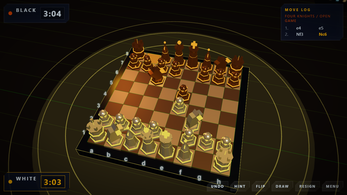
Performance measures are built into the presentation. The AI thinks in the background so the game does not freeze, and adaptive resolution helps keep play smooth. Players can adjust graphics quality and volume, choose among four themes — Cyber Cyan, Solar Flare, Crimson Void, and Aurora — and switch between three piece sets and three piece styles. Move hints and board labels are optional display aids. The overall look leans into cyberpunk chess rather than a plain tournament set, while the board remains central to castling, en passant, promotion, and the other rules. The game works with mouse, keyboard, or touch, and the camera controls support drag, wheel, and pinch input.
Who should play it
Players who want a chess game with a strong visual identity will find a clear match here: the holographic board, chrome and glass pieces, and glowing megacity setting are part of the appeal rather than an afterthought. The four AI strengths give solo players a named progression, and the rating and rank system from Rookie to Grandmaster adds a reason to return to AI matches. Puzzle players have 85 mate problems, a daily challenge, and a separate puzzle rating to work through.
The opening trainer makes the game useful for players who want to study 26 named lines with the book playing the other side. A local duel for two players on one screen, with an auto-rotating camera, suits shared play. The clock options — bullet, blitz, rapid, or none — let players choose a pace. Because it runs in an HTML5 browser and is free to play, it is easy to try; a tip is optional. Players looking for online competition should note that online play is planned for when a server is available, so the current mode is AI, local duel, puzzles, daily challenge, and opening study. The cyberpunk presentation also gives non-chess players a visual reason to try the 3D board.
Screenshots
How we tested it
The build was loaded from games.debutplay.com in a headless Chromium session on ; the canvas started and no request was blocked. The guide was last checked on .
From the developer
Checkmate Protocol 2076 is a full 3D chess game set above a glowing megacity: chrome and glass pieces, a holographic board and a skyline that never sleeps. Free to play, in your browser. If you enjoy it, you can leave a tip. PLAY - jump straight into a match.MODE - versus the AI (Cadet, Pilot, Commander, Admiral) or a local duel for two players on one screen; choose your side and a clock (bullet, blitz, rapid or none).PUZZLES - 85 checkmate puzzles (mate in 1 and mate in 2), each checked by brute force. Wrong moves are refused, so you can think and try again.DAILY CHALLENGE - one new mate puzzle every day, with a streak counter.OPENING TRAINER - learn 26 named openings move by move; the book plays the other side and tells you when you leave the line. The game also names the opening as you play it.SETTINGS - 4 themes (Cyber Cyan, Solar Flare, Crimson Void, Aurora), 3 piece sets (Classic, Mech, Alien), 3 piece styles (Chrome, Crystal,…
Frequently asked questions
Is Checkmate Protocol 2076 free?
Yes. It is free to play in a browser, and players who enjoy it can leave an optional tip.
What platforms and inputs are supported?
The game runs as an HTML5 browser title and works with a mouse, keyboard, or touch input.
Can two players share one screen?
Yes. Local duel is available for two players on one screen, with an auto-rotating camera.
How many puzzles are included?
There are 85 checkmate puzzles, covering mate in one and mate in two. Each puzzle was checked by brute force, and wrong moves are refused.
Is online multiplayer available?
Online play is planned for when a server is available. The current modes are AI matches, local duels, puzzles, the daily challenge, and opening training.
Does it include the full rules of chess?
Yes. Castling, en passant, promotion with a chosen piece, check, checkmate, stalemate, the 50-move rule, threefold repetition, and insufficient-material draws are all included.
What games are similar to Checkmate Protocol 2076?
The closest matches on DebutPlay are ECHO, Chem Grid, Exit 7. They share the same genre, so the controls and the pace carry over.
Something wrong or missing? Tell us. How we test games.