Puzzle · New game
Chem Grid
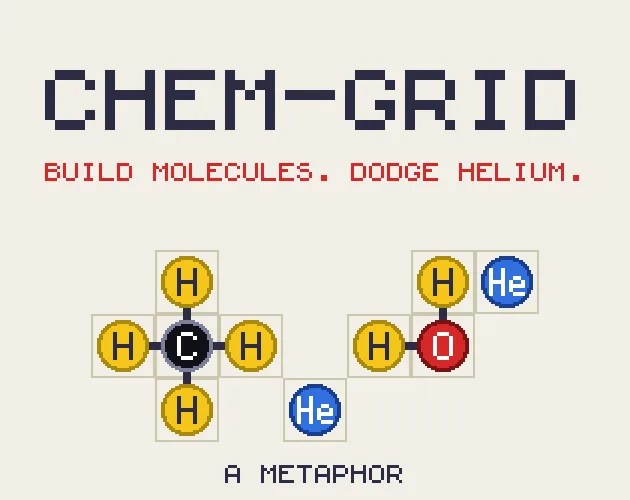
A free browser puzzle about rotating atoms, matching bonds on an 8x8 grid, and closing molecules before helium crowds the tray.
#1 this weekAI-assisted: Code, Graphics, Sound, Text
The game runs in this tab. No install, no account.
The short answer
Chem Grid is a free HTML5 puzzle game built around an 8x8 board. Players rotate atoms, align their bonds, and close molecules for scores, with helium adding pressure and twenty levels offering distinct goals. The mix of quick placement, named-molecule bonuses, and saved best scores makes it worth opening for one run or a score chase.
What is Chem Grid?
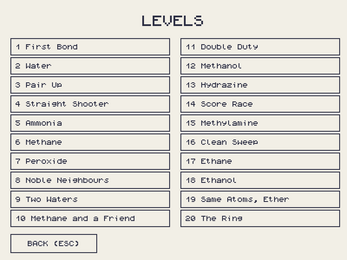
Chem Grid is a puzzle game set on an 8x8 board where atoms are placed so their bonds connect to another bond or to an empty square. The central loop is simple to read but tense to play: choose an atom, rotate it, drop it, and try to close a molecule. A completed molecule leaves the board and adds to the score. The game is free and runs as an HTML5 build. Two broad modes frame the play. Endless mode is a score chase with a changing tray and helium that consumes space. The level mode contains twenty puzzles, each with its own atom supply and a specific target, such as building a named molecule, hitting a score, spending the bag, or leaving almost nothing behind. Named molecules reward planning beyond the immediate fit. Methane, ammonia, water, propane, ethanol, and a cyclobutane ring are among the recognised structures. The board size keeps decisions compact, while the scoring bonus gives a reason to look for familiar shapes instead of merely filling gaps.
Best scores are stored in the browser, so the game has a light run-based structure even before the player starts chasing harder targets.
How to play
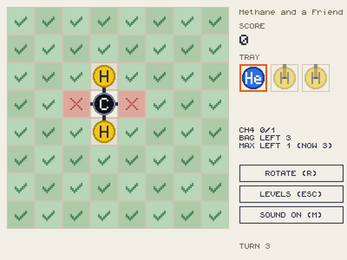
Play begins with an atom in hand. Select the atom, rotate it until its bonds point where the next connection should go, and click a square to commit. The square shows whether the current orientation works. A green check means the atom fits as it is, a yellow question mark means a rotation will make it fit, and a red cross means no rotation will work. The symbols use different shapes as well as colors, so the cue remains readable without relying on hue alone. Each atom has a fixed number of bonds: hydrogen has one, oxygen has two and can be straight or bent, nitrogen has three, and carbon has four. A bond must meet another bond or an empty square. When a molecule closes, it disappears and scores. The formula is total atom weight times bond count, and recognised molecules add a bonus. Helium complicates the tray. It has no bonds, cannot complete a molecule, and never leaves on its own, so it occupies space. While helium is in the tray, it must be placed before anything else.
In Endless, helium arrives every few placements and comes faster as the tray grows. Closing a molecule resets the helium countdown and lifts every helium atom one square; any helium on the top row escapes. Levels swap the score chase for a fixed supply and a stated objective.
Controls
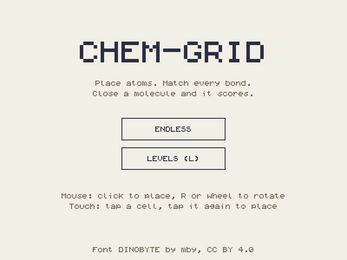
Controls are direct. A click on a square places the atom currently in hand. R or the mouse wheel rotates that atom. Esc opens the menu, and M mutes the game. Touch input uses a two-tap placement: tap a square to select it, then tap it again to place. A dedicated ROTATE button handles orientation on touch. The fit icons are part of the control layer rather than decoration: green check, yellow question mark, and red cross indicate whether the atom can go down immediately, after rotation, or not at all. Because the icons have distinct shapes, the feedback remains clear even when color is hard to distinguish. There is no need to memorise a long command list. The main decisions are which atom to use, how to turn it, and where to put it. The same controls cover the score-chasing Endless mode and the twenty level puzzles, so a player can move between them without relearning input.
| Input | Action |
|---|---|
| Mouse | Click a square to place the atom currently in hand. |
| Mouse wheel | Rotate the atom in hand. |
| R | Rotate the atom in hand. |
| Esc | Open the menu. |
| M | Mute the game. |
| Touch | Tap a square to select it, then tap it again to place it; use the ROTATE button to rotate the atom. |
Tips for your first run
The first run is mostly about learning to read the board before spending atoms. The placement icons are useful enough to slow down for: a yellow question mark is an invitation to rotate, while a red cross means the current atom should be held or redirected rather than forced. Recognised molecules are worth chasing because they add a bonus on top of the weight-times-bonds score. Keep an eye on the tray in Endless; the slot thresholds at 10,000, 20,000, 50,000, 100,000, and 200,000 points change how much room is available. Helium should be treated as a board-management problem, not a scoring piece: it has no bonds, never completes a molecule, and must be placed before other atoms while it sits in the tray. In levels, read the goal first and let it shape placement: a named molecule target is different from using up the bag or leaving almost nothing behind.
- Rotate before committing when a yellow question mark appears; the fit is there, but not in the current orientation.
- Look for recognised structures such as methane, water, ammonia, propane, ethanol, or a cyclobutane ring because they add a bonus.
- Close a molecule to reset the helium countdown and push every helium atom up one square; top-row helium then escapes.
- In Endless, plan around the tray slots and the faster helium arrivals that come as the tray grows.
- In levels, match each placement to the stated goal rather than taking the first fit.
Content and replayability
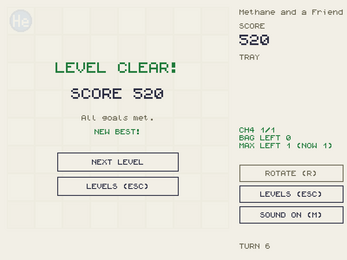
Chem Grid carries two content structures. The Endless mode is built for repeat runs: the tray starts with one atom, new slots appear at 10,000, 20,000, 50,000, 100,000, and 200,000 points, and the tray can reach six slots. Helium enters every few placements, with the pace increasing as the tray grows, so a high score requires both molecule building and space management. Closing a molecule resets the helium countdown and lifts helium one square; helium on the top row escapes. The twenty level puzzles are more curated, each with its own atom supply and goal. The goals include constructing a named molecule, reaching a score, using the entire bag, and leaving almost nothing on the board. Best scores are saved in the browser, including the best result for each level, which gives the level set a natural replay hook. Recognised molecules add another layer of mastery: ammonia, methane, water, ethanol, propane, and a cyclobutane ring are among the structures that pay a bonus.
The combination of a score chase, fixed puzzles, and saved personal bests makes the game suitable for short sessions and longer attempts at cleaner solutions.
Presentation and performance
Chem Grid presents its puzzle board in pixel art. Sound effects accompany play, and the visual and audio assets came from the Anvil of SPLORR!!, The Grumpy GameDev's own asset tools. The text uses DINOBYTE by mby under CC BY 4.0. The build is written in Odin and compiled to WebAssembly, with drawing handled by a plain 2D canvas. Those choices fit a compact grid puzzle: the screen has to communicate atom shapes, bond directions, fit icons, scores, and tray pressure without clutter. The three fit symbols show the presentation doing mechanical work, since their shapes differ as well as their colors. The project also credits Claude, a generative AI, as working alongside The Grumpy GameDev on the code, art, and sounds. The result is a browser puzzle with a handmade pixel look and an emphasis on readable board states rather than cinematics.
Who should play it
Chem Grid targets players who like compact spatial puzzles with a scoring edge. The 8x8 board is small enough to read at a glance, but the rotation layer gives each placement a real decision. Players who enjoy planning a few moves ahead will appreciate the helium pressure and the way a closed molecule can clear the board and reset the countdown. Score chasers have Endless mode and saved best scores. Players who prefer authored challenges have twenty levels with distinct goals, from building a named molecule to using the whole bag or leaving almost nothing behind. Anyone who likes chemistry-themed structures has the bonus list to pursue: propane, water, methane, ammonia, ethanol, and a cyclobutane ring are recognised targets. The game is free and HTML5-based, and it includes mouse, keyboard, and touch controls. The appeal is in reading fit, turning atoms, and improving a score or solution. That makes it a natural pick for a short break and a reasonable one for a longer score chase.
Screenshots
How we tested it
The build was loaded from games.debutplay.com in a headless Chromium session on ; the canvas started and no request was blocked. The guide was last checked on .
From the developer
Atoms go on an 8x8 board, and every bond has to meet a bond (or an empty square). Close a molecule and it disappears and scores. Keep going until nothing you hold will fit. How it works Pick an atom, turn it so its bonds face where you want them, and click a square. Hydrogen has one bond, oxygen two (straight or bent), nitrogen three, carbon four.A square is tinted by whether the atom in your hand fits there: a green check fits as it is, a yellow question mark fits if you rotate it, a red cross fits at no rotation. The icons differ in shape, so colour is not the only cue.A finished molecule scores the weight of its atoms times its bonds, and recognised ones (water, ammonia, methane, ethanol, propane, a ring of cyclobutane and more) earn a bonus.Helium has no bonds. It never completes and never leaves by itself, so it only takes up room. While one is in your tray it has to be placed before anything else. Endless: a tray that starts…
Frequently asked questions
Is Chem Grid free to play?
Yes. Chem Grid is free to play and runs as an HTML5 game.
What platform is Chem Grid on?
The platform is HTML5. Touch controls use tap-to-select, tap-to-place, and the ROTATE button.
How do players rotate an atom?
Use R or the mouse wheel to rotate the atom in hand. On touch, use the ROTATE button. A yellow question mark means the current atom can fit after rotation.
How is a molecule scored?
A finished molecule scores its atom weight multiplied by its bond count. Methane, water, ammonia, propane, ethanol, and a cyclobutane ring are among the recognised molecules that earn an additional bonus.
What does helium do?
Helium has no bonds, never completes a molecule, and never leaves by itself. While in the tray it must be placed first. Closing a molecule resets the helium countdown and lifts all helium one square; helium on the top row escapes.
Are scores saved?
The best Endless score is saved in the browser, and each of the twenty levels keeps its own best score. That makes it easy to return to a puzzle or chase a higher total.
What games are similar to Chem Grid?
The closest matches on DebutPlay are ECHO, Exit 7, BATHORY: BLOODLINE — The Ten Rites. They share the same genre, so the controls and the pace carry over.
Something wrong or missing? Tell us. How we test games.