Puzzle · New game
Kortzale Solitaires
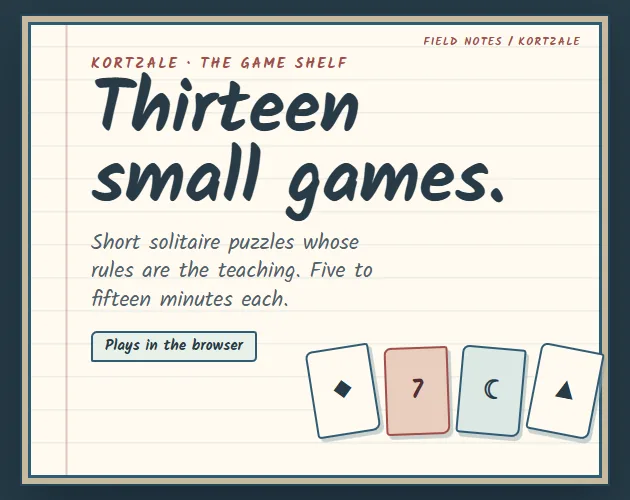
Thirteen short solitaire puzzles share a single hand-drawn notebook, and each one is built around a decision that outlasts the round.
#8 this weekAI-assisted: Code, Graphics, Sound, Text
The game runs in this tab. No install, no account.
The short answer
Kortzale Solitaires gathers thirteen small solitaire puzzles into one hand-drawn notebook, each readable in about a minute and playable in five to fifteen. Pick a title from the shelf, work out its logic, and move on whenever you like, with progress kept per game in the browser, free, using mouse or touch controls.
What is Kortzale Solitaires?
Kortzale Solitaires is a collection of thirteen compact solitaire puzzles laid out as pages in a single field notebook. Every entry stands alone: a short game with a rule set compact enough to absorb in about a minute, built around one decision that tends to linger well after the last card is placed. A sitting usually runs somewhere between five and fifteen minutes, and then the shelf is open again for a different title.
The name comes from the croze, the groove cut inside a barrel's staves that seats the head. It is load-bearing and invisible once the barrel is assembled, which is the point being made about rules here: the rules do the teaching, and the games otherwise stay out of the way.
It sits in puzzle and card game territory, and the surrounding tags point at casual play, deduction, logic, a minimalist look, relaxation, and short sessions for one player. Nothing about it behaves like a campaign; it behaves like a notebook you flick through.
How to play
The loop is the same everywhere: choose a game from the shelf, read its opening and its rules card, play to the ending, then pick again. A Rules button stays available while a game is in progress, so an edge case can be checked without abandoning the board.
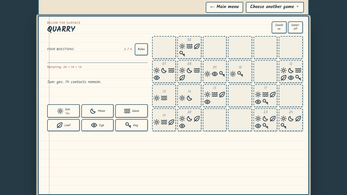
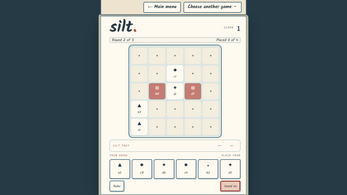
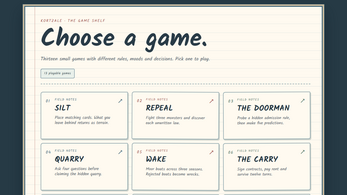
The titles differ sharply in what they ask. In SILT, matching cards go onto a grid and the two left behind come back as terrain. REPEAL sets three monsters against you, each enforcing an unwritten law, and while killing one is easy, naming its law is the actual game. THE DOORMAN has you probe a hidden admission rule and only then call five cards. QUARRY hands over four questions to cut twenty-four contacts down to the single one you claim.
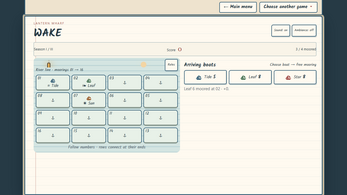
Elsewhere the pressure is spatial or economic. WAKE spans three seasons of mooring boats, and the boats turned away come back as wrecks. THE CARRY is twelve turns of signing contracts and covering rent. THE HEAVIEST HAND lets you buy goods and then deducts points from whichever purse you drew on most.
Controls
Everything runs on a mouse or on touch, and the pages read the same whether the pointer is a cursor or a fingertip.
A top bar holds the exits: a back arrow to the main menu and an option to choose another game. Inside any title, a Rules button opens the rule card mid-session, which matters most in the deduction games where one clarified clause changes the next move.
Each game carries its own sound switch, independent of the others, and nothing starts playing on its own. Progress is remembered by the browser per game, so a return visit to the shelf picks up where the previous one stopped.
On a phone the top bar and the Rules button are the whole interface, and no install step stands between opening the page and playing.
| Input | Action |
|---|---|
| Mouse | Play any of the thirteen games |
| Touch | Play any of the thirteen games on a phone |
| Rules button | Open the rule card while a game is in progress |
| Top bar back arrow | Return to the main menu |
| Top bar Choose another game | Switch to a different title from the shelf |
Tips for your first run
The collection rewards a little setup before the first card moves. Read the rule card rather than guessing, keep the Rules button within reach, and treat the five-to-fifteen-minute span as the natural unit of play instead of trying to clear several games in one sitting. A few habits help with specific titles and with the shelf as a whole.
- Read the opening rules card first; each set is written to be absorbed in about a minute.
- Keep the Rules button handy during play, especially in deduction games where a single misread clause costs the round.
- Switch games mid-sitting when a puzzle stalls; each title keeps its own saved progress in the browser.
- Use the top bar to hop between titles rather than forcing one solve in a single stretch.
- In CAIRN, twelve stones sit across four descending columns with one chance to leave room, so decide that gap early.
- In THE DOORMAN, spend the probes testing the hidden admission rule before committing the five cards.
Content and replayability
Five further titles round out the shelf, and each turns on a different resource. THE ASSAY asks whether to sample hidden layers piece by piece or claim whole cores outright. THE WIDENING gives a budget of steps and a choice: climb with them now, or spend them making every later climb cheaper. THE TENDING sets six plots against a ten-turn clock, with harvesting required before the crop fades. THE ROW is about claiming a site and then seeing the street beside it. THE STILL weighs patience against appetite, holding out for the valuable tokens or taking what is ready.
Replay comes from the structure rather than from unlocks. Progress is kept in the browser for each game individually, so a puzzle can be dropped mid-sitting and resumed after another title has been tried. Because every entry is short and self-contained, rotation is the natural pattern: five to fifteen minutes on one, then a different rule set entirely.
The mix of deduction, resource management, and placement means the shelf rarely asks for the same kind of thinking twice in a row.
Presentation and performance
The whole collection lives inside a handwritten field-notebook look: paper, ink, pencil, and one bundled handwriting font carrying the text. Nothing is dressed up as a storefront or a dashboard, and the rule cards read like notes in the margin.
Sound is quiet and synthesized, scored per game, with a separate switch for each, and nothing begins playing unprompted. It is a browser build with nothing to install, running on desktop or phone, keeping per-game progress locally, and asking for no account, no ads, and no tracking.
Direction and design came from a single person, with the code, the rule writing, and the presentation produced alongside an AI collaborator; one game's creature portraits are AI-generated images, and playtesting involved both people and an AI tester. The minimalist and hand-drawn tags match the result: uncluttered pages where the cards and the rules carry the screen.
Who should play it
Anyone who enjoys solitaire logic without a long commitment fits here: the games are short, the rules are short, and the endings arrive inside a coffee break. Deduction players have REPEAL, THE DOORMAN, and QUARRY, where the real work is naming a hidden rule or narrowing a set. Resource-minded players have THE CARRY, THE HEAVIEST HAND, THE WIDENING, and THE TENDING, all built around spending something that does not come back. THE STILL and CAIRN suit anyone who enjoys the tension of waiting one beat too long.
The collection also suits players who want a browser tab rather than an install, a phone session rather than a desktop one, and no account at the door. Those drawn in by the relaxing and casual tags will find quiet sound, minimalist pages, and the freedom to leave whenever a puzzle stops being interesting.
Someone hunting a single deep strategy game, a campaign, or a competitive ladder will not find that shape here. These are thirteen small, complete pieces, and the pleasure sits in moving between them.
Screenshots
How we tested it
The build was loaded from games.debutplay.com in a headless Chromium session on ; the canvas started and no request was blocked. The guide was last checked on .
From the developer
Thirteen small games, one notebook. Each one is a short solitaire puzzle with a rule set small enough to read in a minute and a decision you will still be thinking about at the ending. Pick a game from the shelf, play five to fifteen minutes, pick another. Kortzale is named for the croze — the groove inside a barrel's staves that seats the head. Load-bearing, and invisible once assembled. The rules are the teaching; the games stay out of the way. What's on the shelf SILT — place matching cards on a grid; the two you leave behind come back as terrain.REPEAL — fight three monsters that each enforce an unwritten law. Killing one is easy. Naming its law is the game.THE DOORMAN — probe a hidden admission rule, then call five cards.QUARRY — four questions to narrow twenty-four contacts to the one you claim.WAKE — moor boats across three seasons; the boats you turn away return as wrecks.THE CARRY — sign contracts, pay rent, survive twelve…
Frequently asked questions
Is Kortzale Solitaires free to play?
Yes. It costs nothing to open in a browser, with no account, no ads, and no tracking layer attached to it.
How long does one game take?
The collection is built around five-to-fifteen-minute sittings, and each rule set is written to be read in roughly a minute before play begins.
Can it be played on a phone?
Yes. It runs in a browser on desktop or phone, accepts mouse or touch input, and requires no installation.
Does the game save progress?
Progress is held in the browser for each game separately, so a player can switch titles mid-sitting and come back to an unfinished puzzle later.
Must every rule be learned before starting?
No. Each title opens with its own rules card, and a Rules button stays available during play for anything that needs checking mid-round.
Is there sound, and does it start on its own?
Each game has its own quiet synthesized audio with a separate on and off switch, and nothing autoplays, so the page stays silent until a switch is used.
What games are similar to Kortzale Solitaires?
The closest matches on DebutPlay are BATHORY: BLOODLINE — The Ten Rites, Before You Wake, Finders’ Bureau. They share the same genre, so the controls and the pace carry over.
Something wrong or missing? Tell us. How we test games.