Puzzle · New game
Ding Ding! Boxing Match-3
A browser match-3 bout where clearing pieces deals damage, three rounds decide the fight, and card choices shape each comeback.
#18 this week
The game runs in this tab. No install, no account.
The short answer
Ding Ding! Boxing Match-3 is a browser puzzle game that turns match-3 clears into boxing damage across three rounds. Each round has a move budget, and between rounds you choose one of three cards to adjust damage, moves, or scoring. Ten opponents and four difficulty tiers build toward a title bout. It is free to play and works with mouse or touch.
What is Ding Ding! Boxing Match-3?
Ding Ding! Boxing Match-3 is a browser puzzle game that stages a match-3 board as a three-round boxing fight. The opponent has one health pool, and cleared pieces convert into damage. Empty that pool and the bout ends by knockout. If the pool survives, the result goes to the cards, where the number of rounds won settles the winner.
Each round carries its own move budget, so every swap has a cost in the round's limited supply. Between rounds, the corner offers a choice of three cards that alter damage, move count, or scoring for the rounds ahead. The ladder holds ten opponents across four difficulty tiers, ending with a title bout that is built to go the distance. The game is free, runs as HTML5 in the browser, and accepts mouse or touch input.
How to play
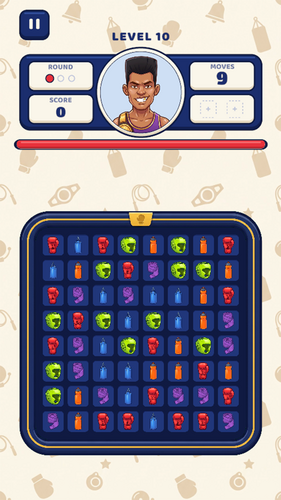
Drag one piece onto an adjacent piece to swap them and form matches. Cleared pieces chip away at the opponent's single health pool; a knockout comes when that pool is empty. Matches of four or more create a special piece drawn from boxing regalia, such as a belt or a gong. These specials only form from a match made on the player's turn, never from a cascade that resolves by itself, so creating one is a deliberate move rather than a lucky chain.
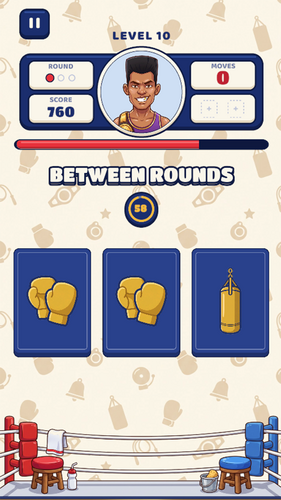
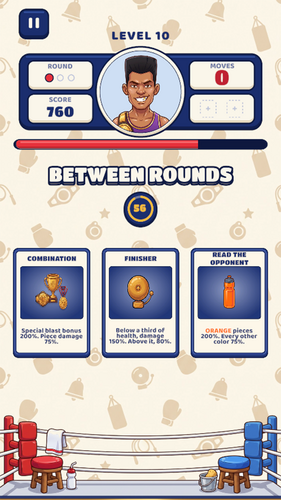
The fight runs three rounds, each with a set number of moves. At the end of a round, the corner presents three cards, and one choice changes damage, move count, or scoring for the next rounds. Early Attack begins the following round with a special piece on the board, Conditioning adds moves, and Finisher raises final-round damage. A points win counts, but a knockout is worth more, and an early knockout is worth more again. Score also tracks cleared pieces, specials made and set off, unspent moves, and a bonus for finishing a round early.
Controls
Control is built around one gesture: dragging a piece onto a neighboring piece to swap their positions. That drag is how every match starts, including the four-piece-or-better matches that produce special pieces. The browser build accepts mouse input or touch, so the same action works with a desktop pointer or a touchscreen. Because specials must come from a match made on the board rather than a cascade, the drag is also the way to plan the biggest hits. The round's move budget gives each swap weight, and the corner card choices sit between rounds rather than inside the drag action. With a move budget attached to each round, a careless drag can cost more than a missed match: it spends a resource that the corner cards may later adjust.
| Input | Action |
|---|---|
| Mouse | Drag a piece onto an adjacent piece to swap them |
| Touch | Drag a piece onto an adjacent piece to swap them |
Tips for your first run
The first fight is a warm-up, and a strong opening round can end it on the spot. Use that bout to learn how quickly clears drain the health pool and how specials form from deliberate four-piece-or-better matches.
- Build specials with your own match. Cascades cannot create medals, trophies, belts, or gongs, so plan the four-piece-or-better line instead of hoping for a chain.
- Treat each round's move budget as a resource. Clearing pieces does damage, but unspent moves contribute to score, and finishing a round early adds a bonus.
- At the corner, read the fight. A lead favors scoring cards; a deficit favors cards that help reach the final round, such as Conditioning for extra moves.
- Use Early Attack when the next round needs a head start, and consider Finisher for the last round, where it raises damage.
- Expect the second fight to close the quick knockout route. The fifth and eighth opponents answer back, and the tenth title bout is designed to go the distance and likely beat a first attempt.
Content and replayability
The opponent ladder has ten fights across four difficulty tiers. The opening bout is a warm-up that a strong first round can finish immediately. From the second fight onward, that early door closes and the climb becomes steadier. The fifth and eighth opponents hit back: a second-round knockout is still possible with a strong performance, but mistakes are not forgiven. The tenth fight is the title bout, built to go the distance and expected to beat most players on a first try.
Replay value comes from score chasing and card decisions. Every fight keeps a best score, and the rankings screen lists those results. Scoring draws from cleared pieces, specials created, specials triggered, leftover moves, and early round finishes. A points win is still a win, but a knockout pays more, and an early knockout pays more again. Because the corner offers three cards between rounds, different choices can shift damage, move count, or scoring for the remainder of a run.
Presentation and performance
The game presents its boxing theme through a 2D arcade style, with the match-3 board serving as the ring action. The browser build is the listed platform, and the control scheme accepts mouse or touch. The fight flow stays compact: three rounds, a corner choice of three cards, then the next opponent.
Behind the board, the rules are written as a standalone library with no engine dependency and are covered by 87 automated tests. A simulator plays each level thousands of times with three different bots, so the difficulty curve is measured rather than guessed. The method and the numbers are published alongside the rule set itself. That testing work supports the tuning of the fifth, eighth, and tenth fights.
Who should play it
Players who enjoy match-3 puzzles but want a clear combat goal should find the three-round boxing frame direct: clears deal damage, the opponent has one health pool, and a knockout is the target. The corner cards add a decision layer between rounds, with choices that affect damage, move count, or scoring. Anyone who likes score attack has a reason to replay fights: best scores are kept per fight and listed on the rankings screen.
The difficulty ladder suits players who want a measured climb rather than a flat set of boards. Ten opponents and four difficulty tiers move from a warm-up to checkpoints at the fifth and eighth fights, then to a title bout meant to go the distance. A first loss in that final fight is part of the expected path, not a sign that the run is over. The HTML5 format and mouse-or-touch dragging make it approachable for a session, while specials created from four-piece-or-better matches give planners a skill outlet.
Screenshots
How we tested it
The build was loaded from games.debutplay.com in a headless Chromium session on ; the canvas started and no request was blocked. The guide was last checked on .
From the developer
Ding Ding! Boxing Match-3 Step into the ring, match the pieces, put your opponent on the canvas. Ding Ding! runs a match-3 board under the rules of a boxing match. Your opponent has a single health pool and the fight lasts three rounds. Every round has its own move budget. Clearing pieces deals damage, and emptying the pool wins by knockout. If no knockout comes, the fight goes to the cards and the number of rounds you won decides it. The corner between rounds At the end of every round you return to your corner and pick one of three cards. Cards change damage, move count or scoring for the rounds that follow. Early Attack opens the next round with a special piece already on the board, Conditioning adds moves, Finisher raises the damage of the final round. Which card you take depends on where the fight stands: ahead, you play to build the score; behind, you play to reach the last round alive. Special pieces Matches of four or more…
Frequently asked questions
Is Ding Ding! Boxing Match-3 free to play?
Yes. The game is available at no cost and runs in the browser as an HTML5 title.
What platform and inputs does it use?
It plays in the browser as an HTML5 game. Swaps use mouse or touch, with dragging as the way to exchange adjacent pieces.
How does a fight end?
The bout ends by knockout when the opponent's health pool is emptied. If no knockout happens, the number of rounds won decides the result on the cards.
What happens between rounds?
The corner offers three cards. One choice changes damage, move count, or scoring for the following rounds; examples include Early Attack, Conditioning, and Finisher.
Do cascades create special pieces?
No. Specials form only from a match made on the board, never from a cascade that resolves on its own. Creating a medal, trophy, belt, or gong is a deliberate act.
How many opponents are there?
There are ten opponents across four difficulty tiers. The first is a warm-up, the fifth and eighth hit back, and the tenth is the title bout.
What games are similar to Ding Ding! Boxing Match-3?
The closest matches on DebutPlay are Impossible Factory, Checkmate Protocol 2076, ECHO. They share the same genre, so the controls and the pace carry over.
Something wrong or missing? Tell us. How we test games.