Strategy · New game
Fatebound: War of the Four Suits
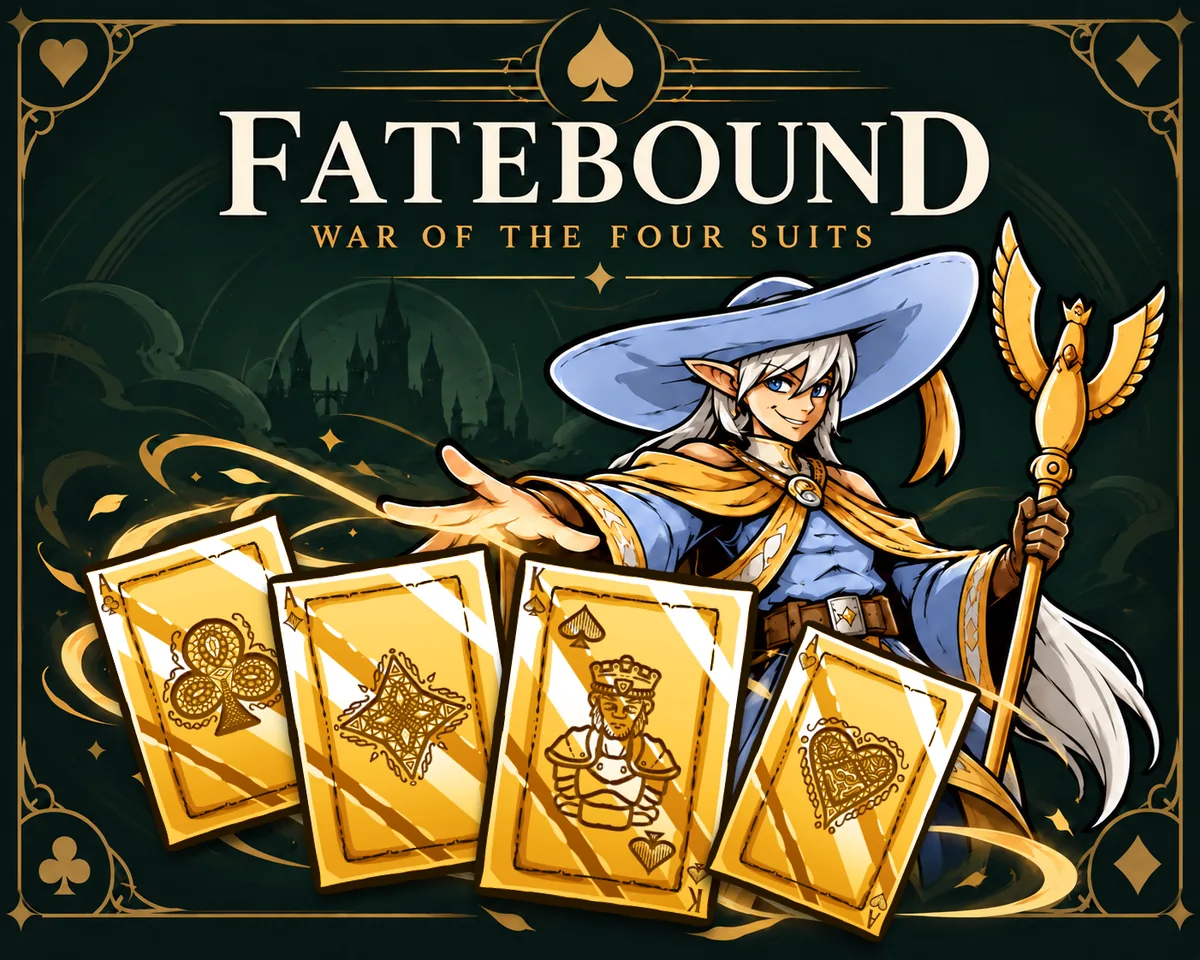
Fatebound: War of the Four Suits takes the old card game War and gives it three scoring fronts, rotating suits, and a fantasy campaign to fight through.
#20 this week
The game runs in this tab. No install, no account.
The short answer
Fatebound: War of the Four Suits is a free browser card battler that takes the rules of War and spreads them across three scoring fronts, then adds deck building, rotating favored suits, and risky WAR tie-breaks. Six characters, a twelve-rival campaign, repeatable Skirmishes, and a ten-floor Tower give it plenty to chew on.
What is Fatebound: War of the Four Suits?
A fallen kingdom, four rival houses, and a stolen crown set the scene for a card battle built on one familiar rule: the higher card takes the trick. Fatebound: War of the Four Suits keeps that spine and wraps a tactics layer around it. Each round deals five cards, and those cards go to three battlefield positions rather than a single pile — a left flank worth one point, a center worth three, and a right flank worth two. The first side to reach 20 points closes the match, though every front resolves before the score is final.
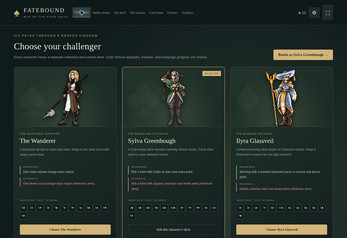
Behind the table sits a story campaign against rival characters, a favored suit that rotates each round and pays bonus points to whoever wins with the right color, and a deck-building layer where a twelve-card list is the entire toolkit. Six playable characters each arrive with their own starting deck plus a distinct bonus and drawback, so who sits down at the table shapes what the cards are expected to do.
How to play
Every match begins with a hand of five cards and three positions to fill. Players alternate placing cards face up, so a round is a conversation: one side commits, the other answers, and both try to read which front deserves the strongest card. Anything still in hand at the end of a round carries forward, which makes restraint a resource rather than a wasted turn.
The favored suit rotates each round, paying bonus points to whoever wins a front with it, so a modest card can suddenly outearn a big one. Reaching 20 points wins, but only after every front has been resolved, so a late swing still matters.
Ties are where the tension lives. A drawn front triggers WAR: commit another card as a hidden reinforcement, or withdraw and preserve the rest of the hand. Taking a contested position can turn a match, and spending a key reserve on it can leave the next round thin.
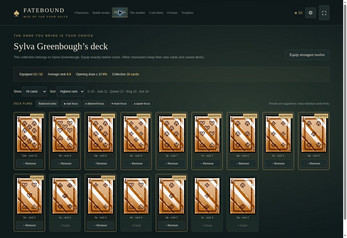
Outside battle, collected cards are shaped into a twelve-card deck, with balanced and suit-focused presets offered as starting points. Gold from play feeds permanent Fortune upgrades, while scouting and redraw abilities stay limited inside a single fight, so timing them is a decision of its own.
Controls
Fatebound runs in a browser frame and is played with a mouse. Cards are committed to the three battlefronts and menus are navigated with pointer input, so the pressure comes from deciding which card goes where rather than from reacting quickly.
Settings allow the audio to be adjusted and optional visual effects to be switched off, and the frame supports fullscreen so the battlefield can fill the display. Progress saves automatically on the local machine, which means a session can be closed without extra steps.
The on-ramp is a guided training table hosted by Captain Rowan, pairing practice rounds with lessons that explain how decks, collections, and upgrades connect. A journal keeps discovered conversations available to revisit later.
| Input | Action |
|---|---|
| Mouse | Place cards on the three battlefronts and navigate menus |
Tips for your first run
Treat the hand as a budget rather than a stack of weapons. With five cards spread across three fronts, giving up a flank cheaply is often better than bleeding a strong card into a lost position, and the unused cards follow into the next round where they can matter more.
Watch the favored suit before committing. Winning a front with the rotating suit adds bonus points, so a mid-rank card in the right color can beat a higher card in the wrong one. Against the center, remember it pays three points — the largest single swing on the board — but it is also the front an opponent is most likely to reinforce during a WAR.
- Concede a flank with a low card instead of overspending to save it.
- Keep one strong reserve back specifically for WAR reinforcements.
- Track the favored suit each round before choosing which front to contest.
- Use scouting and redraw early enough that the information still changes a decision.
- For the Tower, settle on a character, deck, and upgrades before the climb begins.
Content and replayability
The story campaign runs across four chapters and twelve rival encounters, told through portrait dialogue with secrets that unfold as rivals fall. A journal stores every conversation discovered so far, so the plot can be pieced together at leisure.
Skirmish mode strips out the narrative and lets any rival be challenged repeatedly for gold, tracking victories, defeated opponents, and current winning streaks. The Covenant Tower is the structured test: character, deck, and upgrades are locked in, then ten floors of escalating opposition stand between the run and the summit champion. Gold earned during a climb is kept even if the climb ends early.
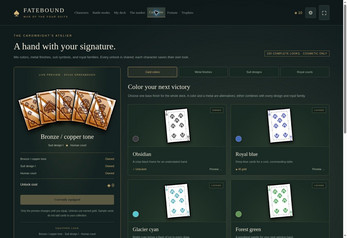
Each of the six characters holds a separate collection and saved custom deck, while gold, upgrades, and campaign progress are shared across the roster — an incentive to experiment without losing ground. Fifteen achievements cover battles, collecting, campaign milestones, Skirmishes, and Tower progress, and a cosmetic shop stacks ten color and metal finishes, four suit designs, and Human, Goblin, Elven, and Dwarven royalty into 160 combinations.
Presentation and performance
Battles are sold with motion: animated card draws and clashes, impact effects, screen shake, and victory particles carry the moment a front resolves. The optional visual effects toggle means that spectacle can be dialed back if it gets in the way of reading the board.
Audio is split between separate menu and battle music, with adjustable volume for players who want the table quiet while they think. Because the game is delivered as an HTML5 build, it opens in a browser frame with fullscreen support and no separate launcher to manage.
Progress is saved automatically to local storage, which keeps the campaign, collections, and streaks intact between sessions on the same machine.
Who should play it
Anyone who played War as a child and wanted it to require a decision will find the hook here: three fronts, rotating suits, and a tie rule that puts reserves on the line. Deck-building players get a tight twelve-card construction puzzle with presets to lean on while learning, and tactics-minded players get a readable board where information about an opponent's commitments is worth as much as raw card strength.
Story players have twelve rivals, four chapters, and a journal to work through, while completionists have fifteen achievements, a cosmetic shop with 160 combinations, and a ten-floor Tower that rewards repeated climbs with kept gold. The mouse-driven browser build also suits anyone who wants a turn-based strategy card game that loads in a tab rather than a launcher.
Screenshots
How we tested it
The build was loaded from games.debutplay.com in a headless Chromium session on ; the canvas started and no request was blocked. The guide was last checked on .
From the developer
♠️ Fatebound: War of the Four Suits Chance deals. You decide. A fallen kingdom. Four powerful houses. A stolen crown—and a place waiting for you at the table. Fatebound: War of the Four Suits transforms the familiar rules of War into a fantasy card-battle adventure built around meaningful choices. Collect cards, customize your deck, and challenge a cast of rivals through a story campaign, repeatable Skirmishes, and a ten-floor Tower. The highest card wins the battle. Knowing where to play it can win the match. ⚔️ Five Cards. Three Fronts. Your Move. Draw five cards and compete across three battlefield positions: the left flank is worth 1 point, the center 3, and the right flank 2. Take turns placing cards face up, read your opponent’s commitments, and decide which fronts deserve your strongest cards. Spend an Ace to secure the center, sacrifice a low card to concede cheaply, or hold something powerful for the next round. Unused cards…
Frequently asked questions
Is Fatebound: War of the Four Suits free?
Yes. It is free to play, with no purchase needed to sit down at the table.
Where can it be played?
It runs as an HTML5 game inside a browser frame, played with a mouse, with fullscreen support available.
How do you win a match?
The first side to 20 points takes it, but every front resolves before the result is final, so late points still count.
What happens when a front ties?
A tie triggers WAR. The player either commits another card as a hidden reinforcement or withdraws and keeps the rest of the hand.
Do characters share progress?
Gold, upgrades, and campaign progress are shared, while each of the six characters keeps a separate collection and saved deck.
What is the Covenant Tower?
A ten-floor climb where character, deck, and upgrades are locked in. Gold earned is kept even if the run ends early.
What games are similar to Fatebound: War of the Four Suits?
The closest matches on DebutPlay are Against History: WW2, Boilerworks, Metal Fighting Robots. They share the same genre, so the controls and the pace carry over.
Something wrong or missing? Tell us. How we test games.