Simulation · New game
Gate & Globe
A launch-day guide to Gate & Globe, a free browser airline sim where players build routes, manage fleets, negotiate timetables, and compete in persistent worlds.
#1 this weekAI-assisted: Code, Graphics, Text
The game runs in this tab. No install, no account.
The short answer
Gate & Globe is a free HTML5 airline management sim played in a browser. Players join a shared world, pick a home airport, name an airline, buy or lease aircraft, open routes, set fares, and staff operations. Real-city demand, aging airframes, fleet-wide timetables, shares, alliances, and persistent worlds give new CEOs plenty to plan on day one.
What is Gate & Globe?
Gate & Globe is a free airline management simulation built for the browser. Players join a shared online world, establish an airline, and compete with other players rather than managing a private spreadsheet in isolation. The starting decision is a home airport and an airline name, backed by initial capital. The fleet can be assembled from used aircraft, leased types, or new orders, and each airframe is treated as an individual unit that accumulates hours and cycles and requires checks.
The setting is shaped by the world’s date. Aircraft availability follows the era, and used listings are tied to the real fleet history of each type. A broker can hunt for an aircraft type that no one in that world currently holds. Demand comes from travel between real cities, so filling seats depends on route choice, connections, ticket pricing, schedule frequency, elapsed journey time, comfort, service quality, and reputation. Released on 24 October 2026, the title runs as an HTML5 browser game.
How to play
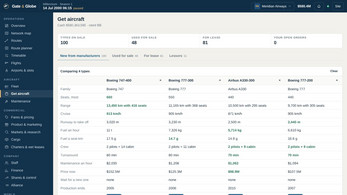
Begin by joining a world and choosing a home airport, then name the airline. Initial capital gives the first footing, and part of the company can be sold to outside investors for additional funds. Fleet expansion has three paths: buying used aircraft, leasing them, or ordering new ones. After aircraft are in hand, the operational work expands into opening routes, fitting cabins, setting fares, and staffing the airline.
Route demand is not created by adding seats. Travel between cities supplies the passenger base, and extra capacity can fly empty. Travelers compare ticket price, how often a route flies, total journey time, cabin comfort, service quality, and airline reputation; they also connect across networks rather than treating each route as an isolated point-to-point line. Flight planning traces airway segments from the departure procedure through to arrival, taking into account closures that apply on that world’s date and the corridors that remain open.
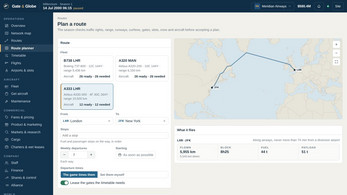
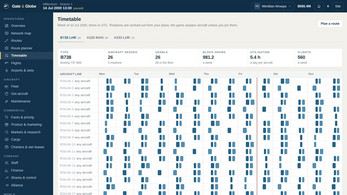
Timetables are central. Fleets fly real timetables, and the route planner displays schedule times and seat counts in both directions. A timetable tool can propose improved times across the whole fleet, while chosen routes can be locked to prevent changes. Shares add another layer: players own shares, a company can join the share market for its world, takeovers are possible, and the CEO is chosen by shareholder vote.
Controls
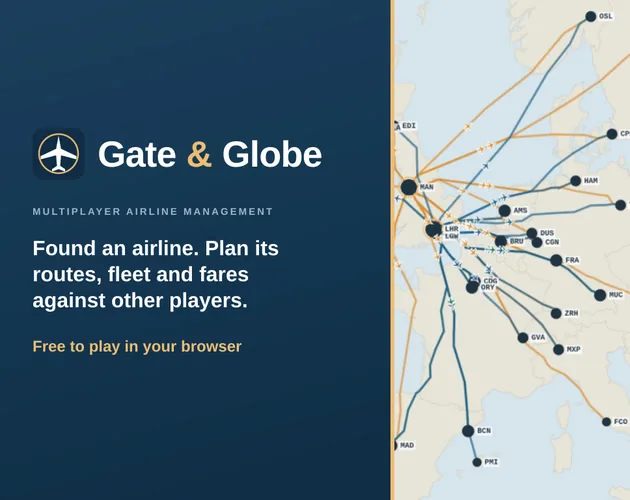
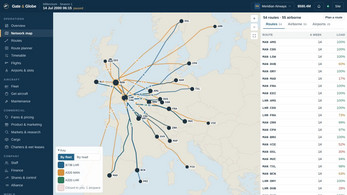
Gate & Globe runs inside the browser, so the game’s own site is the control surface for the airline. The route planner lays out schedule times and seat counts for both directions, and the timetable system can suggest improved schedules across the fleet. Routes that should remain untouched can be locked. The map is the spatial reference: it shows airspace closed on the game date, the corridors used for flight paths, and the borders as they stood in that era.
Fleet purchases, cabin layouts, ticket prices, staffing, and share decisions are handled across the management screens. Shares are owned by players, a company can join the share market for its world, and the CEO is chosen by shareholder vote. Alliances and member-run leasing companies extend the social side of the operation. Because the title runs on its own site, the account and airline persist between visits, and an established carrier can keep flying for days.
The game page does not list its controls. Check the in-game tutorial or pause menu for the current scheme.
Tips for your first run
Treat capacity as a consequence of demand, not a way to create it. The passenger base comes from real travel between cities, so extra seats on a weak route can simply fly empty. Keep the first network focused, then compare ticket price, schedule frequency, elapsed journey time, comfort, service quality, and reputation because travelers weigh those factors and connect across the network.
Fleet choices deserve the same care. Each additional aircraft family creates a pilot-qualification cost, so every family added to the operation has a budget consequence. Individual airframes age with hours and cycles and go in for checks, making maintenance planning part of the growth curve. The timetable can propose improved times across the fleet; lock any route that must stay unchanged. Share choices matter: the CEO is chosen by shareholder vote.
- Start with a clear home-airport identity and a route plan that matches real travel between cities.
- Use the timetable suggestion tool to spot better fleet-wide times, then lock routes that should stay fixed.
- Watch pilot-qualification costs before adding another aircraft family.
- Track hours and cycles on each airframe so checks do not surprise the operation.
- Consider the share price and voting implications before selling part of the company to investors.
Content and replayability
Worlds are the main engine of replayability. Each one sets its own era, pace, and rules. A sample span could start in 1985 and end in 2035, while another world could track the actual calendar without a reset. That changes which aircraft are available, how quickly fleets age, and what kind of network can be built. Private worlds for friends can be hosted by members, adding a smaller-scale social option.
Competition extends beyond schedules and fares. Players own shares, a company can join the share market for its world, and takeovers are possible. The CEO is chosen by shareholder vote, and outside backers support a chief executive when the share price tracks the market. Alliances let airlines coordinate, and members may operate leasing firms that place aircraft with other airlines. Tournaments hand out multi-month membership prizes to the strongest airlines, giving established carriers a recurring target.
The aircraft market reinforces the time setting. Used aircraft arrive in line with each type’s real fleet, and a broker can search for a type that nobody in the world holds yet. Because each airframe is individual and ages with use, a long-running world develops its own fleet history. An established airline keeps flying for days between visits, so a world does not go dormant simply because a player steps away for a while.
Presentation and performance
Gate & Globe runs as an HTML5 browser game. The planning screens carry the visual load: the map shows borders from the game date, closed airspace, and the corridors that shape flight paths. The route planner lays out schedule times and seat counts for both directions, making the timetable legible as a two-way schedule rather than a single line. Four launch screenshots are available.
The interface is built around management layers rather than a single action view. Fleet purchases, cabin layouts, ticket prices, staffing, and share decisions each feed into airline performance. The map gives spatial context for routes and airspace, while timetable tools support fleet-wide schedule checks.
Continuity is part of the experience. The game runs on its own site, so the account and airline remain between visits. An established carrier can keep flying for days, supporting the sense of a living world rather than a session that starts from zero. The persistent world and the map’s date-specific borders give the management screens a historical frame.
Who should play it
Gate & Globe suits players who enjoy airline tycoon games with a strong planning layer. The appeal is not a single takeoff or landing but the chain from home airport and capital to aircraft acquisition, cabin configuration, fares, staffing, and timetable design. Players who like comparing schedule frequency, elapsed travel time, cabin comfort, service quality, and reputation will find those factors built into traveler choice. The shared world adds competition for routes and the social pressure of alliances, share voting, and leasing arrangements.
Economy-minded players get individual airframes with hours and cycles, maintenance checks, used-market timing, and era-based aircraft availability. Strategy players get company ownership: shares can be sold to investors, a company can join the share market, and takeovers are possible. The CEO is chosen by shareholder vote, so control can become a live question. Membership is optional, paid in advance, and does not auto-renew; it strips ads from game screens and unlocks leasing-company operation plus private-world hosting. Remaining paid extras are cosmetic, every world and airline is free, and no purchase changes competitive outcomes.
Anyone interested in persistent multiplayer management should find the day-one setup clear: choose a world, pick a home airport, name the airline, and begin building a network. The game is most compelling for players who want an airline that keeps flying for days between visits.
Screenshots
How we tested it
The build was loaded from games.debutplay.com in a headless Chromium session on ; the canvas started and no request was blocked. The guide was last checked on .
From the developer
Gate & Globe is a free multiplayer airline management game in the spirit of Airline Empires, played in any web browser. Every player runs an airline in a shared world against other players. Play at gateandglobe.com: the game runs on its own site, so your airline and account are kept between visits. Found an airline Join a world, choose a home airport and name your airline. You start with your own capital and can sell part of the company to outside investors for more. From there you buy used aircraft, lease them or order new ones, open routes, fit cabins, set fares and staff the operation. Aircraft of the era The aircraft on offer follow the world's date. Used aircraft come onto the market in line with each type's real fleet, and a broker can search for a type nobody in the world holds yet. Each aircraft is an individual airframe that ages with hours and cycles and goes in for checks. Pilots are qualified on an aircraft family, so…
Frequently asked questions
Is Gate & Globe free?
Yes. Every world and airline is free, and no purchase changes competitive outcomes. Membership is optional, paid in advance, and never auto-renews; it removes ads from game screens and unlocks leasing-company operation and private-world hosting, while other paid extras are cosmetic.
What platform does the game use?
It runs in a web browser as an HTML5 game. The title operates on its own site, so the account and airline are kept between visits.
Do airlines keep operating between visits?
Yes. An established airline keeps flying for days between visits. The persistent world and own-site account structure support an operation that does not restart from zero each session.
Can players compete and cooperate?
Yes. Airlines share a world with other players. They can form alliances, operate leasing firms that place aircraft with other airlines, own shares, join a world’s share market, and pursue takeovers.
How does passenger demand work?
Demand comes from real travel between cities. Extra seats do not create passengers. Travelers compare ticket price, schedule frequency, elapsed journey time, cabin comfort, service quality, and airline reputation, and they connect across networks, so route design and timetable quality matter.
Are tournaments and private worlds available?
Tournaments hand out multi-month membership prizes to the strongest airlines. Members can host private worlds for friends, and each world sets its own era, pace, and rules. A sample span could run from 1985 to 2035, while another could track the actual calendar without a reset.
What games are similar to Gate & Globe?
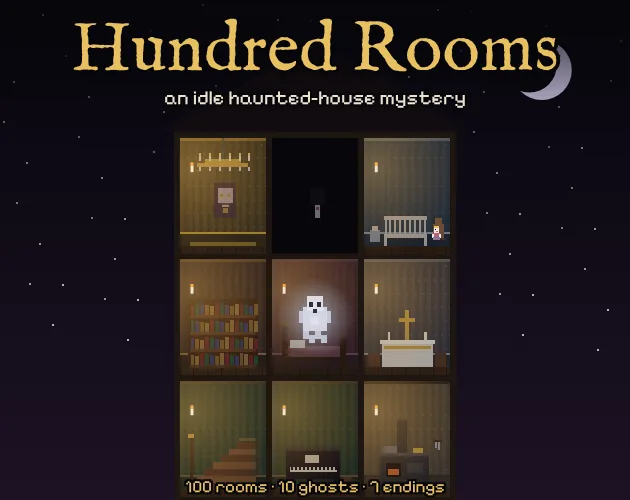
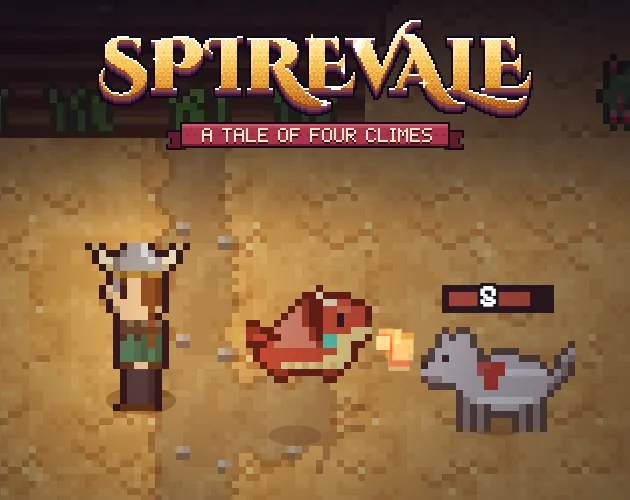
The closest matches on DebutPlay are Sai no Kawara, Hundred Rooms, Spirevale (Demo). They share the same genre, so the controls and the pace carry over.
Something wrong or missing? Tell us. How we test games.