Simulation · New game
Sai no Kawara
A free HTML5 idle game about stacking stones on a folklore riverbank, turning every collapse into Impermanence, and automating the cycle with Jizo statues.
#2 this weekAI-assisted: Code, Graphics, Sound, Text
The game runs in this tab. No install, no account.
The short answer
Sai no Kawara is a free browser idle game inspired by a Japanese Buddhist folk tradition of stacking and destroying stones. Click to build towers on a riverbank, watch a demon topple them, and convert each fall into Impermanence. Summon Jizo statues to automate stacking, use Foresee for timely collapses, and unlock reincarnation and other progression systems.
What is Sai no Kawara?
Sai no Kawara is a free HTML5 simulation game from oka-project, released on 25 October 2026. Its core scene is a riverbank where stones are stacked one by one. The premise draws on a Japanese Buddhist folk tradition in which stones are repeatedly piled up and knocked down. The game turns that cycle into an idle and incremental loop rather than a static ritual.
The central twist is that collapse feeds progress. A demon arrives and destroys the towers, but every fallen stone becomes Impermanence, a resource that helps the player grow stronger. Destruction is therefore part of the plan rather than a dead end. Play can be active or automated: clicking builds the stack, while Jizo statues can continue the work. Foresee adds timing decisions by allowing towers to be collapsed at the right moment for additional rewards. Reincarnation and further progression systems expand the experience over time.
The appeal is not loud action but the slow transformation of a small ritual into a larger system. Scenery shifts, weather changes, music sets the mood, and hidden events appear, giving the riverbank room to evolve. It is free to play, with no account registration required. Progress saves automatically and locally, and offline play is supported after the initial load. That makes it easy to open a browser, place a first stone, and return later to a riverbank that has kept changing.
How to play
Begin with a single action: stack stones one by one on the riverbank. The towers are temporary by design. A demon will arrive and destroy them, and each fallen stone becomes Impermanence. That resource is the route to becoming stronger, so a collapse is a step in the loop rather than a loss to avoid at all costs.
From there, the game opens into automation and timing. Jizo statues can be summoned to handle stone stacking, letting the riverbank continue working even while the player is away. Active players can keep clicking, but they can also let the statues carry the routine. Foresee is the timing layer: use it to collapse towers at the right moment and earn additional rewards. The choice between active clicking and automated progress is part of the design.
Longer-term play is about unlocking more of the system. Reincarnation and additional progression systems gradually expand what the riverbank can become. The goal is not a single finished tower but a growing cycle of stacking, collapse, conversion, and return. The game is free to play, requires no account registration, saves progress automatically and locally, and supports offline play after the initial load. That structure suits short check-ins as well as longer idle sessions.
Controls
The main input is clicking. Active play asks the player to click rather than wait for automation, and that is the main way to take part in the stacking loop. Jizo statues provide an alternative by automating stone stacking, so clicking is a choice rather than a permanent requirement.
Foresee is a timing control rather than a separate mode. The mechanic lets the player collapse towers at the right moment and earn additional rewards. That means the useful skill is watching the state of the riverbank and deciding when a collapse should happen, not simply clicking as fast as possible. The game is an HTML5 browser experience, so play happens inside the browser frame.
Progress saves automatically and locally, and offline play is supported after the initial load. No account registration is required. The release is available in Japanese, English, Simplified Chinese, Traditional Chinese, and Korean.
| Input | Action |
|---|---|
| Click | Play actively by stacking stones; use Foresee to collapse towers at the chosen moment |
Tips for a first run
Start by watching the cycle rather than fighting it. Stones stack, the demon destroys, and Impermanence arrives from the fall. Treat each collapse as the next input into progress, not as a setback. The first useful habit is to keep the riverbank moving and let the resource build.
Then add automation and timing. Summon Jizo statues when the goal is to keep stones stacking without constant clicking. Use Foresee when a collapse should happen at a chosen moment and additional rewards are the aim. Because progress saves automatically and locally, there is little reason to fear closing the browser. Offline play after the initial load also supports a more relaxed routine.
- Stack steadily at first, because every tower is meant to fall and feed Impermanence.
- Summon Jizo statues to automate stacking when active clicking becomes routine.
- Watch for the right moment to use Foresee instead of collapsing at random.
- Expect the demon, and plan around destruction rather than treating it as failure.
- Use automatic local saving and offline play after the initial load for return visits.
Content and replayability
Replayability comes from the loop rather than a fixed campaign. Each collapse produces Impermanence, which helps the player grow stronger. Jizo statues automate stacking, Foresee adds a timing decision, and reincarnation plus additional progression systems gradually expand the experience. The riverbank itself is not static: scenery shifts, weather turns, music carries the atmosphere, and hidden events surface on return visits.
The game supports different play rhythms. A player can click actively, or let the Jizo statues do the work and check back later. Automatic local saving keeps progress on the device, and offline play is supported after the initial load. The experience is available in Japanese, English, Simplified Chinese, Traditional Chinese, and Korean. No account registration is required, which lowers the barrier for a first session.
Because the design is incremental, the content is measured in gradual unlocks rather than a list of discrete stages. Impermanence, automation, Foresee rewards, reincarnation, and the evolving riverbank all point toward longer-term progress. The cycle of stacking and collapse is both the subject and the engine, so repetition is meant to reveal more of the system over time.
Presentation and performance
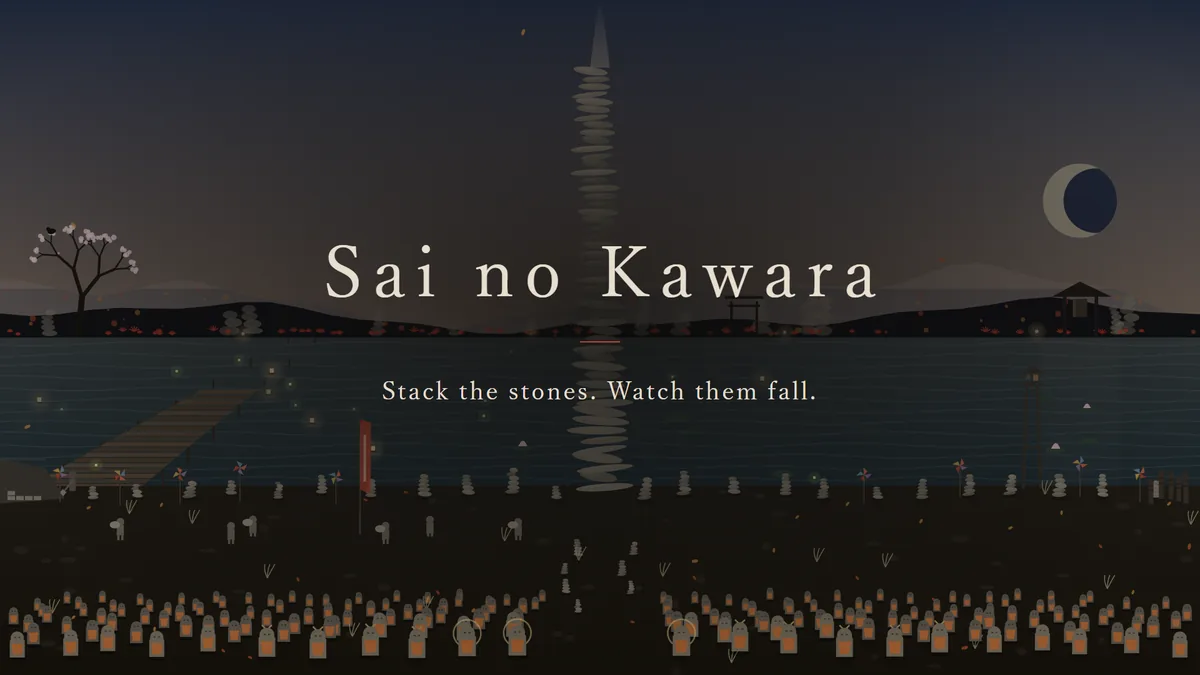
Presentation is built around atmosphere. The riverbank is the stage, and the stone towers are the moving parts. A demon arrives to destroy them, while Impermanence turns the aftermath into a resource. Shifting scenery, changing weather, mood-setting music, and secret events support the folklore mood and make the setting feel less like a fixed background. Four screenshots accompany the release.
The visual and audio details are tied to progression. The riverbank gradually transforms, and the evolving world is part of the appeal. The HTML5 format keeps the experience inside a browser frame, with automatic local saving and offline play after the initial load. The game is free to play and requires no account registration. It is available in Japanese, English, Simplified Chinese, Traditional Chinese, and Korean.
The intended pace is slow and atmospheric rather than loud or rushed. Stones stack, towers fall, Impermanence accumulates, and Jizo statues take over the routine when summoned. Foresee adds a moment of timing to an otherwise calm loop. That mix gives the presentation a ritual quality while leaving room for active play.
Who should play it
Sai no Kawara suits players who like idle and incremental games with a clear loop and a strong mood. The appeal is stacking stones, watching a demon destroy them, and turning each collapse into Impermanence. Players who enjoy automation will find Jizo statues that keep the riverbank working, while those who prefer active play can click and use Foresee for timed collapses and extra rewards.
It also fits folklore-minded players. The premise comes from a Japanese Buddhist folk tradition of repeated stacking and destruction, and the game builds on that with an enigmatic riverbank, shifting scenery, weather, music, and hidden events. Reincarnation and additional progression systems give the long-term structure that incremental players expect. The game is free to play and requires no account registration.
Players who want a low-friction browser session are a good match. Progress saves automatically and locally, offline play works after the initial load, and the game is available in Japanese, English, Simplified Chinese, Traditional Chinese, and Korean. The pace is flexible: active clicking is optional once Jizo automation is in place. Those who prefer a fixed, story-driven campaign may find the repetition central rather than incidental, so the game is best approached as a cycle to shape over time.
Screenshots
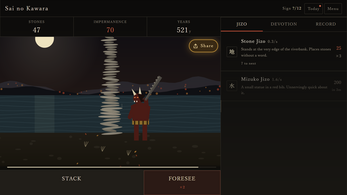
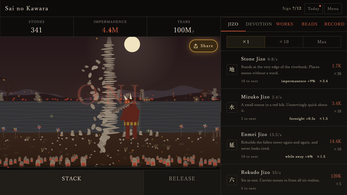
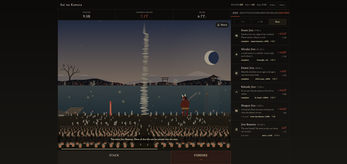
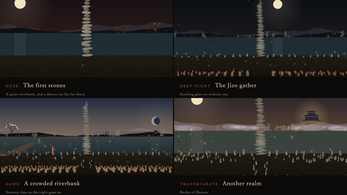
How we tested it
The build was loaded from games.debutplay.com in a headless Chromium session on ; the canvas started and no request was blocked. The guide was last checked on .
From the developer
Stack the stones. Watch them fall. Begin again. Sai no Kawara (賽ノ河原) is a free idle and incremental browser game inspired by Japanese folklore. On a mysterious riverbank, you stack stones one by one. Eventually, a demon arrives and destroys the towers you've built. But destruction is not the end. Every fallen stone becomes Impermanence, a resource that helps you grow stronger. Summon Jizo statues to automate stone stacking, unlock new mechanics, and gradually transform the riverbank. Features Progress through destruction: Every collapse contributes to your next step.Build an automated riverbank: Summon Jizo statues that continue stacking stones, even while you're away.Master your timing: Use the Foresee mechanic to collapse towers at the right moment and earn additional rewards.Explore an evolving world: Discover changing scenery, weather, atmospheric music, and hidden events.Unlock new possibilities: Reincarnation and additional…
Frequently asked questions
Is Sai no Kawara free to play?
Yes. It is free to play, and no account registration is required.
What is the core loop?
Stack stones on a riverbank, watch a demon destroy the towers, and turn every fallen stone into Impermanence. Jizo statues can then automate stacking while Foresee adds timed collapses.
What is Impermanence?
Impermanence is the resource created from fallen stones. It helps the player grow stronger after a collapse, making destruction part of progression rather than a dead end.
What does Foresee do?
Foresee allows towers to be collapsed at the right moment. A well-timed collapse earns additional rewards.
Does the game save progress and support offline play?
Progress saves automatically and locally. Offline play is supported after the initial load.
What languages are available?
The game is available in Japanese, English, Simplified Chinese, Traditional Chinese, and Korean.
What games are similar to Sai no Kawara?
The closest matches on DebutPlay are Hundred Rooms, Spirevale (Demo), Box Ring Master. They share the same genre, so the controls and the pace carry over.
Something wrong or missing? Tell us. How we test games.