Action · New game
HUNGERETH
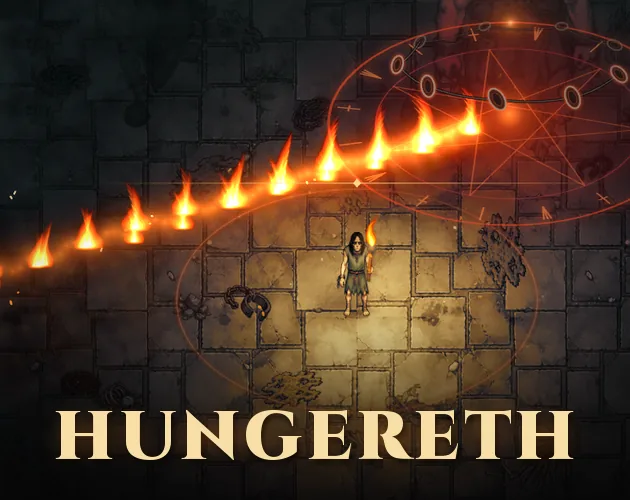
A torch-lit roguelite where the flame doubles as a health bar, and every wave survived feeds the light keeping the run alive.
#4 this weekAI-assisted: Code, Graphics, Sound, Text
The game runs in this tab. No install, no account.
The short answer
HUNGERETH is a free browser survival game about keeping a torch burning in a dark dungeon. The flame is the health bar, draining with time and taking damage from hits, while enemies that get close are scorched by it. Between descents, ash becomes permanent upgrades on a 38-skill tree, so every failed run still builds toward the next.
What is HUNGERETH?
HUNGERETH is a top-down survival game built around one fragile resource: a burning torch. That flame is also the health bar. It shrinks steadily as time passes, and every hit landed on the player strips more light away, so staying alive means protecting a fire that is already dying. Foes arrive in waves out of the dark, and the flame scorches any that come close enough, which makes positioning both a defense and a way to refill, since what the burned enemies leave behind feeds the torch again.
Runs are structured as descents. The aim is to last until dawn and earn freedom from the dungeon, and dying returns the player to a cell rather than a menu. A keeper in that cell converts ash into permanent upgrades spread across a skill tree of 38 skills, so a lost attempt still pushes the account forward. The result is a singleplayer roguelite with bullet hell pressure, a dark setting, and a browser build that starts in seconds.
How to play
A loop begins in the cell. Walk to the gate on the right side of the room and press E to head down. Once inside the dungeon, movement is the main defensive tool: the torch is always burning down, hits accelerate the loss, and the only way to slow the drain is to let the flame do its work on enemies who step into range. Each kill leaves something behind that feeds the fire, so aggressive spacing is rewarded rather than punished.
Card choices arrive during the descent. Pick one with the 1, 2 or 3 keys, or click it, and press R to reroll the offer when nothing fits the run. Death brings up a screen where R descends again, which keeps the retry loop to a single keypress. Back in the cell, spend what has been gathered: the keeper trades ash for permanent upgrades. Between the wave pressure, the shrinking light source and the skill tree, every descent is a negotiation between how close to fight and how much torch to keep in reserve.
Controls
Movement uses WASD or the arrow keys, and E handles talking, interacting and continuing through prompts. The dash is called Flicker and sits on Space, but it is not available from the first run: it has to be unlocked on the skill tree before it can be used, which makes it an early progression target rather than a starting tool.
Card selection is bound to 1, 2 and 3 or the mouse. R covers two jobs, rerolling the current card offer and descending again from the death screen. Esc pauses the game and opens the settings menu, where loudness, brightness, screen shake and flash options, fullscreen and a gentler mode can be adjusted. The game recommends headphones because the narration is voiced.
| Input | Action |
|---|---|
| WASD or arrow keys | Move |
| E | Talk, interact and continue |
| Space | Flicker, a short dash unlocked on the skill tree |
| 1, 2, 3 or mouse click | Pick a level-up card |
| R | Reroll the cards, or descend again from the death screen |
| Esc | Pause and open settings |
Tips for your first run
The torch is not a resource to hoard; it is a countdown that also happens to be a weapon. Fighting closer lets the flame burn approaching enemies and recover some of what has been lost, but standing still in a wave is how light disappears fastest. Keep moving through the dark and let enemies come into the fire instead of chasing them.
Treat the skill tree as the real long game. Since Flicker is locked behind it, the first few descents are partly about banking ash rather than expecting a deep run. The settings menu is worth a look before the first descent too, particularly for anyone sensitive to screen shake or flashing.
- Unlock Flicker early so the short dash is available when waves tighten.
- Reroll a card offer with R rather than taking an option that does nothing for the current build.
- Spend ash between descents; permanent upgrades carry more weight than a single good run.
- Watch the flame rather than a separate health bar, since both damage and time drain the same pool.
- Take the headphones the game asks for, as the narration is voiced.
- Use the gentler mode and the flash and shake toggles if the dark, busy screen gets uncomfortable.
Content and replayability
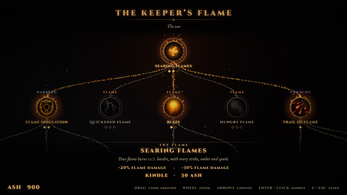
The skill tree holds 38 skills, which is the backbone of the game's replay value. Each descent adds something permanent, and because the tree is fed by ash rather than by a single successful run, repeated attempts keep paying out even when dawn stays out of reach. Card choices during a descent add a second layer on top of that: two runs with the same unlocked skills can still diverge based on what gets offered and rerolled.
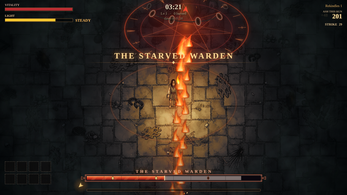
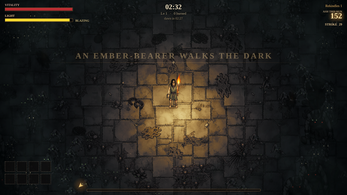
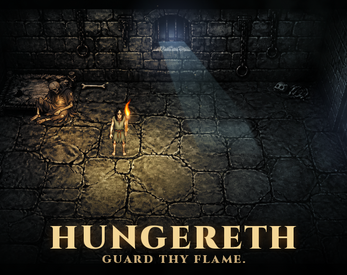
Enemy pressure comes in waves rather than a fixed level order, and the run only ends at dawn, at death, or when the player quits to the cell. That makes for short, repeatable sessions rather than a long campaign, and it suits the browser format. The singleplayer focus means the whole loop is about the player's own improvement: learning how tightly to orbit a crowd, when to reroll, and which branches of the tree are worth finishing first. Four screenshots are available for a look at the dungeon and its torch-lit art before starting.
Presentation and performance
HUNGERETH runs in the browser on the LittleJS engine by Frank Force and is bundled with esbuild, so there is nothing to install before the first descent. The art is dark and top-down, built around torch light, and the character, environment and torch visuals were generated with SpriteCook. A soundtrack of Creative Commons and public domain tracks, plus layered sound effects from open libraries, sits under the narration.
That narration is synthesized speech and is meant to be heard, hence the headphones suggestion. The settings menu is unusually complete for a jam release: volume, brightness, screen shake and flash options, fullscreen and a gentler mode are all adjustable without leaving the pause screen. The game is upfront that most of it was made with AI, with the code, design and sound mixing handled using Claude by Anthropic, art through SpriteCook and the spoken lines synthesized. It was created by Remini Anis for AI Browser Game Jam 5, under the theme Torch.
Who should play it
This is a good fit for players who like bullet hell pressure but prefer a defensive twist: the threat is not just the enemies, it is the clock on the torch. Roguelite players who enjoy meta progression will find the 38-skill tree and the ash economy give them a reason to keep descending, and the wave structure keeps individual sessions short enough for a browser tab.
It also suits anyone who wants a dark, atmospheric action game with honest accessibility switches, since the pause menu covers brightness, flash, screen shake and a gentler mode. Players who want a fixed, hand-built campaign with set levels should look elsewhere, as the loop here is repeatable descents toward a single dawn. It is free to play and singleplayer throughout, with the whole experience built for the browser.
Screenshots
How we tested it
The build was loaded from games.debutplay.com in a headless Chromium session on ; the canvas started and no request was blocked. The guide was last checked on .
From the developer
HUNGERETH is a top-down survival game about keeping a torch alight. Your light is your health: it drains as time passes and every hit takes some of it. Foes come out of the dark in waves, the flame burns the ones that get close, and what they leave behind feeds it again. Between descents you wake in a cell. The keeper there turns ash into permanent upgrades on a skill tree of 38 skills. Walk to the gate on the right and press E to go down again. The goal is to survive until dawn and earn your freedom from the dungeon. Controls WASD or arrow keys: move E: talk, interact, continue Space: Flicker, a short dash (unlocked on the skill tree) 1 / 2 / 3 or click: pick a level-up card R: reroll the cards, or descend again from the death screen Esc: pause and settings Settings include volume, brightness, screen shake and flash options, fullscreen, and a gentler mode. Headphones are recommended; the game has voiced narration. Credits Game by…
Frequently asked questions
Is HUNGERETH free to play?
Yes. It is free, with nothing to buy before playing, and it runs directly in a browser through an HTML5 build.
What platform is HUNGERETH on?
It is a browser game built on HTML5 with a playable frame on its page. It is listed for HTML5 only, and no other platform is named.
How does health work in HUNGERETH?
The torch is the health bar. It drains continuously as time passes, and any hit taken removes more of the light, so damage and the clock pull from the same pool.
Does progress carry between runs?
Yes. Between descents, a keeper in the cell converts ash into permanent upgrades on a skill tree of 38 skills, so a death still leaves something behind.
How do you unlock Flicker?
Flicker is the short dash on Space, and it is not available at the start. It must be unlocked through the skill tree before it can be used in a descent.
Are there accessibility options?
The pause menu includes volume, brightness, screen shake and flash options, fullscreen and a gentler mode, all adjustable from the Esc settings screen at any point.
What games are similar to HUNGERETH?
The closest matches on DebutPlay are Hordebreaker, Starport Express, Furious Street. They share the same genre, so the controls and the pace carry over.
Something wrong or missing? Tell us. How we test games.