Simulation · New game
Late Checkout
A night clerk, a haunted Nevada motor court, and a dawn that never arrives: this story-driven idle game hands you a bell, a ledger, and fourteen dead guests with unfinished business.
#2 this weekAI-assisted: Code, Graphics, Text
The game runs in this tab. No install, no account.
The short answer
Late Checkout is a story-rich idle game set at the Gloaming Motor Court on Halloween, 1962. Ring the bell, rent rooms to dead travellers, and finish each guest's last request while keeping the Night Manager away from the office window. Ten chapters, fourteen guest stories, and four endings plus a secret carry roughly two hours to the first finale.
What is Late Checkout?
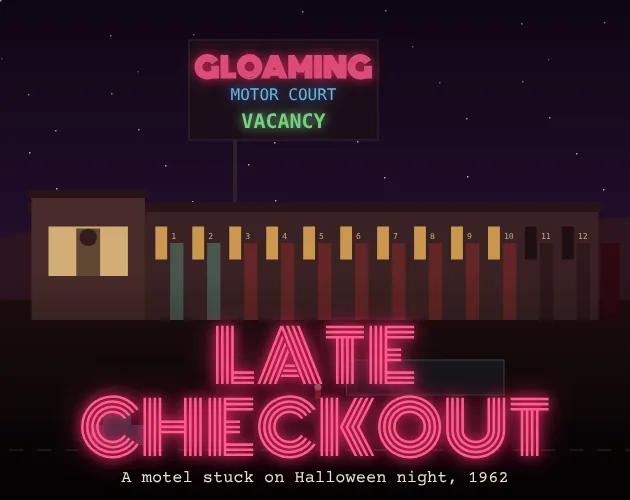
Late Checkout is a simulation-leaning idle game from developer Leonardo Guidolin, set at the Gloaming Motor Court on Highway 9 in Nevada on Halloween night, 1962. The player takes the night clerk shift after being hired by letter. The owner has gone, leaving a key and a single instruction pencilled on paper: Room 13 is never to be rented, and no one checks out before dawn. That rule is the whole problem, because the guests are long dead, they arrive from 1910, 1928, 1944 and 1962, and sunrise never comes.
The shift is a loop of strange hospitality. Ring the bell, fill the rooms, and see every spirit's final request through to the end, while keeping the Night Manager from turning up at the office window. Underneath the counter work sits a mystery: somebody signed the Ledger, and working out who is the long game.
The full release costs two dollars and ships as one offline HTML file that runs on Windows, Mac, Linux and Android. Chapters one to three are playable free in the browser at roughly twenty-five minutes, which is enough to learn the bell, the rooms and the first requests before spending anything.
How to play
A night runs on three habits: answer the bell, assign arrivals to rooms, and satisfy the request each guest carries. Requests are the story delivery system as much as the objective, and there are forty-two of them spread across fourteen guests. Failure states are not the point here; the pressure comes from the Night Manager, who must be kept away from the office window while the work continues.
Structure arrives in layers. Ten chapters are split into three acts, and each act adds a system on top of what came before: the early act is rooms and requests, the middle act brings the neon sign, highway traffic and a resource called Dread, and the final act opens the dawn loop and the Ledger itself. Alongside that, forty-four upgrades, twelve random events and thirty achievements fill out the nights.
The loop resets at dawn, but not punishingly. Checking out restarts the night while memories persist, and brass keys earned along the way buy ten permanent perks. Eighteen Ledger pages, a codex of people and places, and a closing deduction turn the repetition into investigation. Progress also accrues while away, and auto-save plus three save slots mean a run can be closed and reopened without ceremony.
Controls
Input is deliberately narrow: mouse or touch, nothing else. On desktop the whole game runs on pointer clicks, and on Android the same actions are handled by tapping. No keyboard layout is documented, and no gamepad support is listed, so the expectation should be a one-hand, click-and-read experience rather than anything reflex-driven.
That fits the pacing. Ringing the bell, renting a room and resolving a request are all pointer actions, and the idle layers keep ticking between visits. Save management is handled quietly in the background through auto-save, with three slots available for players who want separate runs, so there is no manual save routine to learn before starting.
The browser demo and the downloadable HTML file use the same pointer scheme, which means time spent learning the interface in chapters one to three carries over directly to the paid build.
| Input | Action |
|---|---|
| Mouse | Ring the bell, rent rooms and resolve guest requests with pointer clicks |
| Touch | Perform the same bell, room and request actions by tapping on Android |
Tips for your first run
Treat the opening two hours as one long lesson rather than a race. The first ending sits about two hours in, and the systems that unlock across the three acts are designed to be absorbed in order, so rushing the early rooms will not skip anything useful.
The dawn reset is progress, not a loss. Memories stay, brass keys accumulate, and the ten permanent perks bought with them are what make later nights faster and broader. Spend keys rather than hoarding them, and expect the second pass through a night to look different from the first.
Use the free browser demo as a genuine trial. It covers chapters one to three in about twenty-five minutes; if the bell-and-request rhythm clicks there, the full file adds the neon sign, traffic, Dread and the Ledger on top.
- Never rent Room 13, per the pencilled rule left with the key
- Keep the Night Manager away from the office window while requests are open
- Bank brass keys into the ten permanent perks instead of saving them
- Collect Ledger pages as they appear; the final deduction depends on them
- Leave the game closed between sessions to let offline progress build
- Use the three save slots to explore different endings on separate runs
Content and replayability
The volume here is unusual for an idle game. Ten chapters hold roughly twenty-three thousand words in each supported language, English and Português (BR), and the guest roster is written rather than generated: a waitress who went back into a fire, a pilot, a jazz singer, twin sisters, a trucker, a nun, a runaway, an astronomer and a runaway bride among them, each with requests and a checkout of their own.
Replay is built into the fiction. There are four endings plus one secret, a gentle romance thread with Cal the ghost handyman, and a final deduction that rewards players who assembled the eighteen Ledger pages rather than skimmed them. Second Shift mode adds exclusive scenes, doubles speed, and unlocks an epilogue set in 1963.
Between the forty-four upgrades, twelve random events and thirty achievements, no two nights fill identically, and the dawn loop with ten permanent perks means every restart starts from a stronger position. The two-dollar purchase is a single offline HTML file, so the whole archive of story, codex and endings lives locally once downloaded.
For Portuguese-speaking players, the full script is localised rather than machine-translated, which matters when the mystery turns on what the Ledger actually records.
Presentation and performance
The tone is signposted clearly by its tags: retro, Halloween, horror and mystery, with story-rich and idle sitting alongside them. Expect a 1962 roadside motel mood, a pencil-written rule about Room 13, and a cast of ghosts whose eras span 1910 to 1962 rather than a jump-scare haunted house.
Technically, the release is modest and portable. It is delivered as a single HTML5 file that runs offline on Windows, Mac, Linux and Android, with auto-save, three save slots and offline progress all handled inside that file. There is no launcher, no install chain and no server dependency described.
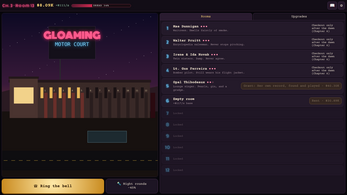
Because the same HTML5 build powers both the free browser demo and the paid download, performance expectations should be set by the text-and-numbers nature of the game rather than by anything twitchy. Four screenshots are available for a look at the interface before committing.
Who should play it
This is for players who like their idle games with a plot attached. The incremental skeleton is real, with forty-four upgrades and offline progress, but the reason to stay is fourteen ghost stories and a Ledger that has to be decoded rather than ground down.
It also suits Halloween-horror readers who want atmosphere over threat. The scares are built from a rule about Room 13, guests who cannot check out, and a Night Manager to keep away from a window, not from combat or reflexes, of which none is documented. Mystery players get eighteen Ledger pages, a codex and a closing deduction to argue with.
Players on Android or an older desktop will appreciate that the entire game is one offline file with mouse or touch input, and Brazilian Portuguese speakers get a full localisation of the roughly twenty-three thousand words. Anyone who wants a short, complete arc will find the first ending about two hours in, while completionists have four endings plus a secret, thirty achievements and Second Shift mode to chase.
Screenshots
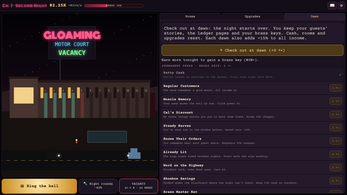
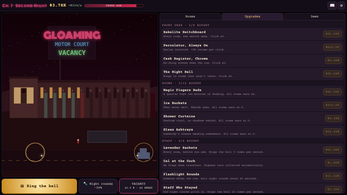
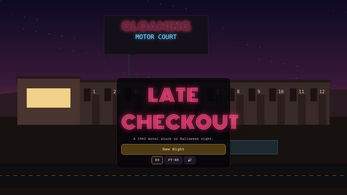
How we tested it
The build was loaded from games.debutplay.com in a headless Chromium session on ; the canvas started and no request was blocked. The guide was last checked on .
From the developer
Halloween, 1962. Highway 9, Nevada. You took the night clerk job at the Gloaming Motor Court by letter. The owner left you a key and one rule in pencil: "Never rent Room 13. No one checks out before dawn." Your guests are dead. They come from 1910, 1928, 1944, 1962... and the dawn never comes. Ring the bell, rent the rooms, grant each guest's last request, and keep the Night Manager out of the office window. Then find out who signed the Ledger. 🛎 What's inside About 2 hours to the first ending (idle/incremental with a full story) 10 chapters in 3 acts, each act adds a new layer: rooms & requests → neon sign, highway traffic & Dread → the dawn loop & the Ledger 14 guest stories with 42 requests and their own checkouts (a waitress who went back into a fire, a pilot, a jazz singer, twin sisters, a trucker, a nun, a runaway, an astronomer, a runaway bride...) 18 Ledger pages to find, a codex of people and places, and a final deduction 44…
Frequently asked questions
How much does Late Checkout cost?
The full game is two dollars as a single offline HTML file. Chapters one to three are available as a free browser demo lasting about twenty-five minutes.
How long does it take to finish?
About two hours to reach the first ending. Beyond that sit ten chapters, fourteen guest stories, four endings plus a secret, and Second Shift mode with an epilogue set in 1963.
Which platforms are supported?
HTML5 in the browser, plus Windows, macOS, Linux and Android through the downloaded file. Input is mouse or touch; no keyboard or gamepad scheme is listed.
Is there a free demo?
Yes. The browser demo covers chapters one to three and runs about twenty-five minutes, using the same pointer controls as the full release.
Does progress continue while the game is closed?
Offline progress is part of the build. Auto-save and three save slots are included, so closing the file does not require a manual save first.
What happens when the night ends?
Checking out at dawn restarts the night while memories carry over. Brass keys earned during runs are spent on ten permanent perks, and Second Shift mode later doubles speed with exclusive scenes.
What games are similar to Late Checkout?
The closest matches on DebutPlay are Nusantara: Governor Simulator, Dig to Australia Deluxe, SHOALKEEPER. They share the same genre, so the controls and the pace carry over.
Something wrong or missing? Tell us. How we test games.