Platformer · New game
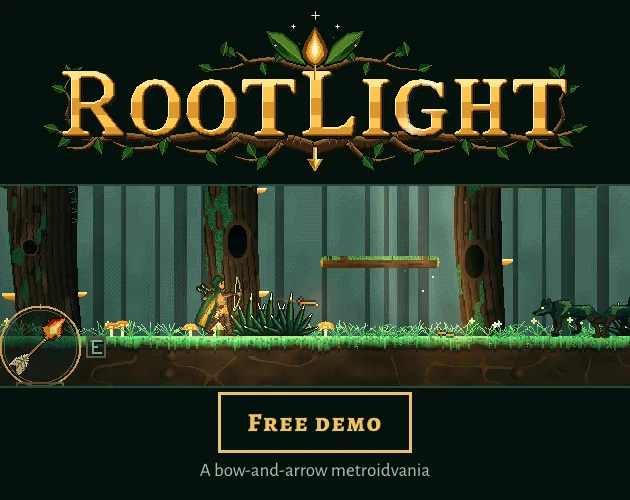
Rootlight
A free browser platformer that hands Hazel a bow, a nearly empty quiver, a lantern firefly and seven arrows that each reshape how the forest can be crossed.
#37 this weekAI-assisted: Code, Graphics, Sound
The game runs in this tab. No install, no account.
The short answer
Rootlight is a 2D exploration platformer set in a rotted forest, where an archer named Hazel descends toward a corrupted Heart with seven special arrows and a firefly lantern. The playable opening act spans fifty-two rooms, six regions, five bosses and ten monster types, with a zoomable map, day and night states and a three-stage bow charge. It runs in the browser and costs nothing to try.
What is Rootlight?
The Heart of the Forest has gone bad, and the creatures that lived beneath the canopy have turned into monsters. Hazel, the last Archer of the Edge, walks in anyway, carrying a bow, a quiver that is nearly out of arrows, and a firefly sealed inside a bark lantern. Her route leads downward, toward the Heart itself.
That premise frames Rootlight as a 2D pixel-art platformer built around exploration. Progress is less about keys and doors than about which arrow answers which obstacle: flame clears webbing and dry roots and can set a brazier burning, light frees a firefly that exposes what darkness covers, vine catches on an anchor and becomes a climbing rope, wind shoves objects and opens the bird seals, blast shatters sealed rock, and resin freezes dark water once night falls. The bow itself charges through three stages, so a held shot and a quick one are different tools.
Moon Cartridge is developing it. The current build, published 21 October 2026, is an in-development demo of the first act that runs in a browser.
How to play
A run pushes Hazel deeper through linked rooms on the way to the Heart, and most rooms are solved with the bow before they are survived with it. An obstacle in the way usually points at the arrow that clears it, whether that means burning something down, lighting a dark corner, hooking a vine to an anchor, pushing a bird seal open, cracking sealed stone or freezing a stretch of dark water.
Combat is a reading test rather than a reflex test. Monsters signal their attacks before the hits land and then leave a gap, and the cleanest answer is the arrow that creature fears. A single keypress swaps straight to that arrow, which keeps attention on spacing instead of on scrolling through a quiver.
The bow holds a charge across three stages, and shots can be aimed by hand or handed over to auto-aim. Escape pulls up the pause menu and the map, which zooms, while the up arrow handles anything interactive: shrines, chests, conversations.
Rooms are short enough that the loop reads quickly: look, identify, switch arrows, commit. The map and the quiver sit a button away, so a wrong guess costs a second rather than a restart.
Controls
Keyboard play uses the left and right arrows to walk, Z or Space to jump, and C or Shift for a dash. The bow sits on X, J or the mouse button: hold to build the three-stage charge, release to send the arrow. Q and E cycle through arrows, number keys 1 through 7 jump straight to a specific one, and F picks whatever the current fight calls for. R is mapped to sap.
The up arrow covers context actions such as using a shrine, opening a chest or starting a conversation, and Escape opens both the pause menu and the map. A gamepad is supported as well, and on a phone the controls are drawn on screen, so no physical keyboard is needed.
Putting aim and fire on the mouse leaves movement on the other hand, and arrow switching stays on the keyboard either way. Nothing about the layout forces a trip through a menu mid-room.
| Input | Action |
|---|---|
| Left and Right arrows | Move |
| Z or Space | Jump |
| X, J or mouse | Bow: hold to charge, release to fire |
| C or Shift | Dash |
| Q and E, or number keys 1-7 | Switch arrows |
| F | Select the arrow the current fight calls for |
| R | Sap |
| Up arrow | Use a shrine, open a chest, talk |
| Escape | Pause and open the map |
| Touch | On-screen controls on mobile |
Tips for your first run
The first act is generous but not padded, and a handful of habits will carry a new archer through the six regions without much backtracking. Treat every stuck room as a question about arrows first and about execution second.
- Hold the bow through all three charge stages before releasing at anything that telegraphs slowly; the timing of the release is the skill.
- Wait for the pause after a monster's attack. That opening is where the arrow it fears does its work.
- If a stretch of dark water refuses to freeze, check the hour. Resin only works at night.
- Press F instead of cycling. It goes straight to the arrow the fight calls for and saves the manual search for puzzles.
- Escape opens the map along with the pause menu, and the map zooms. Check it before wandering into a new region.
- The up arrow is the interact key at shrines, chests and conversations, so try it whenever a room holds something worth reaching.
- Dash on C or Shift is separate from the bow, which makes it the fastest way to cross a room that has already been solved.
Content and replayability
The first act covers 52 rooms across six regions, and it finishes properly: a beginning, a middle and an end, with the ending and the credits included. Inside that span sit seven arrows, four abilities, ten kinds of monster and five bosses, along with four characters to meet and shrines spread through the regions. Both day and night exist, and at least one arrow behaves differently depending on which one is running.
Replay value comes from the arrow system rather than from a second campaign. Because each arrow has its own job, rooms can be re-entered with a different selection and a different charge, and the choice between free aim and auto-aim changes how demanding each fight feels. Four abilities sit alongside the bow, and the zoomable map gives a second pass something concrete to measure itself against. Ten music tracks carry the run, and the build ships in English and Portuguese.
Presentation and performance
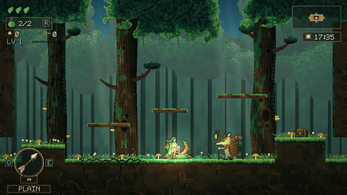
Rootlight's look is pixel art, and its atmosphere leans on the setting rather than on cutscenes: a rotted wood, a corrupted Heart, and one firefly in a bark lantern doing the work of a torch. Visuals, music and sound are generated procedurally by AI-assisted code, with no image or audio files stored in the game, and the act carries ten music tracks. Footage of the game shows it running rather than pre-rendered.
Concept and direction are credited to Flávio Henrique Bonfim of Moon Cartridge, with Claude and Codex named as development collaborators while concept, creative direction, build testing and the final keep-or-cut calls stay with the designer. English and Portuguese are both selectable at the title screen. The game runs as an HTML5 build in the browser, which keeps installs out of the way, and on mobile the touch controls appear over the action.
Who should play it
Anyone who likes a metroidvania where the gate is a tool rather than a key will recognise the shape and find the twist specific: every obstacle becomes a question about which of seven arrows is in hand. Players who enjoy archery timing, with a three-stage charge, readable enemy wind-ups and a punish window after each attack, get a combat loop built on that rhythm instead of on combos.
Short browser sessions suit it. There is no install and no cost, touch controls mean a phone works, and the act's ending and credits give a session a shape rather than letting it trail off. Portuguese-speaking players get a full language option on the title screen.
It is a poorer fit for anyone wanting a finished, long campaign, since what is playable is the first act of a game still in development. Players who dislike assistance can aim by hand instead of leaning on auto-aim, and the six arrow functions give puzzle-minded players plenty to test.
Screenshots
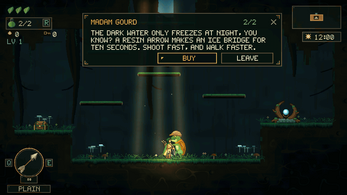
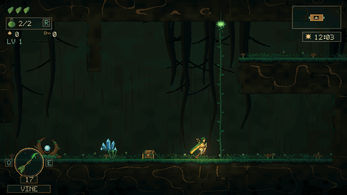
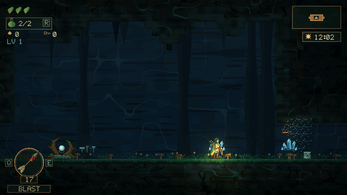
How we tested it
The build was loaded from games.debutplay.com in a headless Chromium session on ; the canvas started and no request was blocked. The guide was last checked on .
From the developer
The old forest has rotted. The Heart of the Forest has been corrupted, and everything that lived beneath the canopy turned into monsters. Hazel, the last Archer of the Edge, walks into the wood with a bow, a nearly empty quiver and a firefly caught in a bark lantern, and goes down to the Heart. Seven arrows. Each one opens the world. Fire burns webs and dry roots and lights braziers. Light releases a firefly that reveals what the dark hides. Vine catches on anchors and becomes a rope to climb. Wind pushes, and opens the bird seals. Resin freezes the dark water, at night only. Blast breaks sealed rocks. Hold to charge the bow in three stages. Aim freely or let auto-aim find the target. Every monster telegraphs its attack and leaves an opening after: use the arrow it fears. The demo: the whole first act 52 rooms in 6 regions, 7 arrows, 4 abilities, 10 kinds of monster, 5 bosses, 4 characters, shrines, a zoomable map, day and night, 10…
Frequently asked questions
Is Rootlight free?
Yes. The browser build costs nothing to play, so the first act can be tried without a purchase.
Can Rootlight be played on a phone?
Yes. Touch is one of the supported input options and the on-screen controls appear on mobile, alongside keyboard and gamepad support on other devices.
How much of the game is playable now?
The whole first act: 52 rooms in six regions, seven arrows, four abilities, ten monster kinds, five bosses and four characters, running through to an ending and credits.
Does Rootlight have a map?
Yes. A zoomable map opens together with the pause menu when Escape is pressed, which makes it easy to check a region before committing to a direction.
Which languages does Rootlight support?
English and Portuguese. The language option sits on the title screen, so it can be changed before the run starts.
How does the bow work?
Hold to build a charge through three stages and release to fire. Shots can be aimed freely or left to auto-aim, and F selects the arrow a fight calls for.
What games are similar to Rootlight?
The closest matches on DebutPlay are ARCANUM: Path of the Magus, TORCH, TORCH!, Hold On!. They share the same genre, so the controls and the pace carry over.
Something wrong or missing? Tell us. How we test games.