Adventure · New game
ARCANUM: Path of the Magus
A novice mage with a mostly blank grimoire descends into the ruins of Asterion, solving environmental puzzles with three-rune spells across twenty chapters.
#5 this weekAI-assisted: Code, Graphics, Sound, Text
The game runs in this tab. No install, no account.
The short answer
ARCANUM: Path of the Magus is a 2D fantasy puzzle adventure that runs in a browser and costs nothing to play. Jackdaw, an adventurer who wants to learn magic somewhere useful, explores twenty chapters of ruins, buried districts and dream-logic spaces, casting spells by entering three-rune formulas until his repertoire reaches fourteen abilities.
What is ARCANUM: Path of the Magus?
ARCANUM: Path of the Magus is a 2D fantasy puzzle adventure built around Jackdaw, an adventurer by trade and a novice mage by ambition. He would rather learn magic somewhere it matters than somewhere safe, so he heads for Asterion, a set of forgotten ruins full of ancient inscriptions, sealed passages and abandoned machinery. He arrives with a sturdy grimoire, far too many blank pages and two spells he can usually count on, and the ruins are where that short list starts growing.
The journey runs across twenty chapters, moving from a sunlit gate into buried districts and eventually into places where waking life and dreams stop being easy to separate. Each location poses a practical problem — a damaged structure, an unreachable passage, an apparently useless machine — and answers it through observation and spellcraft rather than force.
Magic is the constant tool. Spells are cast by entering formulas of three runes, and the repertoire expands to fourteen abilities over the course of the descent. The game released on 22 October 2026, runs as an HTML5 title in the browser, and is free to play.
How to play
Everything routes through the grimoire. Casting a spell means entering a formula built from three runes, and each formula learned adds a tool rather than a weapon. Revelatio uncovers hidden writing and markings, which is how inscriptions turn into directions. Motus sets objects and mechanisms in motion. Lumen carries light into corridors that have gone dark. Memoria lets Jackdaw investigate the impressions left behind by the people who once lived there.
The early chapters lean on those four. Puzzles ask for connections restored between ancient devices, signals followed through a network of pipes, and an understanding of how sound, reflection and movement alter a mechanism's behaviour. In the gardens beneath the salt, living plants become part of the solution, and elsewhere careful observation followed by one well-timed action achieves what force cannot.
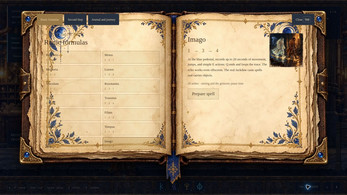
Later areas layer complications on top of familiar spells. Stasis holds an object in its present state so machinery that refuses to stay still can be worked on. Tempus rewinds or advances an object's local time, letting its earlier and later conditions be studied. Gravitas redirects gravity, opening routes across walls and ceilings. Imago records an echo of Jackdaw's movements and simple actions, then replays it so two versions of him can operate mechanisms together.
Controls
The grimoire sits between the player and the world. Casting is expressed as a three-rune formula: assemble the runes for the spell wanted and the effect lands on the environment rather than on an enemy. The opening toolkit is small enough to hold in mind, with Revelatio, Motus, Lumen and Memoria forming the first working set, but the full repertoire reaches fourteen abilities, so remembering which formula does what becomes part of the challenge.
Many interactions come down to timing and placement rather than reflexes. Stasis freezes an object in its present state. Tempus pushes an object forward or backward through its own local time. Gravitas turns gravity so walls and ceilings become traversable surfaces. Imago records a movement echo and simple actions, then replays them, which allows two versions of Jackdaw to work a mechanism in coordination. Elsewhere the action is simply a well-timed move made after careful observation.
The game page does not list its controls. Check the in-game tutorial or pause menu for the current scheme.
Tips for your first run
Treat the grimoire as a notebook rather than a gun rack. Spells are answers to environmental questions, and a machine that looks broken is often waiting for the right formula rather than a repair. When a passage seems unreachable, check whether the problem is distance, light, movement or timing before experimenting.
Observation pays off more than speed. Sound, reflection and movement all change how a mechanism behaves, and the later chapters deliberately return to spells learned early, asking for them to be used with a new purpose in mind.
- Cast Revelatio on inscriptions and wall markings before assuming a room is finished.
- Use Motus on any mechanism that has an obvious moving part but no obvious switch.
- Keep Stasis in mind for machinery that will not hold still long enough to be studied.
- Test Tempus on objects whose condition might matter at a different point in their local time.
- Record an Imago echo when a mechanism needs two simultaneous actions.
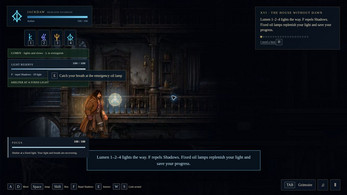
- In The House Without Dawn, keep Shadows at a distance, shelter near fixed lights and watch the light reserves.
- Revisit an unsolved chamber after learning a new formula instead of forcing a solution.
Content and replayability
Twenty chapters form the spine of the game, and they escalate rather than repeat. Early rooms teach single spells against simple obstacles; later challenges ask for several ideas combined, and familiar formulas return with new purposes attached. The grimoire grows from a book of possibilities into a record of hard-earned experience, and by the final chapter every spell has a part to play in the way forward.
One chapter breaks the pace deliberately. In The House Without Dawn, pursuing Shadows turn darkness into a genuine threat, and Lumen shifts from an exploration tool into a means of protection. Keeping the creatures at a distance, seeking shelter near fixed lights and managing light reserves all happen while a corridor puzzle demands attention, so the pressure of footsteps closing in changes how the puzzle is solved.
The structure rewards a second look at old ground. Because progress is measured in understanding — learning a formula, recognising where it belongs, then making it work under pressure — rooms read differently once the full set of fourteen abilities is available.
Presentation and performance
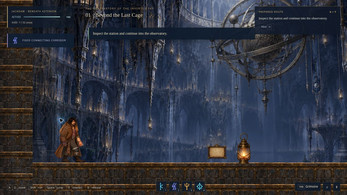
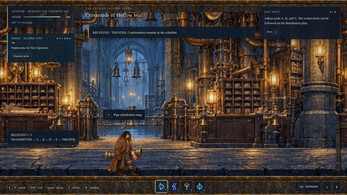
The chapters are painted rather than tiled. Warm light falls across ivy-covered stone, lanterns illuminate abandoned workshops, and vast underground halls fade into cold blue distance. Animated characters move against layered backgrounds, with magical effects and environmental sound carrying the atmosphere of each area.
The scenery shifts as the descent continues. Dreamlike houses and forests give way to clockworks, buried streets and an observatory beneath an inverted sky, so no two stretches of the journey look alike. Music and ambient audio sit underneath the puzzle work rather than over it.
The game is delivered as an HTML5 build that plays inside a browser frame, with a downloadable-in-page setup rather than a separate client. Detailed painted art and layered backgrounds are the heaviest visual element on show, and the frame is the only place the game needs to run.
Who should play it
This suits players who like puzzles that are solved by understanding a place rather than by reflexes. The verb set is knowledge: uncover writing, set a mechanism moving, carry light, read the past. Anyone who enjoys returning to a room with a new tool and immediately seeing the answer will find the chapter structure generous.
It also suits players who want a fantasy adventure without combat systems to manage. The tension in The House Without Dawn comes from darkness, pursuit and limited light, not from a health bar or an attack button, so the scariest section is still a puzzle to be reasoned through.
The low barrier matters too: a browser game that is free to play, playable without installation, and structured in twenty chapters that can be approached a few at a time. Players who prefer to wander, test formulas and read inscriptions will get more out of Asterion than those who rush the exits.
Screenshots
How we tested it
The build was loaded from games.debutplay.com in a headless Chromium session on ; the canvas started and no request was blocked. The guide was last checked on .
From the developer
ARCANUM: PATH OF THE MAGUS Jackdaw has a sturdy grimoire, far too many blank pages, and two spells he can usually rely on. An adventurer by trade and a novice mage by ambition, he has decided that the best place to learn magic is somewhere it might actually be useful. The forgotten ruins of Asterion seem promising: ancient inscriptions, sealed passages, abandoned machinery—and plenty of opportunities to discover whether he knows what he is doing. ARCANUM: PATH OF THE MAGUS is a 2D fantasy puzzle adventure that follows Jackdaw through twenty chapters of exploration and discovery. His search for lost formulas takes him beyond a sunlit gate, deep into buried districts, and across the uncertain boundary between waking life and dreams. Each new place brings another practical problem to solve, another trace of the people who lived there, and another reason to keep filling the grimoire. Magic is your most versatile tool. Cast spells by…
Frequently asked questions
Is ARCANUM: Path of the Magus free?
Yes. The game is free to play, with no purchase required before starting.
What kind of game is it?
A 2D fantasy puzzle adventure about exploration and spellcasting, blending adventure, platformer and puzzle elements across twenty chapters.
How does spellcasting work?
Spells are cast by entering formulas of three runes. The repertoire grows to fourteen abilities, beginning with Revelatio, Motus, Lumen and Memoria.
Who is the main character?
Jackdaw, an adventurer by trade and a novice mage by ambition, who carries a sturdy grimoire and starts with two spells he can usually rely on.
Where does the game run?
It is an HTML5 browser game with a playable frame, released on 22 October 2026.
What is The House Without Dawn?
A chapter where pursuing Shadows make darkness dangerous. Lumen becomes protection, fixed lights offer shelter, and light reserves must be managed while solving a corridor puzzle.
What games are similar to ARCANUM: Path of the Magus?
The closest matches on DebutPlay are The Oasis, TORCH, TORCH!, Raft Drift. They share the same genre, so the controls and the pace carry over.
Something wrong or missing? Tell us. How we test games.