Simulation · New game
So You Wanna Be Black
Altygamer's free browser prototype turns a childhood in fictional A-Town into a chain of needs, report cards, mini-games and strikes that follow you into young adulthood.
#48 this weekAI-assisted: Code, Graphics
The game runs in this tab. No install, no account.
The short answer
So You Wanna Be Black is a free, single-player, 2D isometric life sim about growing up Black in a fictional Atlanta. Name a baby, accept a randomly generated family and household income, then steer one life from newborn coos and crawling mini-games through school afternoons to the risks of the teen years.
What is So You Wanna Be Black?
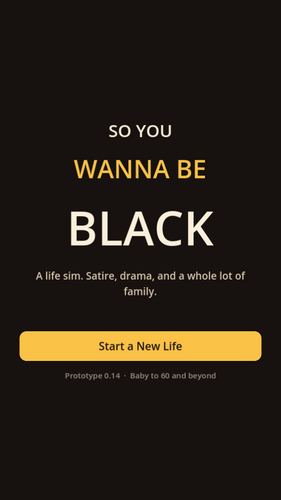
So You Wanna Be Black is a satire-first life simulation from developer Altygamer, built as an HTML5 game that runs in the browser and currently labelled a prototype. It follows a single character from the delivery room to young adulthood, and it stages that journey in a fictional Atlanta the game calls A-Town.
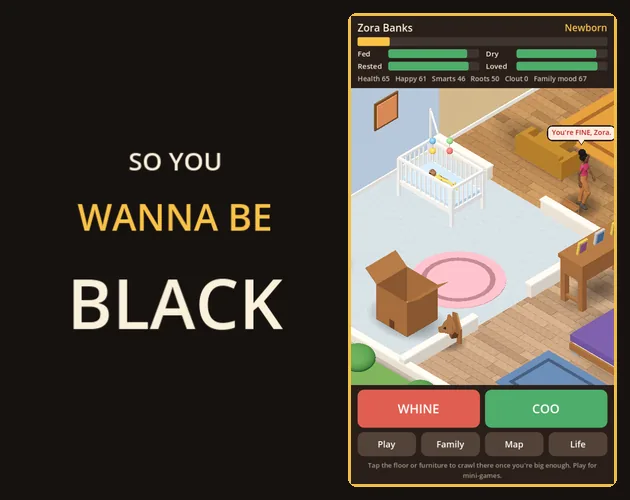
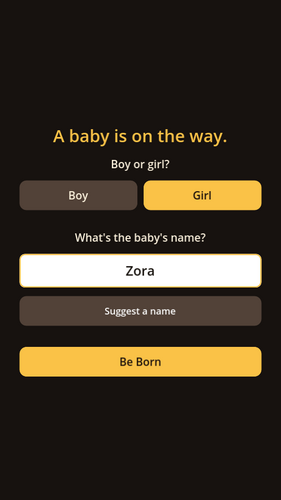
The setup is quick. You name a baby, the game hands over a randomly chosen family together with a household income and a neighbourhood, and the life begins. From there, four needs sit underneath everything: Fed, Dry, Rested and Loved. Keeping those satisfied is what keeps the family's patience intact. Time is the other currency, because how each year's afternoons get spent turns into grades, stats and reputation, while the friends kept and the risks taken travel forward through a strikes system. Every stage inherits what the one before it left behind.
It is a single-player, 2D, isometric game with clear debts to BitLife and The Sims, and it costs nothing to launch in a browser window.
How to play
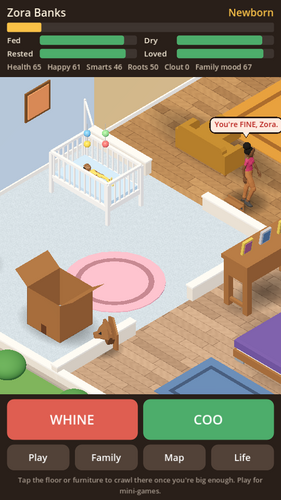
Play starts at the smallest possible scale. As a newborn, the only tools are two sounds: whine when a need drops low, and coo to keep the family on side. Needs and patience pull against each other here, and once the baby can crawl, tapping the floor or furniture moves the character around while the Play panel opens the mini-games.
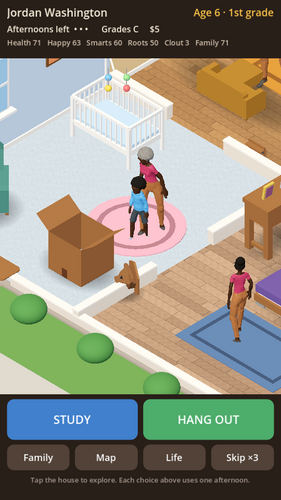
Childhood turns the calendar into a budget. Each year offers a few afternoons, and those afternoons go on studying or hanging out; the house can be tapped to explore, the Map travels to other places, and Skip pushes time ahead. Report cards, money goals and story events start to register on the character.
The teen years keep the same Map, Family, Life and Skip buttons but add two more ways to spend an afternoon: work and hustle, alongside study and hanging out. Moral dilemmas and other event cards interrupt with a choice to tap and a Continue button to confirm it. Autosave runs in the browser, so Continue on the opening screen restores a life already in progress.
Controls
Everything except one action is handled with a tap or a click. The keyboard comes into play only when typing the baby's name into the naming step.
In the newborn stage, the Whine and Coo prompts are on-screen buttons tied to the four needs: answer a falling need with a whine, and use a coo when the goal is winning the family over. Once crawling unlocks, tapping the floor or furniture is the movement command. The Play panel holds the mini-games, and the Family, Map and Life panels sit alongside it.
Childhood and the teen years swap the sound buttons for afternoon choices, with Map, Family, Life and Skip available throughout. Event cards work the same way at every age: tap the choice, then tap Continue.
The game is best played in a fullscreen window. The interaction model is pointer-based from start to finish, and nothing beyond name entry is mapped to the keyboard.
| Input | Action |
|---|---|
| Mouse or tap | Select every panel, afternoon choice and event-card option, including Whine and Coo |
| Mouse or tap | Move the crawling baby by tapping the floor or furniture |
| Keyboard | Type the baby's name during the naming step |
Tips for your first run
Four needs run the newborn stage and the family's patience is the meter that answers to them, so the first useful habit is checking Fed, Dry, Rested and Loved before things get desperate. A whine is the emergency lever; a coo is the diplomatic one.
- Coo when nothing is urgent. Winning the family over is worth doing before the first crisis, not during it.
- Crawl early. Movement unlocks access to the floor, the furniture and the Play panel that holds Peekaboo, Stack the Blocks and Miss Mary Mack.
- Treat each year's afternoons as a fixed budget. Only a few exist, and study and hanging out push grades, stats and reputation in different directions.
- Track your strikes. Risks taken and friends kept carry into the next stage, so a cheap shortcut now is a debt later.
- In the teen years, work and hustle join study and hang out as options. Decide early which one the run is built around rather than spreading afternoons evenly.
- Use Skip when a stage is settled, and rely on the browser autosave rather than closing the tab mid-decision.
Content and replayability
Replay value comes from the opening roll. Family, household income and neighbourhood are chosen at random, so two runs begin from different positions before a single afternoon has been spent.
Three stages are in place — newborn, childhood and the teen years — covering one arc toward young adulthood, with each stage inheriting the previous one's numbers. Story events, moral dilemmas, report cards and money goals keep interrupting that arc, and the strikes system is the connective tissue that makes earlier decisions visible later.
The mini-games form a lighter second layer: Peekaboo, Stack the Blocks and Miss Mary Mack. Because the build is a prototype, what is playable now is the full scope of this version rather than a finished commercial release.
Presentation and performance
The look is 2D and isometric, drawn around a satirical tone rather than a realistic one, and four screenshots are available to preview the art before starting. The whole thing runs as an HTML5 build in a browser, with no separate launcher described.
Autosave happens in the browser, which makes short sessions practical, and Continue picks up exactly where the last one ended. Fullscreen is the recommended way to play, which matters for a game where panels such as Family, Map, Life and Play all compete for space alongside event cards.
The project is built with the Godot Engine 4.3 under an MIT licence, with AI assistance used for code, disclosed openly by the developer. It was made during the Game Gauntlet SIM Jam, which began in October 2026, and it launched on 26 October 2026. No system requirements, audio credits or performance figures are published, so judge smoothness on your own hardware.
Who should play it
Anyone who has sunk hours into BitLife or The Sims will recognise the shape immediately: a life measured in stats, a handful of choices per year, and consequences that surface much later. The difference is the subject. This is a satirical simulation of growing up Black in a fictional Atlanta, and the humour and the systems point at the same target.
It suits players who like reading event cards and weighing trade-offs more than reflexes. The only action-heavy moments are the crawling mini-games, and the rest is tapping choices, checking needs and watching grades, money and reputation drift.
Browser delivery keeps it low commitment: open a tab, name a baby, spend a few afternoons, and close it knowing the autosave is holding your place. Because it is free and still a prototype, it works well as a curiosity for design-minded players who want to see how needs, patience and strikes get wired into a life sim.
Screenshots
How we tested it
The build was loaded from games.debutplay.com in a headless Chromium session on ; the canvas started and no request was blocked. The guide was last checked on .
From the developer
What it's going for: a satirical life sim of growing up Black in a fictional Atlanta ("A-Town"), where everyday choices about needs, friends, school and money ripple into the person you become. For players who love BitLife and The Sims. So You Wanna Be Black is a satirical life sim. Name your baby, get a randomly chosen family, household income and A-Town neighborhood, and live their life one stage at a time. As a newborn you whine and coo to keep your needs met and your family's patience up, then crawl around and play mini-games. As a kid and then a teen you choose how to spend a few afternoons each year (study, hang out, work or hustle) while story events, moral dilemmas, report cards, money goals and strikes shape your grades, stats and reputation on the way to young adulthood. HOW IT FITS THE THEME (SIMULATION) It simulates a life as a system: needs (Fed, Dry, Rested, Loved) feed family patience; how you spend time feeds grades,…
Frequently asked questions
Is So You Wanna Be Black free?
Yes. It costs nothing and runs in a browser, so there is no purchase step before naming a baby and starting a life.
Where do you play it?
It is an HTML5 game delivered in the browser, best viewed in a fullscreen window. Panels for Family, Map, Life and Play all share that single screen.
Does it save progress?
Yes. The game autosaves in your browser, and the Continue option on the opening screen resumes the life you left, including mid-stage decisions.
How many life stages are there?
Three are described: newborn, childhood and the teen years, carrying the character toward young adulthood. Each stage inherits the grades, stats, reputation and strikes left behind.
What mini-games are included?
Peekaboo, Stack the Blocks and Miss Mary Mack. They open from the Play panel once the baby can crawl, and they sit alongside the Family, Map and Life panels.
Who made it and what is it built with?
Altygamer made it during the Game Gauntlet SIM Jam, which started in October 2026, using Godot Engine 4.3 under an MIT licence. AI assistance was used for code, and the build is labelled a prototype.
What games are similar to So You Wanna Be Black?
The closest matches on DebutPlay are Enfield: Chalkboard Basketball, Le Grenier (The Attic), Sushi Wave. They share the same genre, so the controls and the pace carry over.
Something wrong or missing? Tell us. How we test games.