Visual novel · New game
The Dark Cafe
A cozy counter by day, a ledger of secrets by night: The Dark Cafe asks players to read moods, brew strange drinks, and name a culprit before Halloween.
#1 this weekAI-assisted: Code
The game runs in this tab. No install, no account.
The short answer
The Dark Cafe is a short pixel-art visual novel where a daytime coffee rush funds a nighttime bar for ghosts and monsters who pay in secrets. You read mood words in each guest's talk, mix the matching drink, and build a case about who is making townsfolk vanish. Three days, three nights, about half an hour.
What is The Dark Cafe?
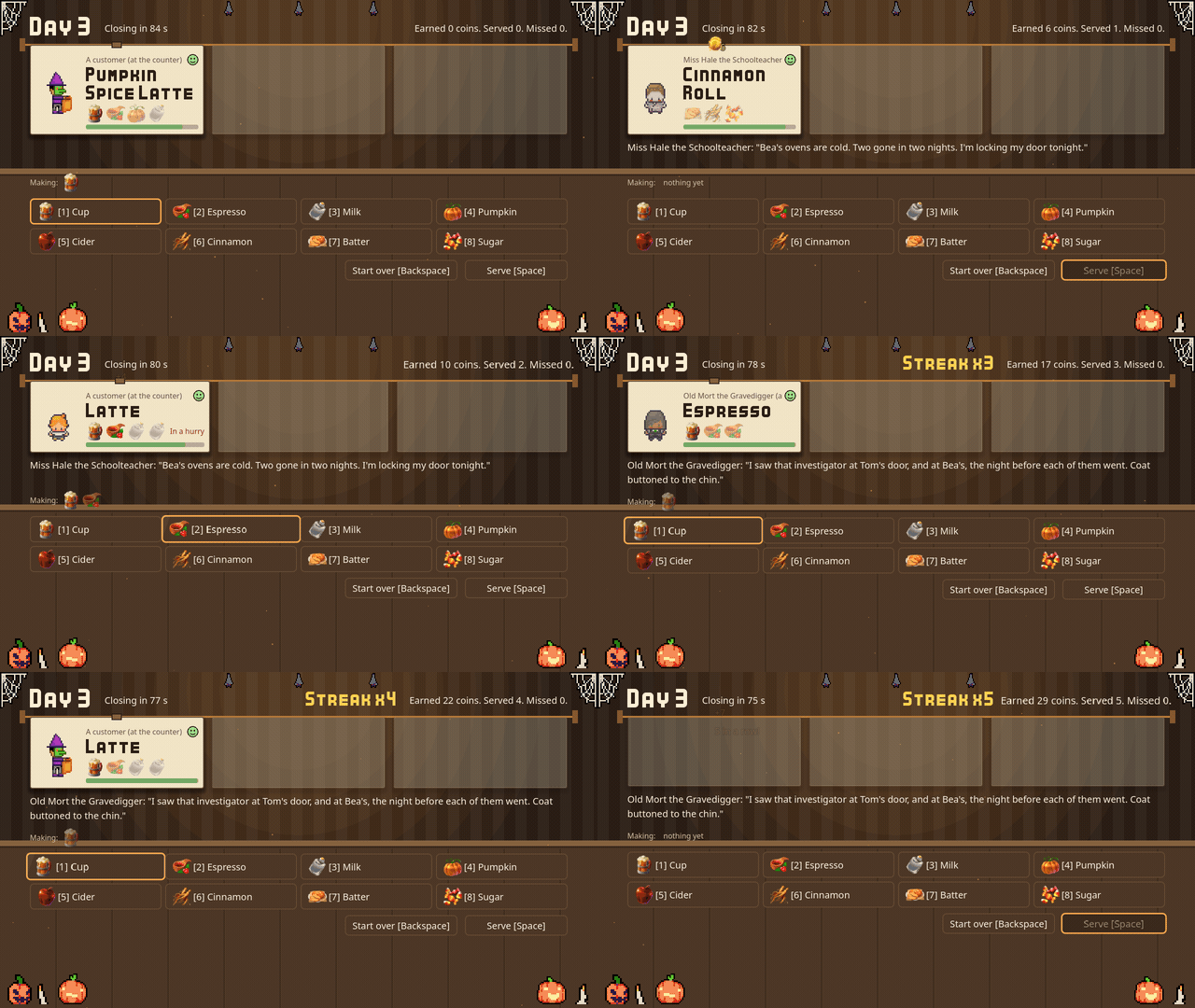
The Dark Cafe is a pixel-art visual novel with a management loop wrapped around a single odd business. In daylight it works like any coffee shop, and the player runs a fast counter for the townsfolk, turning out lattes, pumpkin spice and hot cider. The tips from that rush pay for the ingredients the evening will need.
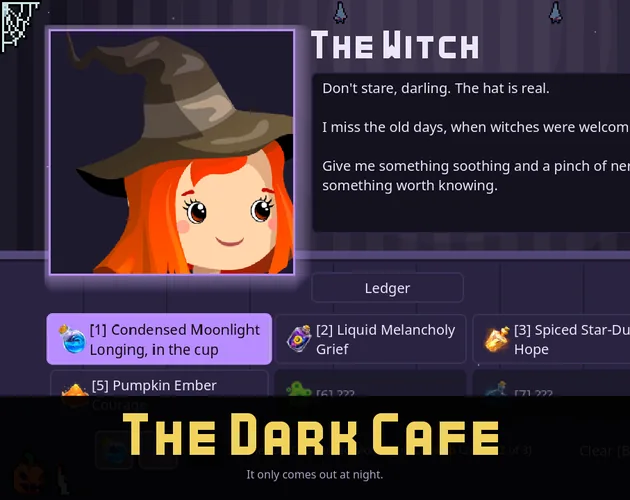
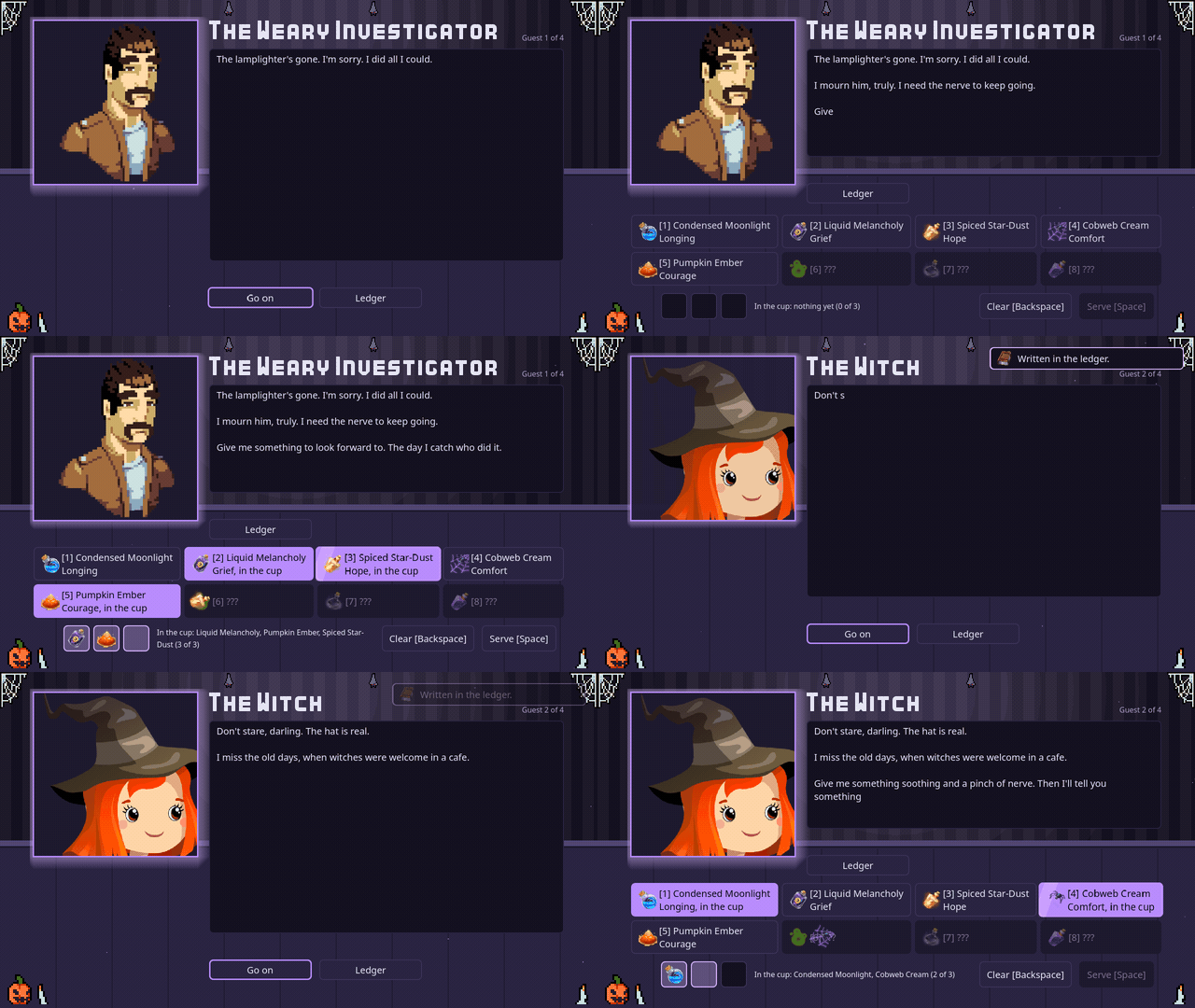
At sunset the human door locks by itself and a portal opens behind the counter. The clientele changes completely: ghosts, a scarecrow, a werewolf, a witch, a banshee, a vampire, a shadow, a headless horseman and a weary investigator arrive, and none of them are after coffee. They order drinks distilled from feelings, among them Condensed Moonlight, Liquid Melancholy and Spiced Star-Dust.
Underneath the bar work sits a mystery. Somebody in town disappears every night, and the player has three days and three nights, roughly half an hour in total, to fill a ledger with what guests let slip. After Halloween night the case has to be closed by naming the person behind the vanishings and explaining the motive that drove them.
How to play
The day shift is a sequence game. Orders hang on a rail, and each ticket shows an order of stations to hit before the drink goes to whoever is standing at the front. Waiting faces sour, so speed matters: correct serves in a row build a streak for larger tips, and a fast serve pays better than a slow one. A wrong cup earns nothing, which makes restarting it the smarter move than handing it over.
Closing time is the shopping phase. Tips convert into fresh ingredients for the night, and an ingredient that has gone stale still goes into the cup but drags the result down to a rumor at best. Three tools change how the week plays out: a larger kettle that buys extra time at the day counter, a tasting spoon that identifies a single correct ingredient, and a lantern that converts one wrong drink into a near miss.
After dark the game becomes close reading. Every guest's speech carries mood words such as grief, longing or courage, and those words point at which jars belong in the cup. An exact drink earns a secret, a near miss earns only a rumor, and a fully wrong one earns nothing at all. Occasionally a guest leaves a rare ingredient behind as a gift.
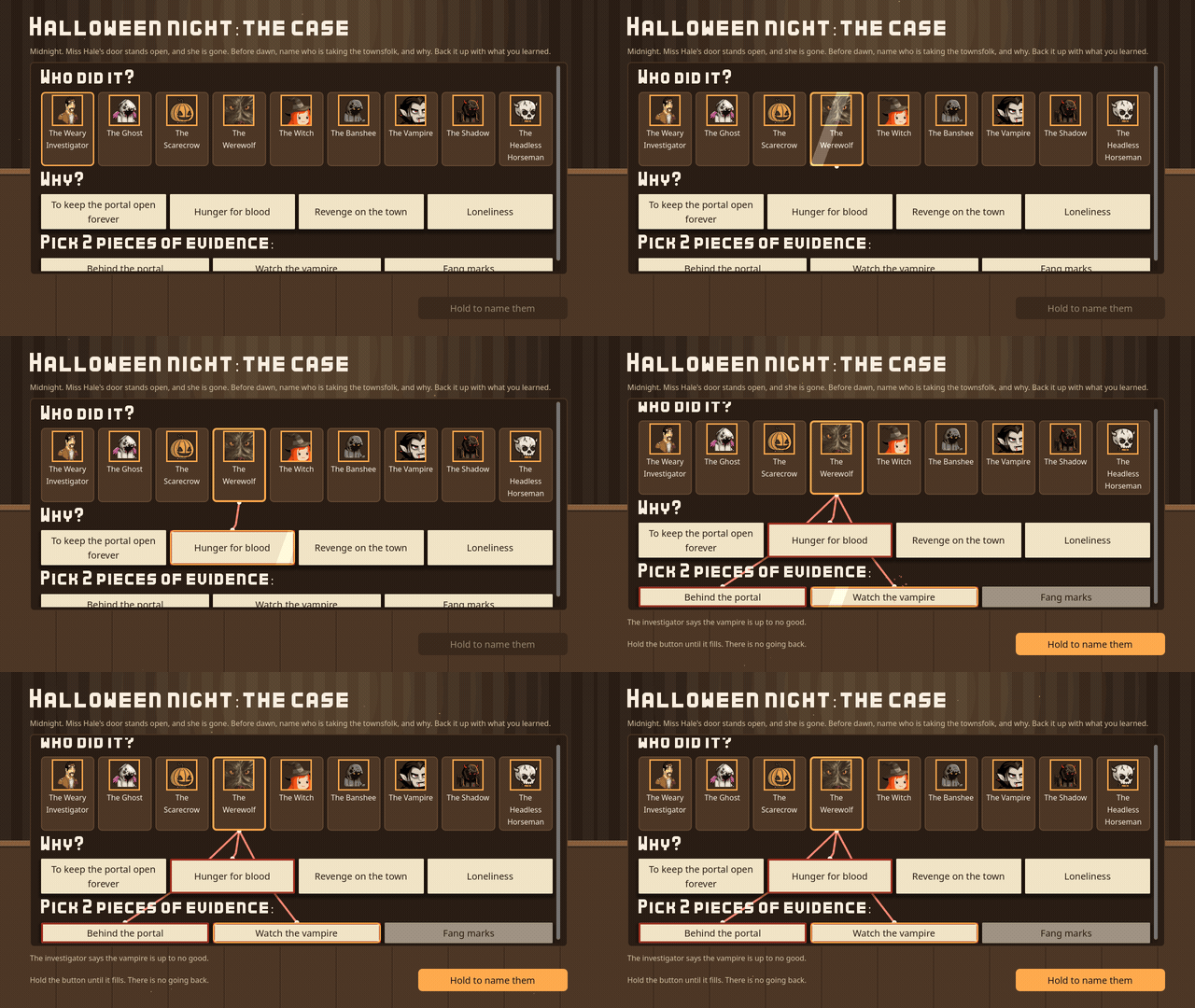
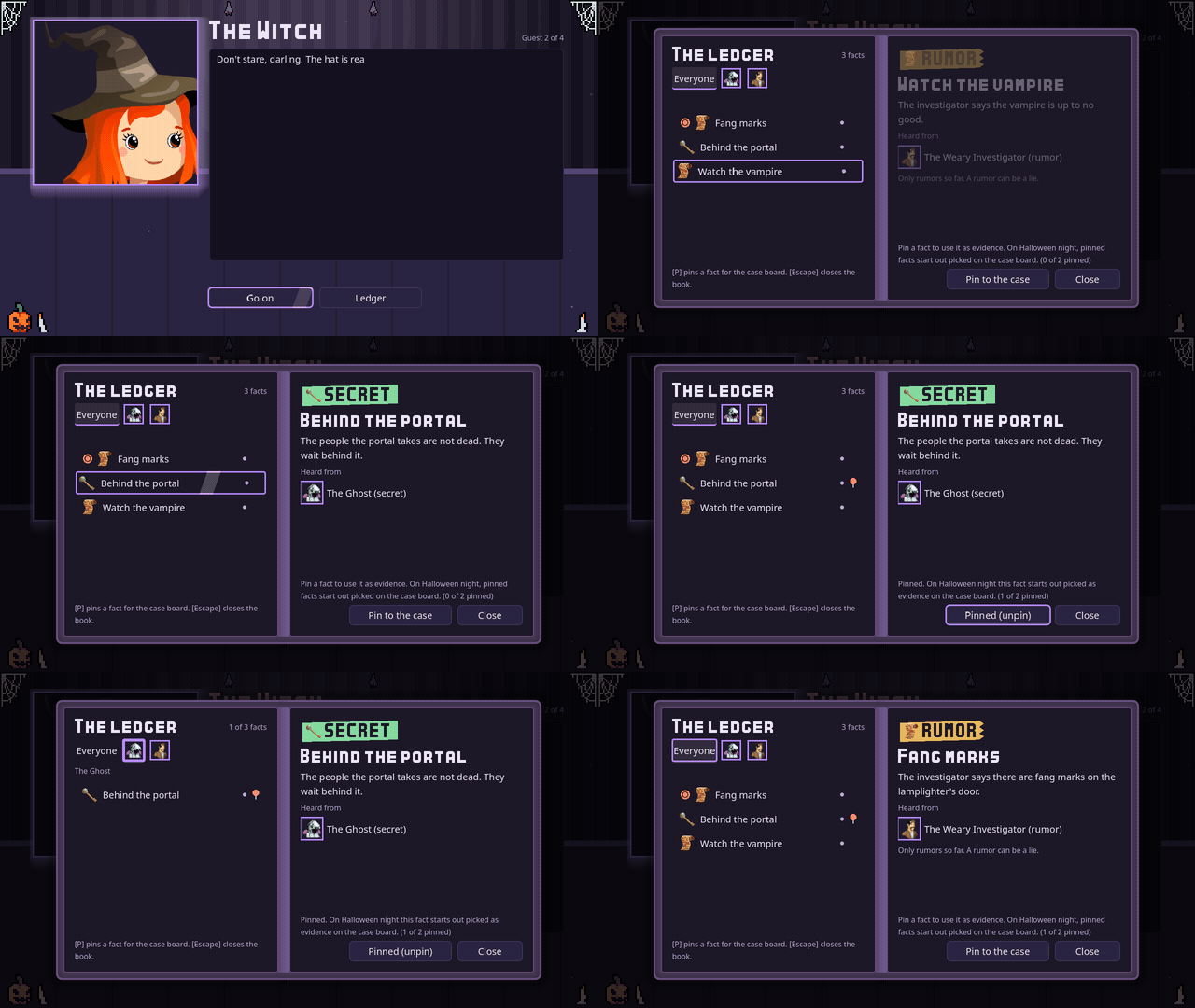
The ledger collects every secret, rumor and scrap of gossip along with the name of whoever said it. Rumors can be lies, while a secret confirms a fact, and trusted facts can be pinned for the final call. Each dawn brings a paper naming who vanished overnight. On Halloween night the player names culprit and motive and supports the accusation with two pieces of evidence, and that case decides which ending arrives.
Controls
Mouse, keyboard and controller are all supported, and the controls menu remaps any key or button on either input method. Focus moves with the arrow keys or Tab, or with a D-pad and left stick on a pad. Enter or Space confirms a press, matching the A button, while Esc backs out or closes a panel and mirrors B.
On the counter, number keys 1 through 8 press a station or pick a jar, and a controller user moves focus and then presses A for the same effect. Space serves the drink, with Y on a pad, and Backspace starts the current cup over, with X on a pad. At night the ledger opens with L or Tab, or the View button, and facts are pinned with P or Y. Esc pauses, as does Start on a controller.
The accessibility menu reshapes difficulty without changing the puzzle. A Relaxed day rush removes the clock so customers wait as long as needed, text scales between 75% and 150%, and reduced motion stops the screen shake, the typewriter text and the idle animations. Mood hints stay marked on every night rather than only the first, and naming the culprit requires a held press so a run cannot end on a stray tap.
| Input | Action |
|---|---|
| Arrow keys or Tab | Move focus (D-pad or left stick on a controller) |
| Enter or Space | Confirm a press (A on a controller) |
| Esc | Back out or close a panel (B); pauses the game (Start) |
| 1-8 | Press a counter station or pick a jar |
| Space | Serve a drink (Y on a controller) |
| Backspace | Start the current cup over (X on a controller) |
| L or Tab | Open the ledger at night (View on a controller) |
| P | Pin a fact in the ledger (Y on a controller) |
| Controls menu | Remap any key or button |
Tips for your first run
The first night is where most runs are won or lost, because guessing at jars wastes expensive ingredients. Spend the early tips on the tasting spoon and let it reveal one correct component per cup, then work the rest of the recipe out from the guest's mood words rather than from trial and error.
Treat the ledger as a filter rather than a diary. Everything a guest says can go in it, but only confirmed facts deserve a pin on the case board, and the dawn paper is the other half of that picture.
- Serve in the order the ticket shows instead of by ingredient; the rail rewards the sequence.
- Restart a mis-poured day cup with Backspace or X rather than serving it for nothing.
- Buy the spoon before the kettle if the night drinks keep landing as rumors.
- Keep streaks alive with quick serves, since tips are the only route to fresh ingredients.
- Watch for guests who hand over a rare ingredient; those gifts stretch a tight budget.
- Cross-check the dawn paper against pinned facts before Halloween night.
- Switch on the Relaxed day rush if the counter clock is spoiling the reading time.
Content and replayability
A full run covers three days and three nights in about thirty minutes, which makes it a single-sitting game rather than a long campaign. The cast is fixed but not static: nine night guests pass through the portal, and four regulars gossip at the day counter. Not all of them survive to Halloween, so who is still around at the end depends on how the week unfolds.
The deduction layer gives the short runtime its replay value. Rumors are explicitly unreliable and secrets are not, so two players can finish with different ledgers, different pins on the case board and different confidence in their accusations. Three endings branch from the final call, and sixteen achievements give completionists something to chase across repeated runs through the same three nights.
Presentation and performance
The look is pixel art, with the cafe's warm day service contrasted against the stranger, dimmer night trade and its visiting ghosts and monsters. Four screenshots preview that split, and the game runs in an HTML5 frame in the browser alongside separate Windows and Linux builds.
The sound team is credited as Arcade Origins and Audio Hero for music, with Kenney, Gamemaster Audio and Arcade Origins handling sound. Art comes from CraftPix.net, Pop Shop Packs and LimeZu, and the fonts are from Kenney and the Noto Project. The project was made with Redot on Nobara Linux, and the full credit roll is available on the in-game Credits screen.
Comfort options carry a lot of the presentation load. Text can be scaled from 75% up to 150%, screen shake and typewriter effects can be switched off together under reduced motion, and the mood words that anchor the night puzzle can stay highlighted permanently rather than for a single evening. Pinning facts and opening the ledger are one-button actions, so note-taking never pulls attention away from the dialogue.
Who should play it
This suits players who like a mystery they have to actually solve. The case is not handed over at the end; it is assembled from mood-matched drinks, guest confessions and a morning paper, and the final accusation has to be argued with two pieces of evidence. Anyone who enjoys a case board with red string will find the loop familiar and satisfying.
It also fits short sessions. Thirty minutes for a complete run means an evening, not a commitment, and the three endings reward a second pass once the culprit is known. The Halloween dressing, the ghost, werewolf and headless horseman regulars, and the cozy-but-creepy cafe setting give it seasonal appeal without requiring horror tolerance.
Players who struggle with timed pressure can still finish, since the Relaxed day rush removes the clock entirely and the text scaling and reduced motion options lower the other barriers. Anyone who mainly wants a pure visual novel should note the day counter is a real sequence game, and anyone who wants a long mystery should note the whole week fits into roughly half an hour.
Screenshots
How we tested it
The build was loaded from games.debutplay.com in a headless Chromium session on ; the canvas started and no request was blocked. The guide was last checked on .
From the developer
THE DARK CAFE A cozy cafe by day. After sunset, the night guests pay in secrets. By day, The Dark Cafe is an ordinary coffee shop. You run a fast counter for the townsfolk: lattes, pumpkin spice, hot cider. The tips pay for tonight's ingredients. At sunset the human door locks by itself, and a portal opens behind the counter. Ghosts, a scarecrow, a werewolf, a witch, a banshee, a vampire, a shadow, a headless horseman and a weary investigator come through. They don't want coffee. They want drinks made of feelings: Condensed Moonlight, Liquid Melancholy, Spiced Star-Dust. Listen to what they say, find the mood in their words, and brew the right cup. Brew it well and they pay you in secrets. Brew it almost right and you get a rumor. Somebody in town is vanishing every night. Fill your ledger, and after Halloween night, name who is behind it and why. 3 days and 3 nights, about 30 minutes.A day rush with streaks, rush hours and customers…
Frequently asked questions
How long is The Dark Cafe?
A complete run spans three days and three nights, which comes to roughly thirty minutes.
Does The Dark Cafe cost anything?
No. It is free to play, with no purchase needed to start a run.
What platforms is it on?
It plays in a browser through an HTML5 frame, and there are separate Windows and Linux builds.
Can the controls be changed?
Yes. Every keyboard key and controller button can be rebound from the controls menu.
How many endings and achievements are there?
There are three endings and sixteen achievements, and the ending is decided by the final accusation on Halloween night.
Are rumors in the ledger trustworthy?
No. Rumors can be lies, while a secret confirms a fact, so only confirmed material is worth pinning to the case board.
What games are similar to The Dark Cafe?
The closest matches on DebutPlay are What the Water Gave Back, Ashes of a Former Life, Rounding Error. They share the same genre, so the controls and the pace carry over.
Something wrong or missing? Tell us. How we test games.