Visual novel · New game
Rounding Error
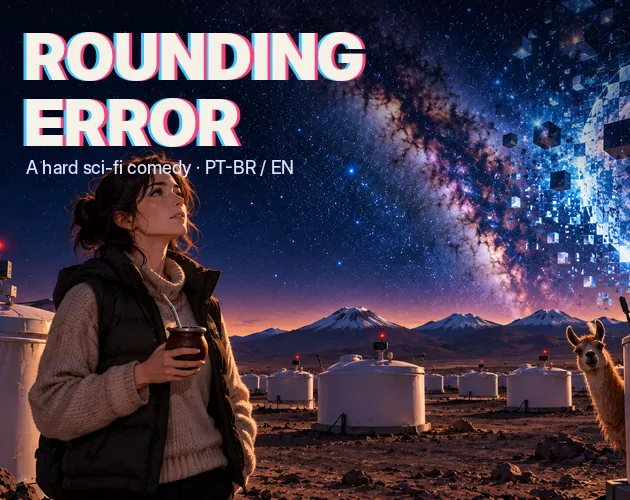
A hard sci-fi comedy visual novel about an impossible cosmic-ray pattern, a simulated universe's overworked scheduler, and the paper that makes it notice.
#44 this weekAI-assisted: Code, Graphics, Sound, Text
The game runs in this tab. No install, no account.
The short answer
Rounding Error is a hard sci-fi comedy visual novel about an insomniac astrophysicist who finds impossible cosmic rays aligned on a grid, and the overworked cosmic process that schedules the simulated universe and has just read her team's paper. Twelve chapters, ten endings, and a free two-chapter browser demo make it easy to start tonight.
What is Rounding Error?
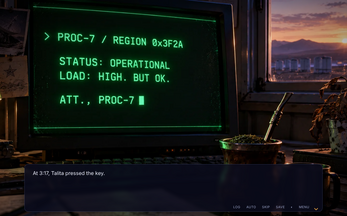
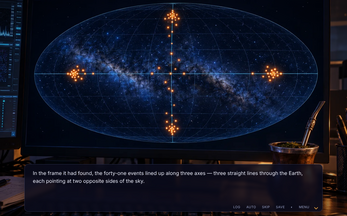
Rounding Error opens at 2:17 a.m. in the Atacama desert, four thousand two hundred metres above sea level, where Dr. Talita Brum registers forty-one cosmic rays carrying far more energy than physics allows, all arriving along three perpendicular axes. The pattern reads like a grid, and the dread underneath the joke is that someone may be economising on resolution.
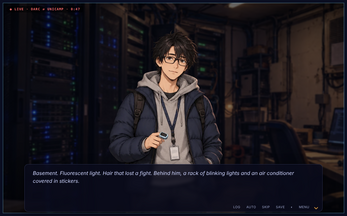
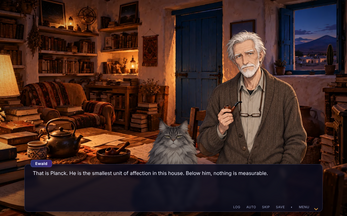
The cast around her is a comedy engine: a lattice physicist convinced of his own ailments, a retired German professor who jots everything onto napkins, an operations manager whose toolkit is silver tape, and a llama named Heisenberg. Above them sits the cold, overloaded process that schedules a simulated universe, and it has just read the team's paper.
The story adapts Erro de Arredondamento, the novel by Prof. Leonardo Gomes Guidolin, and takes its physics seriously; an afterword from the book sits in the in-game codex to separate what is real from what is invented. The main run spans twelve chapters, plus a bonus chapter, Heisenberg's Day, narrated by the llama.
How to play
Play proceeds through dialogue and narration punctuated by decisions. More than sixty choices alter which scenes appear, how relationships develop, and the wording of the bug report that settles the galaxy's future.
Those decisions lead to very different places. Going public too soon turns the team into a Matrix meme, threatening the Operator makes the galaxy read-only, a careless bug report gets the Milky Way optimised, and kindness leads to whatever a cosmic scheduler has waited 13.8 billion years to ask.
Ten endings cover that spread: true, romance, mentor, friendship and comedy routes, three bad outcomes and one secret ending. A first playthrough runs about four to five hours, and seeing everything takes roughly ten. Chapters one and two are playable free in a browser, around an hour of story, which is the least expensive way to test whether the humour lands.
Controls
The interface is built for reading at your own pace. A backlog lets you scroll back through lines already passed, auto and skip options handle text you have already seen, autosave runs in the background, and three save slots let you park a run before a branch.
Language can be switched between full English and Brazilian Portuguese at any point, so a session can move between the two without restarting.
Because the whole game ships as a single offline HTML file, opening that file in a browser is the entire setup on desktop and on Android alike.
The game page does not list its controls. Check the in-game tutorial or pause menu for the current scheme.
Tips for your first run
Treat the first run as reconnaissance. Choices feed the bug report at the centre of the plot as well as the relationships around Talita, so early picks carry weight later, and a comedy ending is as legitimate a destination as a romance one.
The reading tools do most of the housekeeping, but a little discipline pays off across a four-to-five-hour story that branches ten ways.
- Keep a manual save in one of the three slots before a scene that looks like it forks.
- Read the codex entries covering real science; they mark where the physics stops and the invention starts.
- Try the free two-chapter browser demo first if the tone is uncertain; it covers roughly an hour.
- Save the Operator's Log New Game+ for a second pass, since it threads a new Operator-side scene into every chapter.
- Switch to Brazilian Portuguese if it is comfortable; the script runs over eighty thousand words in each language.
Content and replayability
Ten endings plus a New Game+ called Operator's Log carry the replay load. That second mode adds an extra scene from the Operator's perspective to each chapter, so the same twelve chapters read differently once the scheduler's side of the story is visible.
Sixty-one codex entries collect people, places, real science and in-story documents, with thirty-four achievements alongside them. The script exceeds eighty thousand words in each of its two languages, and the bonus llama-narrated chapter sits outside the main arc as a lighter palate cleanser.
Completists should budget around ten hours to see the full spread; a single focused pass lands in the four-to-five-hour range.
Presentation and performance
Sound carries a lot of the atmosphere: fourteen original music tracks, closing with an ending song titled Expensive to Delete.
Delivery is unusually light. The complete game is one offline HTML file that opens in a browser on Windows, Mac, Linux and Android, and an HTML5 build plays directly in the page, so there is nothing to install before the first scene.
The bonus chapter shifts narration to Heisenberg the llama, a change of voice that breaks up the twelve-chapter main line and gives the quietest character the loudest perspective.
Who should play it
Readers who like their science fiction hard and their comedy deadpan will find the premise doing real work: an impossible ray alignment, a simulation under budget pressure, and a cast that argues about it at altitude while a cosmic process reads their preprint.
Visual novel players who chase endings get ten of them plus a New Game+ that rewrites scenes, while players who want one clean run still get a complete four-to-five-hour story with a mystery at its base.
Brazilian Portuguese readers get a full localisation rather than a subtitle pass, switchable mid-game. The experience is text-first throughout, so it rewards patience with prose more than reflexes.
Screenshots
How we tested it
The build was loaded from games.debutplay.com in a headless Chromium session on ; the canvas started and no request was blocked. The guide was last checked on .
From the developer
At 2:17 a.m., at 4,200 metres in the Atacama desert, Dr. Talita Brum discovers that the universe has corners. Forty-one cosmic rays, far too energetic to exist, all arriving along three perpendicular axes — as if space were a grid. As if someone were saving on resolution. Rounding Error is a hard sci-fi comedy visual novel about an insomniac astrophysicist, a hypochondriac lattice physicist, a retired German professor who writes everything on napkins, an ops manager armed with silver tape, a llama called Heisenberg… and the cold, overworked process that schedules our simulated universe — which has just read their paper. Publish too early and the internet turns you into a Matrix meme. Threaten the Operator and your galaxy goes read-only. Write a sloppy bug report and the Milky Way gets optimized. Or be kind — and find out what a cosmic scheduler has been waiting 13.8 billion years to ask. Based on the novel Erro de Arredondamento by…
Frequently asked questions
Is Rounding Error free?
Chapters one and two are free to play in a browser, roughly an hour of story. The complete game costs US$4.99.
How long does a playthrough take?
About four to five hours for a first run, and roughly ten hours to see every branch and ending.
How many endings are there?
Ten: true, romance, mentor, friendship and comedy endings, three bad endings and one secret ending.
Which platforms are supported?
An HTML5 build runs in the browser, and the full game is a single offline HTML file for Windows, macOS, Linux and Android.
Is there a Portuguese version?
Yes. The script is complete in English and Brazilian Portuguese, over eighty thousand words in each, switchable at any time.
What is the Operator's Log?
A New Game+ mode that adds a new scene from the Operator's side to every chapter.
What games are similar to Rounding Error?
The closest matches on DebutPlay are Almost Real, Kabedon, Greyline. They share the same genre, so the controls and the pace carry over.
Something wrong or missing? Tell us. How we test games.