Browser games · New game
The sensible choice
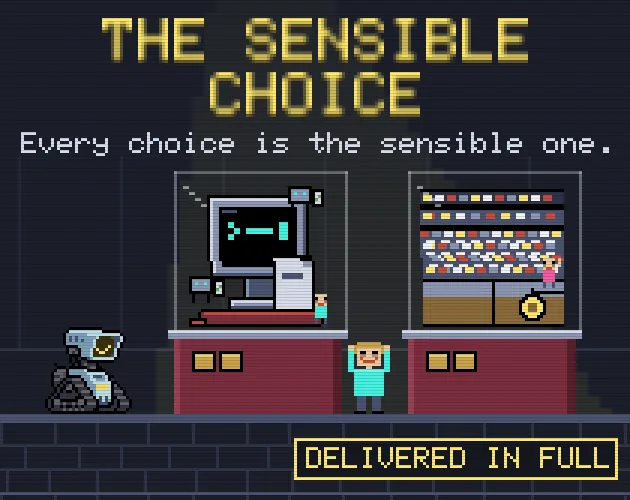
A free browser satire set in a 6202 museum, where a short-staffed robot curator hands a Visitor a simulator and eight turns to make every sensible choice.
#39 this weekAI-assisted: Code, Graphics, Sound, Text
The game runs in this tab. No install, no account.
The short answer
The Sensible Choice is a short HTML5 satire about a museum in the year 6202 where a robot named Code lets a Visitor run a simulator of human civilisation. You pick three cards, predict the results, then spend eight turns rewinding or advancing policies. It is free, plays in a browser, and is worth a look now for its wildcard-driven replayability.
What is The Sensible Choice?
The Sensible Choice is a short browser game set in a museum in the year 6202. The curator is a short-staffed robot called Code, serial MJ-068, who hands a Visitor — that is you — the controls to an ancient simulator rebuilt from a fragment of human civilisation. The museum knows what people chose and has no idea why any of it turned out the way it did, which is the hook the whole thing hangs on.
Your job is to pick the sensible option, then fix the problems it creates with more sensible options, filling the hall with exhibits as you go. The stated theme is evolution read as the evolution of a society rather than of a body: nothing here gets less capable, nobody is blamed, and each convenience or metric makes sense at the moment it is adopted. It is a satirical comedy about good intentions going wrong, made for Micro Jam 068 and published as a prototype on 31 October 2026. It runs as HTML5 in a browser and costs nothing to play.
How to play
A run opens on an empty, unrendered screen labelled NOTHING LOADED, and the hall is built only from what you pick. You choose one card from each of three slots, and every card becomes an exhibit in its own room. For each exhibit you record what you expect from it, then see what you actually got — the gap between the two is where much of the comedy sits.
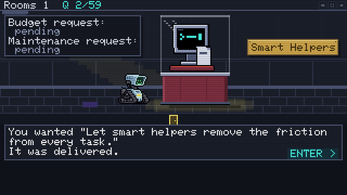
After the picks, a run runs for eight turns. Each turn offers a choice between Rewind, which takes a choice back out, and Advance, which adds a policy presented as a fix for whatever your earlier decisions created. Promises made along the way get delivered exactly as written, so the fixes tend to arrive with consequences attached. When the run ends, the hall dissolves back to nothing, and you are handed an inventory of your choices signed by you, plus a real study or two on why it went the way it did.
Controls
On a phone the game is played by tapping, and it is landscape only — it explicitly asks you to turn the device sideways. Fullscreen kicks in on the first tap. On a mouse, clicking does the work. Keyboard players get Enter or Space to continue, the 1, 2 and 3 keys to pick a card, R to rewind, A to advance, B to go back, and the < and > keys to look at other rooms. M toggles sound, F toggles fullscreen, and Esc opens the menu.
The menu sits in the top right and holds Resume, Restart run, Quit to title, a settings panel and the Visitor Questions you have unlocked. Settings cover text speed, volume, a reduce flash option and captions. Because the layout is built around rooms, the < and > keys are worth learning early: they let you walk back through exhibits you have already placed without restarting anything.
| Input | Action |
|---|---|
| Phone | Tap to play; landscape only, with fullscreen starting on the first tap |
| Mouse | Click to pick cards and move through the game |
| Keyboard | Enter or Space to continue |
| Keyboard | 1, 2 and 3 to pick a card |
| Keyboard | R to rewind, A to advance, B to go back |
| Keyboard | < and > to look at other rooms |
| Keyboard | M for sound, F for fullscreen, Esc for the menu |
Tips for your first run
The loop rewards attention more than speed. Before confirming an exhibit, commit to a specific prediction; the comparison between what you expected and what the card actually delivered is the substance of the game, and vague guesses waste the turn. Treat every Advance policy as a fresh choice rather than a repair — it is offered as a fix, but it joins the hall like everything else and shapes what comes after.
If a room reads badly, Rewind is there for exactly that, and the eight turns are the whole budget, so early corrections cost less than late ones. Phone players should settle into landscape before starting; the game will not proceed comfortably otherwise.
- Write the expectation line before confirming a card — the mismatch with the result is the point of the loop.
- Spend Rewind on choices that look wrong early, since the eight turns are a fixed budget.
- Read an Advance policy as a new exhibit with its own consequences, not as a reset button.
- Use the < and > keys to revisit other rooms instead of restarting the run.
- Switch on captions or reduce flash in settings if either helps; both live in the top-right menu.
- Replay after finishing to surface wildcards, as some sensible choices take several runs to find.
Content and replayability
Each visit offers three slots to fill, and the card pool is not fixed: some choices are wildcards that only sometimes appear, so no two visits present the same set. A handful of the sensible options are rare enough to take several runs to surface at all, which gives the prototype a reason to be replayed beyond curiosity.
Structure is deliberately tight. Eight turns of rewinding or advancing sit between the opening picks and the closing inventory, and the hall resets to nothing at the end of each attempt — the game's own framing is that nothing here is changed and the simulator is only re-run. What persists is knowledge: the Visitor Questions unlocked in the menu accumulate, and the closing inventory paired with the real studies gives each run a legible record of what you chose and why it landed where it did. The satire is aimed at good intentions rather than at any real person, group or political position, and the futures shown are fiction; the short lines at the very end quote real studies and records, while nothing during play is presented as data.
Presentation and performance
The look is pixel art drawn in code on a single HTML5 canvas, with Code's sprite and idle animation converted to code and palette-reduced by hand. Music and sound are synthesised rather than loaded from files, and Code has two spoken lines processed into a machine voice. The whole game ships without third-party assets, libraries, fonts, images or audio files, which keeps the download light and the browser build self-contained.
It is built for phone, laptop and desktop browsers, and it is best with sound on. The settings panel covers text speed and volume, and also reduce flash and captions for players who want a calmer read. On a phone the game is landscape only and takes over the screen on the first tap, so it is worth turning the device before starting rather than mid-run. The presentation is openly the work of a jam project: AI assistance is disclosed for the code, the pixel art, the synthesised audio, draft lines for Code and the plaques, and a directed research pass on the closing study lines, with the design, lore and testing done by hand.
Who should play it
This suits players who like short, self-contained browser pieces with a satirical edge and a clear conceptual joke rather than a long campaign. The premise — a museum of human decisions run by an understaffed robot curator — does the heavy lifting, and the eight-turn structure means a full run fits into a break. Anyone who enjoys prediction-and-payoff loops, where you commit to an expectation and then watch it get answered, will find the format familiar and quick to read.
It is a prototype, so treat it as a jam-scale experiment rather than a polished service game. Players who bounce off ambiguity should know the futures shown are fiction and the satire is aimed at good intentions in general, not at any real person, group or political stance. Anyone who wants a game about systems compounding one reasonable decision at a time, with a signed record of their own choices at the end, is the target audience here.
Screenshots
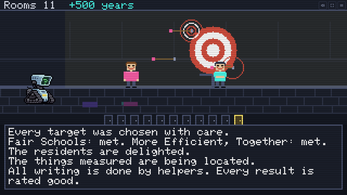
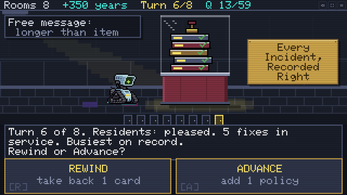
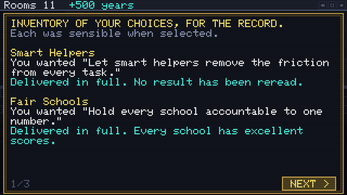
How we tested it
The build was loaded from games.debutplay.com in a headless Chromium session on ; the canvas started and no request was blocked. The guide was last checked on .
From the developer
Every choice is the sensible one. Humanity still ends up here.Museum year 6202. A curator robot called Code (serial MJ-068) is short-staffed, so he lets you, the Visitor, run the museum's ancient simulator: a fragment of a human civilisation from thousands of years ago. They know what the humans chose. They do not know why it went the way it did.Pick the sensible option. Fix the problems it causes with more sensible options. Watch the hall fill with exhibits, and watch every promise get delivered exactly as written.Theme: EVOLUTIONI read the theme as the evolution of a society rather than of a body. Nobody here gets less capable and nothing is anyone's fault. A society evolves to fit the world it builds for itself, one convenience, metric and fix at a time, and each step makes sense when you take it.Prerequisite: You start with nothing!I read it this way: the player has nothing and holds nothing but choices, and the choices change…
Frequently asked questions
Is The Sensible Choice free to play?
Yes. There is no cost attached to the game, so a run can be started in a browser without paying anything.
What devices can run it?
It is HTML5 and works on phone, laptop and desktop browsers. On a phone it is landscape only and asks you to turn the device sideways before play.
How long does a run last?
A run is built around picking one card from each of three slots and then spending eight turns rewinding or advancing, followed by a closing inventory and study lines.
Do the choices differ between runs?
They can. Some choices are wildcards that only sometimes appear, so the set on offer changes between visits, and a few sensible options take several runs to find.
Is it a finished game?
It is published as a prototype, made for Micro Jam 068 and dated 31 October 2026, so it should be approached as a jam-scale experiment.
Does it have sound?
Yes. Music and sound are synthesised in code, Code has two spoken lines in a machine voice, and volume sits in the settings menu. It is best played with sound on.
What games are similar to The sensible choice?
The closest matches on DebutPlay are Bean Wars, Fear Feast: Rot n' Roll, punnamada Legends: vallam kali. They share the same genre, so the controls and the pace carry over.
Something wrong or missing? Tell us. How we test games.