
Visual novel · New game
What is PGSX
A six-to-nine-minute playable tour built around a steel sculpture under starlight, where each chapter asks for a touch, a turn or a quick rhythm run.
#15 this weekAI-assisted: Code, Graphics, Sound, Text
The game runs in this tab. No install, no account.
The short answer
PGSX is a free browser visual novel and simulation hybrid that runs as a guided tour of one studio's work. Four letters, P, G, S and X, become four lanes, and each chapter hands over something small to touch, turn or play, from a dial that clicks to its mark to a ten-second rhythm game and a light rig tuned by hand. It takes six to nine minutes.
What is PGSX?
PGSX is a compact playable tour rather than a conventional game. Each chapter is a small experience built to be touched, turned or played, arranged around a steel sculpture that seems alive beneath starlight. The name unpacks into Precision Guided Simulation eXperiences, and the four letters double as the structure: P, G, S and X mark four separate lanes of work.
That framing matters, because the tour works as a demonstration of craft as much as a piece of entertainment. One developer built it, driven by curiosity, and the chapters act as samples drawn from each of the studio's four work lanes. A run is short by design, roughly six to nine minutes, and nothing locks a visitor in, since chapters can be skipped, revisited or jumped to directly.
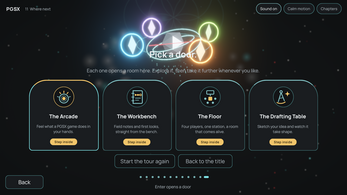
The finale hands over a choice rather than a score screen. Picking a door at the end opens a room inside the tour that can be explored at whatever pace suits. The whole thing is free, runs in a browser as an HTML5 build, and was published on 3 November 2026.
How to play
The tour is a chain of short interactions, and each one asks for a different kind of attention. The opening task is to lift four letters out of the sculpture, with P, G, S and X each standing for a lane of work. From there a dial has to be turned to its mark, a small demonstration of what a tool that respects a player's time feels like.
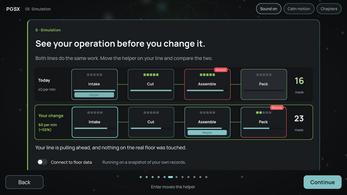
Later chapters shift from handling to comparison and timing. One puts two production lines side by side and asks the player to move a helper along their own line, watching it pull ahead of today's line while the real floor stays untouched. Another is a ten-second rhythm game: strike the lit pads, chain hits into a combo, and light all four pads to reach synergy. A four-player venue station needs its seats filled. A lighting chapter turns every dial into a visible change in the scene, running from the key light through the glow to the starlight.
Nothing is tallied into an account and nothing persists. The tour closes with a door choice, and each door opens a room to wander at leisure. Chapters can be skipped, reversed or jumped to at any point in the run.
Controls
Input is wide open. Choosing works through mouse or touch, Space or Enter, or gamepad A. Next and back are mapped to Page Down and Page Up, or Backspace, with gamepad RB, LB and B covering the same pair. The chapter map appears on M, or gamepad Start.
The pad game uses four keys, D, F, J and K, with the number row from 1 to 4 as an alternative. On a gamepad the same four pads land on X, Y, B and A.
Fullscreen is worth using for the look, and a button under the game triggers it. One wrinkle: Esc exits fullscreen, so the chapter map key M is the dependable way to move around while playing fullscreen. Sound begins switched off and has to be unmuted deliberately.
| Input | Action |
|---|---|
| Mouse or touch | Choose options and operate the interaction in each chapter |
| Space / Enter | Choose |
| Gamepad A | Choose |
| Page Down / Page Up or Backspace | Move forward or back through the tour |
| Gamepad RB / LB / B | Next and back |
| M or gamepad Start | Open the chapter map |
| D F J K or keys 1 to 4 | Hit the four pads in the ten-second rhythm chapter |
| Gamepad X Y B A | Hit the four pads in the rhythm chapter |
| Fullscreen button under the game | Enter fullscreen; Esc leaves fullscreen |
Tips for your first run
A first run goes better with a couple of setup decisions made early. Sound starts muted, so unmute if the score and effects are wanted, and consider calm motion if the camera movement feels busy. Because every chapter can be skipped or reversed, a fumbled interaction costs nothing. Bullets: Press the fullscreen button under the game for the intended look. Unmute the audio; the score and effects share a single key. Use M, or gamepad Start, for the chapter map; Esc only leaves fullscreen. Jump between chapters freely instead of grinding through one that is not landing. Switch on calm motion to ease the camera and soften the effects. Raise text as far as 200 percent, with panels that reflow instead of clipping. Set aside six to nine minutes for a complete pass. Finish at the doors, where each one opens a room to explore at your own pace.
Content and replayability
A full pass runs about six to nine minutes, which makes PGSX closer to a coffee-break visit than a campaign. The content is a set of self-contained chapters: the letter lift, the dial alignment, the paired production lines, the ten-second pad game, the venue seating, the lighting controls, and the closing doors. Skipping and jumping are built in, so a second visit can go straight to whichever chapter appealed.
Replay value comes from tuning and from the rooms rather than from unlocks. The lighting dials can be pushed in different directions, the pad game rewards longer combos and lighting all four pads for synergy, and each door at the end opens a room that can be explored at whatever pace the player chooses. Nothing selected during the tour is stored or transmitted, so every visit starts from a clean slate with no saved presets to carry over. Because nothing is retained, replaying a chapter means playing it fresh rather than resuming a record.
Presentation and performance
Visually the tour orbits a steel sculpture treated as living scenery beneath starlight, and the lighting chapter makes that scene reactive: every dial shifts the real view, from key light through glow to starlight. The score and sound effects were composed in one key, so layers sit together however the tour is played.
Accessibility touches are structural rather than bolted on. Calm motion eases camera movement and softens effects. Text scales to 200 percent, and panels reflow instead of clipping, so larger type stays readable. Input flexibility covers mouse, touch, keyboard and gamepad, and the build is HTML5, running in a browser and on phones.
Scope stays deliberately small, which suits a browser tab. The project was made in Unity with the Manrope typeface under an open font license, and the fullscreen button under the game is the recommended way to see the lighting work properly. Esc leaves fullscreen, so plan on the chapter map key when navigating.
Who should play it
PGSX suits players who enjoy seeing how things are made and who prefer a sampler to a long commitment. Anyone curious about the studio's four work lanes gets a hands-on look instead of a written explanation: a dial that clicks to its mark, a production-line race, a rhythm round, a lighting rig. It is also built for players who need flexibility, with large text, calm motion and four input methods available, plus a phone-ready HTML5 build that runs where a browser already is.
Short-session players are the other obvious fit. With a run of six to nine minutes and free navigation between chapters, stopping halfway carries no penalty, though progress itself is not retained. Players hunting progression systems, unlocks or persistent scores will find the tour deliberately light in that direction. Anyone who wants a gentle, tactile introduction to a studio's approach before exploring deeper can start with the four letters and follow the doors at the end.
Screenshots


How we tested it
The build was loaded from games.debutplay.com in a headless Chromium session on ; the canvas started and no request was blocked. The guide was last checked on .
From the developer
What is PGSX? A short, playable tour of the studio. Every chapter is a small eXperience you touch, turn or play, set around a living steel sculpture under a field of starlight. PGSX = Precision Guided Simulation eXperiences. (And so much more.) What you'll do Lift the four letters out of the sculpture: P, G, S and X are four lanes of work.Turn a dial to its mark to see what a tool that respects your time feels like.Race two production lines: move a helper on yours and watch it pull ahead of today's, with nothing on the real floor touched.Hit the lit pads in a ten-second rhythm game. Chain strikes for a combo and light all four for synergy.Fill the seats around a four-player venue station.Tune the look: every dial moves the real scene, from the key light to the glow and the starlight.Pick a door at the end. Each one opens a room inside the tour that you can explore at your own pace. Made for everyone About 6 to 9 minutes. Skip, go back…
Frequently asked questions
Is PGSX free to play?
Yes. There is no price attached to it, and the tour runs free in a browser.
How long does a full run take?
Roughly six to nine minutes. Skipping, backtracking and jumping straight to any chapter are all available, so a run can be shorter.
What does the name stand for?
Precision Guided Simulation eXperiences. The same four letters, P, G, S and X, also map to four lanes of work inside the tour.
Where can it be played?
It is an HTML5 build that runs in a browser and on phones, with mouse, touch, keyboard and gamepad all supported.
Does the tour save anything?
No. Nothing chosen during the tour is stored or sent anywhere, so each visit begins from a fresh state.
Can the audio be turned off?
Sound starts off and only plays once it is switched on. Calm motion also softens the effects for a quieter presentation.
What games are similar to What is PGSX?
The closest matches on DebutPlay are The Dark Cafe, What the Water Gave Back, Ashes of a Former Life. They share the same genre, so the controls and the pace carry over.
Something wrong or missing? Tell us. How we test games.