Strategy · New game
Ballotta
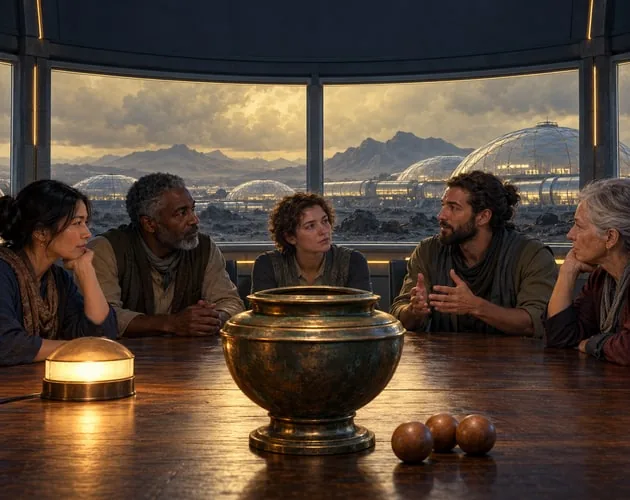
A free browser strategy simulation in which a Steward puts laws before randomly selected citizens on Venus and lives with the consequences.
#2 this weekAI-assisted: Code, Graphics, Sound, Text
The game runs in this tab. No install, no account.
The short answer
Ballotta is a turn-based browser strategy game set on Venus, where a Steward submits budgets, reforms, pacts and wars to citizen panels chosen by lot. Jurors have interests, trust and doubts, and every vote gets a breakdown. Rival polities, a shared sky, procedural maps and five endings make each ninety-day term a political story worth reading.
What is Ballotta?
Ballotta is a turn-based strategy and simulation game set on Venus centuries after the cloud cities, the Shade War and the Quiet. The player is a Steward rather than a ruler: power lies in deciding what the people will consider, while a panel of citizens drawn by lot from the districts decides the outcome. Budgets, pacts, laws, reforms and wars all pass through that panel, so the central act is not issuing an order but building a case before a vote.
The game is free to play in a browser and is built for a single player. Its political map is shared with up to four rival polities that settle plains, trade, make agreements and fight. The sky is also shared, and emissions from every polity affect it. A term runs toward a ninety-day horizon, and five distinct outcomes can end it. The scale can change with the map: small maps hold three polities, standard maps four and large maps five.
How to play
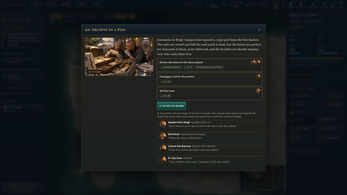
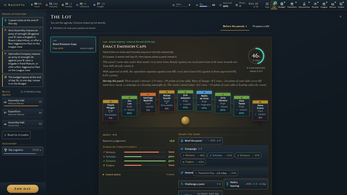
Each decision begins with a bill or proposal. Before the panel votes, the game shows every juror: their identity, home district, preferences and the likelihood of support. The player can brief the panel, campaign, revise the wording, stage a hearing, contest a juror or pull the item. The vote is then revealed one card at a time, with a running tally and the name of the person whose ballot decided the result.
Consequences are tracked by person and place. At the close of each day, a summary shows who was helped, who was harmed and the reason. Harmed citizens remember and can appear on later panels, so a short-term win may create a future opponent. The wider world keeps moving: rival polities use their own methods for drawing Lots, the League votes on charters and sanctions, and old machines remain buried while a relic script is read in fragments.
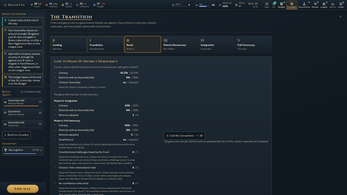
Long-term play revolves around the Transition, a six-phase path from emergency rule to a government that cannot be captured. Each phase needs a Convention passed by the citizens, and there are 32 laws to pass, 22 reforms to make and 22 discoveries to find. The League's Concord, full Venocracy, the Sky Engine's Second Dawn, Dominion and the strongest Legacy at ninety days are the five ways a game can end.
Controls
On desktop, the mouse handles the map: drag to move the view, scroll to zoom and click a district to inspect it. Pointing at an element opens its breakdown, and holding Shift pins the tooltip in place. Keyboard players can pan with WASD or the arrow keys and zoom with plus and minus. Tab moves focus to the map, the arrows step from district to district, Home returns to the capital and Space acts on the selected district.
The day ends with Enter or E. Single-letter shortcuts call up the map, the Lot, the budget, the Transition, discoveries, people, the League, history and the Codex, while Esc closes a panel and Ctrl+Z undoes the last action of the day. On a tablet, tap to select, long-press for an explanation and pinch to zoom. The whole game can be played by keyboard, including the map, and districts are named aloud as they are reached. Juror cards work as buttons, dialogs keep focus until Escape, and explanations also open on keyboard focus.
| Input | Action |
|---|---|
| Mouse | Drag to pan, scroll to zoom, click a district to inspect it, point at elements for breakdowns, and hold Shift to pin a tooltip |
| Keyboard movement | WASD or arrow keys pan; plus and minus zoom; Tab focuses the map, arrows move between districts, and Home returns to the capital |
| Keyboard actions | Space acts on the selected district; Enter or E ends the day; Ctrl+Z undoes the last action of the day |
| Keyboard shortcuts | M opens the map, L the Lot, B the budget, T the Transition, K discoveries, P people, G the League, H history and C the Codex; Esc closes panels |
| Tablet | Tap to select, long-press for a breakdown and pinch to zoom |
| Accessibility keyboard | The whole game, including the map, can be played by keyboard; juror cards are buttons and districts are named aloud |
Tips for your first run
Start by reading the panel, not the bill. The juror view exposes each person's district, preferences and the signed factors behind their expected vote, including trust, wariness, the room's mood and personal uncertainty. Use that information before choosing whether to brief, campaign, revise, hold a hearing, contest a juror or withdraw.
- Open every number that matters. Each figure has a breakdown, and an unavailable button states why it cannot be used.
- Check the end-of-day report for who gained and who lost. Harmed citizens can sit on later panels, so track consequences beyond the immediate tally.
- Use Ctrl+Z when an action of the day was a mistake; the undo applies to the last action, not the whole day.
- Watch the Harm and Sky meters. Emissions from all polities affect the shared sky, so local choices have planetary weight.
- Pin tooltips with Shift and use keyboard focus when comparing jurors; this keeps explanations visible while moving through the interface.
Content and replayability
Replay value starts with the map. A new Venus is generated from a seed, and the size determines how many polities share it: small maps hold three, standard maps four and large maps five. The five named powers each use a different method for drawing their panels: Maxwell's Wardens draw through a Service Lot, the Aino Assembly uses an Open Lot, the Lakshmi Lyceum a Shortlist, the Loom Union a Party system and the Aphrodite Company a Stakeholder arrangement. That changes the politics around the player as well as the composition of rival governments.
The story layer includes 108 events, advisors who disagree with one another, and follow-ups that return to the rival and district where they began. A relic script is read a little at a time, and the League votes on charters and sanctions. Every ending has its own text, plate, epilogue and final standings, along with the closest vote of the game, charts that can be read as tables and a chronicle. Saves are made at the end of each day; Continue resumes the run, and a save file can be downloaded and loaded again.
Presentation and performance
Ballotta runs in HTML5 in a current desktop browser. The viewport needs to be no smaller than 1024 by 768, with input through a keyboard and mouse, or a tablet used on its side. The initial load is about 0.8 MB; a long game can reach roughly 90 MB as pictures and music arrive. No account, advertising or tracking is involved, and saves remain in the browser used for play unless a save file is downloaded. There are no timers, because the game is turn-based.
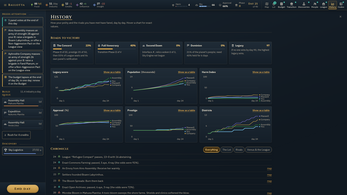
The interface is built for readable comparisons. Muted text meets at least 5:1 contrast, no text is below 11 px, locked items use a lock mark rather than fading, and constituencies pair colour with a glyph. Screen readers get named regions and dialogs, named Harm and Sky meters, a one-line result for the day and charts that can be read as tables. Reduce motion follows the system setting and can also be set inside the game, while the verdict reveal can be skipped. Dialogs retain focus and shut with Escape; explanations open on keyboard focus as well as hover and long press.
Who should play it
Ballotta suits players who want political strategy rather than reflex combat. The core pleasure is reading a jury, weighing competing interests and deciding which proposal can survive a vote. Anyone drawn to 4X maps, procedural generation, constitutions, budgets, pacts and rival states will find those systems here, but they are filtered through a sortition model in which ordinary citizens, not a single ruler, hold the final say.
The game is also a fit for players who need a turn-based pace with no timers. Keyboard-only play is supported across the map, touch controls are available on a tablet held sideways, and the interface includes screen-reader regions, table versions of charts, reduced motion and skippable verdict reveals. The ninety-day horizon and five endings give a run a clear shape, while the daily save makes it possible to resume without losing the term. Those who prefer real-time action, multiplayer competition or a purely abstract numbers game should look elsewhere; Ballotta is a single-player political simulation with a story layer and a procedural map.
Screenshots
How we tested it
The build was loaded from games.debutplay.com in a headless Chromium session on ; the canvas started and no request was blocked. The guide was last checked on .
From the developer
Govern a young polity on Venus, centuries after the cloud cities, the Shade War and the Quiet. You are its Steward, not its ruler. You decide what goes before the people, and the people decide. Laws, reforms, budgets, pacts and wars go to a panel of citizens drawn by lot from your districts. Before they vote you can see every juror: who they are, where they live, what they want, and the chance they vote with you. Brief them, campaign, amend the bill, hold a hearing, challenge a juror, or withdraw it. Then the verdict, one card at a time, and the name of the person whose vote decided it. Every choice lands on someone. At the end of each day you see who was helped, who was harmed, and why. The harmed remember, and they sit on the next panels. You are not alone on the planet. Up to four rival polities draw their own Lots their own way, settle the plains, trade, make pacts and go to war. The League of polities votes on charters and…
Frequently asked questions
What is Ballotta?
Ballotta is a free browser strategy and simulation game about a Steward on Venus who puts proposals before citizen panels chosen by lot. It is turn-based, single-player and runs on HTML5.
Is Ballotta free?
Yes. It costs nothing to play, and there is no account requirement, advertising or tracking.
What platforms does it run on?
It runs in HTML5 in a current desktop browser, with a viewport no smaller than 1024 by 768. A tablet used on its side is also supported with touch controls.
How does the voting work?
Before a vote, every juror's identity, home district, preferences and likelihood of support are visible. The player can brief, campaign, amend, hold a hearing, contest a juror or withdraw the proposal, then watch the verdict reveal.
Does it have timers?
No. Ballotta is turn-based and has no timers. Enter or E ends the day, and the game saves at the end of each day.
How do saves work?
The game saves at the end of each day. Continue resumes from that point, and a save file can be downloaded and loaded again; saves otherwise stay in the browser used for play.
What games are similar to Ballotta?
The closest matches on DebutPlay are Ember Vault, FPS DEUCE, Heroes of the Three Kingdoms GBA Demake. They share the same genre, so the controls and the pace carry over.
Something wrong or missing? Tell us. How we test games.