Simulation · New game
Ember Vault
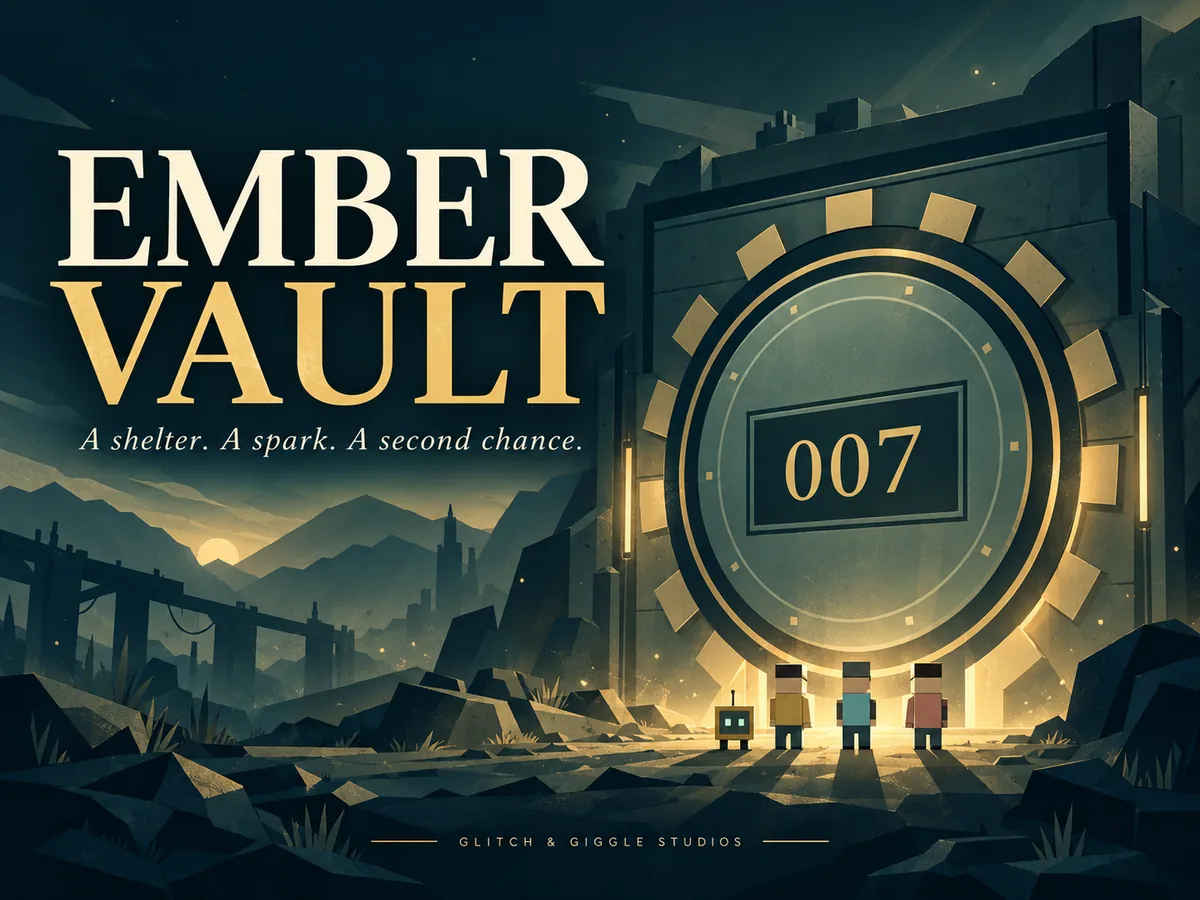
A free browser colony sim about turning empty underground rooms into a home, staffing them with survivors, and keeping the lights on while the wastes watch.
#2 this weekAI-assisted: Code
The game runs in this tab. No install, no account.
The short answer
Ember Vault is a post-apocalyptic shelter management game that runs in the browser at no cost. Players expand downward through six decks, fill 18 construction bays with a dozen room types, and balance power, food and water while placing survivors according to their Tech, Care and Grit. The long goal is restoring the Dawn beacon and broadcasting into the wastes.
What is Ember Vault?
Ember Vault is a post-apocalyptic shelter management game from Glitch & Giggle Studios that runs in a browser and costs nothing to play. The surface has gone quiet, and the parts of the world still worth saving are the chambers dug out beneath the ash. There is no single character to walk around a map; the job is closer to running a building, carving out rooms, keeping utilities from failing, and choosing which survivors come through the blast door.
The stated end goal is the Dawn beacon, a transmitter that has to be restored and fired into the wastes on the chance somebody is still listening. Reaching it means juggling power, food and water as the population grows, and managing a roster in which every resident carries different amounts of Tech, Care and Grit. Those three values decide which jobs suit which person, so the roster is a puzzle as much as it is a resource.
The game sits where simulation, strategy and survival overlap. Base-building is the spine, resource management supplies the pressure, and the outside world provides the interruptions. It is single-player and 2D, built around a colony that has to become worth protecting rather than merely functional.
How to play
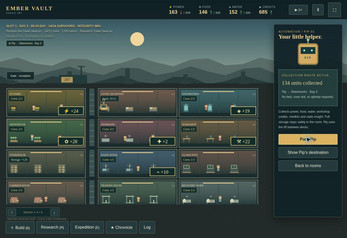
Construction happens in bays. There are 18 of them spread across six decks, and the vault grows downward as more space is needed. Each bay takes one of the dozen available room types: living quarters and growhouses for the population and its food, dynamos for power, workshops and radio rooms for the working floors, guard posts for the gate. Rooms can be upgraded when demand rises and dismantled again when a layout stops making sense.
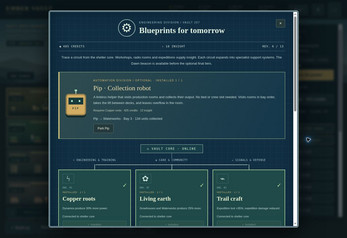
Survivors are the second layer. Each one is compared on Tech, Care and Grit, then placed in whichever job matches those numbers. Skills can be trained upward over time, and injured crew need looking after before they are worth much. Research opens further improvements, with 13 blueprints spread across production, storage, training, recovery and defense.
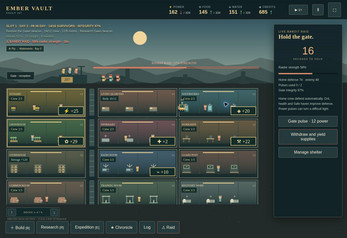
The outside world pushes back. Scavenging parties are sent beyond the blast door, and their progress can be followed on a live route with a countdown, with salvage as the reward. Weather, breakdowns, traders and community events all demand a response. Bandit raids at the gate offer three routes: fight them off, negotiate their departure, or hand over supplies to keep people safe.
Controls
Pacing is the main adjustable part of the interface. Time can run at normal speed, at double speed, or at four times speed, which is useful while a growhouse is filling or a production chain is ticking over without supervision. Fullscreen play is supported for anyone who would rather have the vault fill the display instead of sharing it with browser clutter.
Audio is split into separate music and sound controls, so the soundtrack can be turned down without losing the cues that accompany events. Beyond that, a session tends to move between three layers of attention: the construction bays, where empty space becomes living quarters, dynamos or guard posts; the roster, where Tech, Care and Grit decide who works where; and the gate, where a bandit visit turns into a decision about fighting, talking or paying.
Saving runs through three independent slots, so a vault already in progress does not have to be overwritten to try a different layout.
The game page does not list its controls. Check the in-game tutorial or pause menu for the current scheme.
Tips for your first run
Early expansion is tempting, but the vault runs on power, food and water before it runs on ambition. Get the infrastructure rooms placed in the first bays so the growhouses and dynamos are feeding the colony before living quarters pull in more mouths. Research is a slow build, so pick a direction rather than spreading blueprints thin.
The roster deserves as much attention as the floor plan. A survivor placed badly is a survivor producing badly, so check Tech, Care and Grit before filling a slot. Expeditions bring back salvage, but they also remove people from the vault and run on a countdown, so send them when the gate is quiet.
- Place dynamos and growhouses before extra living quarters, since power and food underpin every other room.
- Assign jobs by comparing Tech, Care and Grit rather than by whoever is standing idle.
- Use the fastest time setting during quiet stretches, then drop back to normal when a raid or an expedition return is due.
- Check injured crew before handing out new assignments; a hurt survivor is a weaker worker.
- Spend research on production or storage early if the vault is starving for output, and on defense if raids keep landing.
- Treat a bandit demand as a resource question, since yielding supplies can cost less than a fight the guard posts are not ready for.
Content and replayability
The content list is denser than the premise suggests. Twelve room types fit into 18 bays across six decks, and the deck limit turns expansion into a planning problem rather than an open sandbox. Thirteen research blueprints cover production, storage, training, recovery and defense, so a run can lean toward a well-supplied vault, a well-trained one, or a defended one depending on which lines get attention first.
Pip is the small collection robot that can be acquired and then travels between rooms gathering their output automatically, cutting down on manual hauling as the vault grows. Achievements number 17, and three independent save slots allow several shelters to exist side by side, which helps when testing a layout without abandoning the first attempt.
Personal touches carry the replay: choosing the vault number, watching day turn to night on the surface overhead, and reading what residents have to say, from hopeful remarks to practical complaints and a few lines that arguably belong out of the official log. With the beacon still waiting, there is reason to keep a vault running after the first crisis passes.
Presentation and performance
The look is 2D and the setting is underground, with the surface still visible as a day-to-night cycle running above the vault. That contrast does a lot of atmospheric work. Expeditions are tracked on a live route with a countdown rather than resolved off-screen, so a party's status stays readable while the vault carries on around it.
The game is built for HTML5 and runs in a browser, so there is no separate client to keep updated. Fullscreen mode suits longer sessions, and the split music and sound controls allow a quiet run. The three speed settings double as a way of managing attention: a busy vault can be watched slowly, while a settled one can be pushed forward.
Small touches tie the interface to the fiction rather than leaving it as a spreadsheet, from the blast door as a threshold to the Dawn beacon sitting at the end of the research and building work.
Who should play it
This is one for players who like colony sims and management games where the pleasure is in the layout and the ledger. Anyone who enjoys comparing statistics, rearranging rooms after a bad decision, and watching a fragile system hold together will find the loop familiar in the right way. Strategy players who prefer decisions to reflexes will be at home at the gate, where raiders can be fought, talked down or paid off.
Survival fans get a pressure curve rather than a threat that chases them around a map, and browser players get something that runs in a tab with fullscreen support when they want it bigger. Players looking for action, a story campaign with cutscenes, or a character to control directly will not find that here; the tension is administrative, and the satisfaction comes from a vault that keeps breathing.
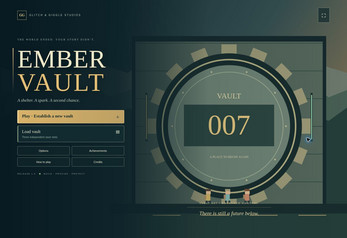
Screenshots
How we tested it
The build was loaded from games.debutplay.com in a headless Chromium session on ; the canvas started and no request was blocked. The guide was last checked on .
From the developer
A Home Beneath the AshesThe world above has fallen silent. Below the ashes, your vault is beginning to breathe.Build an underground home, welcome survivors, and keep the lights burning in Ember Vault, a post-apocalyptic shelter management game from Glitch & Giggle Studios. Balance power, food, and water while turning empty rooms into a community worth protecting.Every survivor has strengths. Find the right job for each person, train their skills, and decide who to welcome through the blast door. Beyond it, expeditions promise valuable salvage—and bandits are watching for an opportunity.Build a Future Below12 room types: Construct living quarters, growhouses, dynamos, workshops, radio rooms, guard posts, and more.18 construction bays across six decks: Expand downward, upgrade rooms, and dismantle them as your plans change.Survivor management: Compare Tech, Care, and Grit, assign jobs, and care for injured crew.13 research blueprints:…
Frequently asked questions
Is Ember Vault free to play?
Yes. It is free, runs in a browser through HTML5, and needs no purchase to start a vault.
What is the goal in Ember Vault?
Restore the Dawn beacon and send a signal into the wastes. Reaching that point means keeping power, food and water supplied while the colony grows.
What are the survivor stats?
Tech, Care and Grit. They are compared when assigning jobs, and skills can be trained up over time.
Can time be sped up?
Yes. Play supports normal speed, double speed and four times speed, with fullscreen available separately.
How many save slots are there?
Three independent slots, so more than one vault can be kept in progress at once.
What happens when bandits raid the gate?
There are three options: defend the gate, negotiate their departure, or yield supplies to protect the residents.
What games are similar to Ember Vault?
The closest matches on DebutPlay are Singularity, Sai no Kawara, Hundred Rooms. They share the same genre, so the controls and the pace carry over.
Something wrong or missing? Tell us. How we test games.