Racing · New game
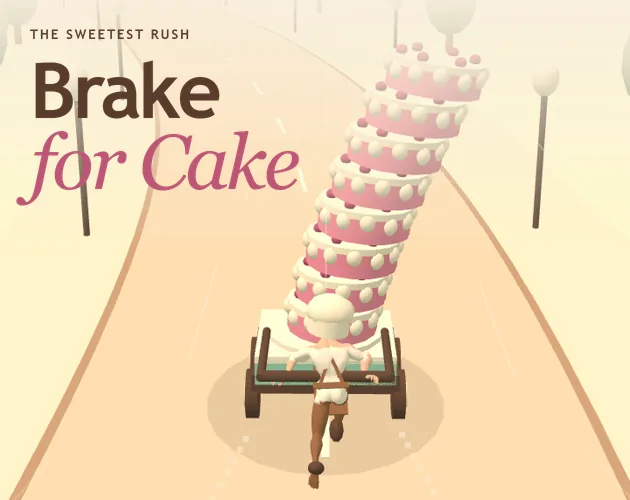
Brake for Cake
A free portrait browser racer in which the fastest line to a customer is also the line most likely to launch a six-layer cake into the road.
#1 this weekAI-assisted: Code, Graphics, Sound, Text
The game runs in this tab. No install, no account.
The short answer
Brake for Cake is a free, single-player 3D racing game that runs in a browser in portrait orientation. A cake cart must reach eight customers inside 76 seconds while the driver buys, protects and sells layers at $25 each against a $60 opening cost. It is short, score-driven and available now.
What is Brake for Cake?
Brake for Cake is a 3D arcade racing game from developer Jason Jung, played in portrait orientation inside a browser and built around one uncomfortable idea: speed is how a delivery gets paid, and speed is also what destroys the goods. It was made for the second Slapjam under that jam's speed theme, and the theme runs through every system on the road.
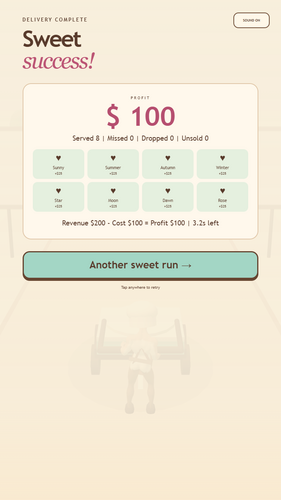
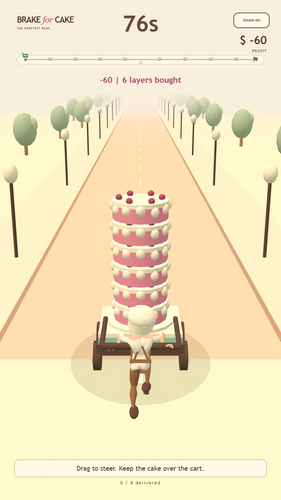
The numbers set the tension. The cart begins loaded with six cake layers valued at $10 apiece, which puts the opening position at a $60 deficit before a single customer is served. Eight customers stand along the route, and passing close to one on that customer's side of the road sells a layer automatically for $25. Score is profit, calculated as revenue minus cost, so any layer still riding on the cart at the finish line has earned nothing and still cost its purchase price.
A 76-second timer covers the whole attempt, and a bakery at the halfway point sells extra layers at $20 each up to a maximum of eight on the cart, with the clock paused while the decision is made. The game is free, single-player, and runs as HTML5 in the browser without a separate download.
How to play
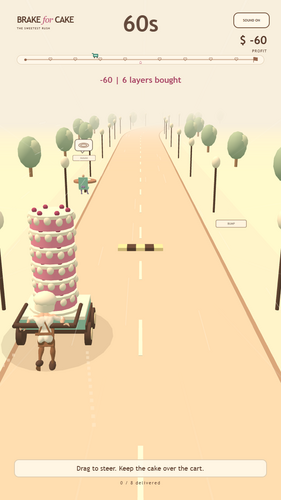
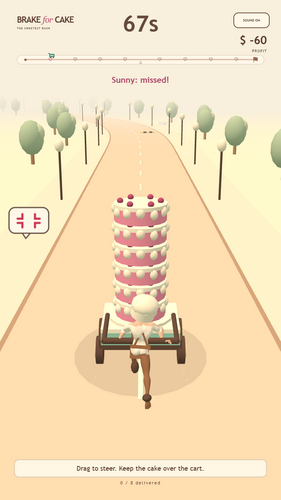
A run opens with six layers aboard and a clock that has not started biting yet. Holding the screen or the mouse button builds speed, and releasing it slows the cart down. Steering is a drag to the left or right, and the stack reacts physically to that steering rather than sitting still like a fixed sprite.
Delivery is proximity-based rather than a separate button press. Passing near a customer on that customer's own side of the road sells a single layer automatically at $25, so the road position taken on approach matters as much as the speed carried into it. Eight customers are spread along the winding route, which caps the day's takings at eight layers of sales.
At the halfway bakery the run pauses and a buying decision arrives. Extra layers cost $20 each, the cart can hold no more than eight, and the choice is either to buy within that ceiling or to continue without buying. Then it is a straight race to the finish against the 76-second timer, with profit as revenue minus cost standing as the final result.
Controls
Three inputs cover the entire game, and they are built for a portrait 3D view rather than a wide desktop screen. Holding the screen or the mouse button accelerates the cart; letting go decelerates it. Dragging left and right steers, and the drag is the only steering input the game asks for.
The control scheme is deliberately one-dimensional because the cake is the real steering problem. Sharp steering at speed pushes the stack sideways, and curves add their own force on top of that, so the drag is less about pointing the cart and more about managing what is balanced above it. The game carries a touch-friendly tag, and the hold-and-drag pattern works with a finger on a screen as readily as with a mouse button and a cursor.
Bumps deserve their own warning. The wide striped ones respond best to an early release, which means the brake input doubles as suspension. Getting that timing wrong is the fastest way to send a purchased layer off the cart.
| Input | Action |
|---|---|
| Screen or mouse button (hold) | Speed up |
| Screen or mouse button (release) | Slow down |
| Drag left and right | Steer the cake cart |
Tips for your first run
The first attempt is usually a lesson in how expensive momentum is. Six layers are already paid for, so the cart is carrying $60 of stock that has to reach customers before the clock runs dry. Treat the opening stretch as a chance to learn the lean of the stack rather than a sprint.
The bakery decision is where most runs are won or lost. Buying layers at $20 to sell at $25 leaves a slim margin on each one, and any layer that never reaches a customer turns that margin into a straight loss. The customers still ahead on the road are the only justification for restocking.
- Release before bumps, particularly the wide striped ones, rather than riding over them at full speed.
- Avoid sharp steering while moving fast, because curves and sideways acceleration both push the cake across the cart.
- Steer smoothly under the lean instead of correcting hard once the stack has already shifted.
- Restock at the halfway bakery only for the customers still waiting further down the road.
- Remember that every extra layer costs money, and unsold stock earns nothing at the finish.
Content and replayability
Everything in a run fits inside one continuous stretch of road and one 76-second timer. There is a single route, a halfway bakery and eight customers, which makes a complete attempt short enough to repeat immediately after a bad outcome. The game is built for single play, with no second player involved in the delivery.
Replay value comes from the profit figure rather than from unlocking content. Two runs can reach the same finish line and end with very different scores depending on how many layers were bought at the bakery and how many of those actually converted into sales. A cautious run that skips the restock keeps costs low; a greedy run that fills the cart to eight layers chases the higher ceiling and risks losing the lot on a curve.
That decision, made at the single pause in the middle of the route, is the main variable to test across attempts. The road and the timer stay fixed, so improvement shows up as a cleaner line, smoother steering and a better read on how many customers are genuinely still ahead.
Presentation and performance
The game runs on Three.js r186.1 and renders a portrait 3D scene rather than a flat 2D track. Character models and animation come from Quaternius's Universal Base Characters and Universal Animation Library, while the roadside shapes, the cakes, the cart and the interface are generated by the game code itself. The result is a small, stylised look that matches the cute and casual tags rather than a realistic driving sim.
Audio is assembled from credited free assets. The music is Sanctuary by Abstraction of Tallbeard Studios, taken from Three Red Hearts – Prepare to Dev, with impact sounds from Kenney's Impact Sounds pack, additional effects from the Ninja Adventure asset pack, and short vocal clips for reactions. Extra synthesised effects are produced by the game code as the cart moves and the cake takes hits.
Because it ships as an HTML5 build, there is nothing to install before the first run. The portrait framing keeps the winding road and the stack readable in a narrow window, which suits a game designed around holding and dragging a single point of contact.
Who should play it
This is a game for players who like a short arcade challenge with a score attached. A run lasts no longer than 76 seconds, the controls are a hold and a drag, and the whole loop is legible from the first attempt: get the cake to the customers, keep it on the cart, finish with more money than the start.
Score chasers get the most out of it. The profit figure rewards a clean line and a well-judged bakery purchase, and the eight-customer limit gives a clear ceiling to push against. Players who enjoy physics-driven comedy, where a slightly too sharp turn sends a paid-for layer into the road, will find the wobbling stack doing most of the entertainment work.
It is a poor fit for anyone wanting a long campaign, a realistic driving model or a competitive mode. There is one route, one timer and one economy, and the appeal is in shaving losses off a very short delivery. Anyone who prefers to read a track once and then master it will get more from repeat attempts than from a single run.
Screenshots
How we tested it
The build was loaded from games.debutplay.com in a headless Chromium session on ; the canvas started and no request was blocked. The guide was last checked on .
From the developer
Speed pays. Until the cake hits the road. Race a wobbling cake cart down a winding road, then ease off before your sweet investment goes flying. Brake for Cake is a portrait 3D browser game about the price of going too fast, made for Slapjam #2's Speed theme. How to play Hold the screen or mouse button to speed up. Release to slow down. Drag left and right to steer. Keep the cake over the cart: steer smoothly under the lean. Pass close to customers on their side of the road to sell a layer automatically. Reach the finish before the 76-second timer runs out. Cake is your investment Start with 6 layers at $10 each: your opening profit is −$60. There are 8 customers, and each successful delivery sells one layer for $25. The halfway bakery sells extra layers for $20 each, up to 8 layers on the cart. Buy as many as you want within that limit, or choose Go!. The timer pauses while you choose. Your score is profit = revenue − cost. Unsold…
Frequently asked questions
Is Brake for Cake free to play?
Yes. It is a free browser game with no purchase required to start a run.
How long does one attempt last?
A run is bounded by a 76-second timer, and the goal is to reach the finish before it expires.
How are cake layers sold?
By passing close to a customer on that customer's side of the road. The sale happens automatically and moves one layer at $25.
How is the score worked out?
Score is profit, which is revenue minus cost. Layers that never reach a customer earn nothing but still count against the cost of buying them.
Can the cart carry more cake?
Yes, up to eight layers in total. A bakery at the halfway point sells extra layers at $20 each, and the timer pauses while that choice is made.
What does the run start out worth?
The opening position is a $60 loss, because the cart begins with six layers that cost $10 each before any customer has been served.
What games are similar to Brake for Cake?
The closest matches on DebutPlay are TurboVektor, TurboVektor, RoombaCat SNES. They share the same genre, so the controls and the pace carry over.
Something wrong or missing? Tell us. How we test games.