Simulation · New game
Singularity
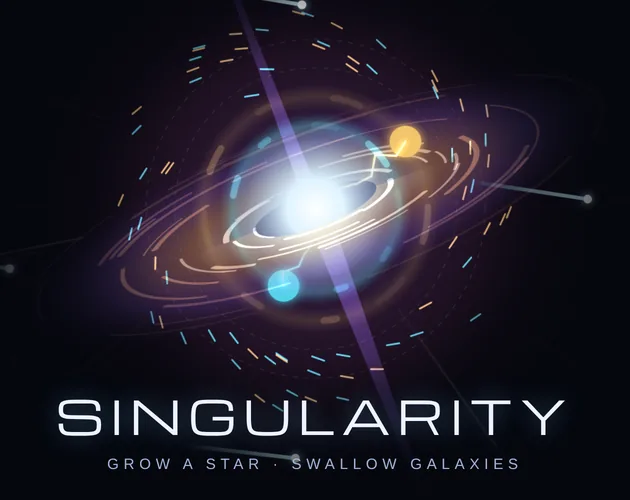
A free browser incremental that starts with a single star and ends with a black hole eating the galaxy, one fusion reaction at a time.
#51 this week
The game runs in this tab. No install, no account.
The short answer
Singularity is a free HTML5 incremental game about the life of a star. Ten elements, 45 fusion reactions and seven tiers run from nebula to black hole, then an Act 2 where the black hole devours galaxies. Nova shards light constellation laws that hold until the next reset. It is in development and playable now in a browser frame.
What is Singularity?
Singularity is an incremental simulation from developer Ne0Jiku that takes an unusual subject: a star, followed from the stardust cloud it condenses out of all the way to the black hole it becomes. Ten elements drive production — Stardust, Plasma, Dark matter, Antimatter, Chronon and Strange matter among them — and each one shapes output in its own way rather than simply scaling a number upward.
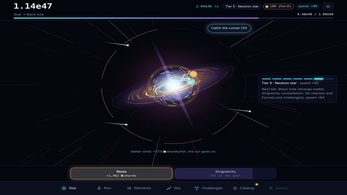
That premise runs in three layers. The star itself climbs seven tiers: Nebula, Protostar, Star, Giant, Supernova, Neutron star and Black hole, each faster than the last and each unlocking new mechanics. Around it, Novas earn shards that light stars in constellations. Then, once the collapse happens, the black hole begins devouring galaxies and a larger one forms in its place.
It is an HTML5 build that runs in a browser with nothing to install, and it is playable straight away. It is free, published 26 October 2026, and offered in English and French. It is also explicitly unfinished: balancing is still moving and more content is planned beyond Act 2.
How to play
Every run starts with a build. One element goes at the core, others are fused around it, and each pairing resolves into one of 45 reactions. Reactions drive production, but they are never free: a configuration carries a stability cost, so the heaviest stack is not automatically the right one.
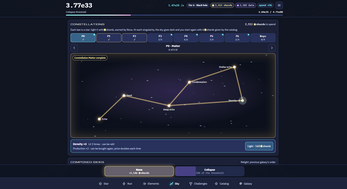
Production feeds Novas. Every Nova pays shards, and shards light stars in constellations — a lit star is a law, a rule that holds until the next singularity. Because laws die with the reset, part of each run is deciding which rules are worth carrying forward.
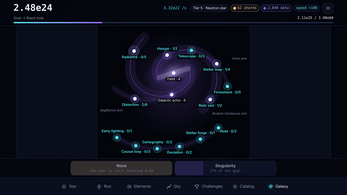
The Black hole tier is not the end. Collapsing the galaxy yields data, and data is spent on a research map shaped like the Milky Way. Each collapse grows the galaxy and automates part of the early game through autopilot, auto-relight and a comet catcher. Probes travel in real time, even while the game is closed, and return relics that can be equipped and combined into sets. Fourteen anomalies rewrite the rules of individual galaxies, and galactic challenges put a whole galaxy under pressure.
Controls
Singularity is a single-player browser game built on decisions rather than reflexes. The input that matters is choice: which element takes the core, which fusions surround it, whether the resulting stability cost is acceptable, and which constellation laws to light with Nova shards.
Play is built to survive interruption. The first hour of away time counts immediately, and everything after it fills a time reserve that can be spent at any chosen moment, so a session does not need to be continuous to be productive. Probes keep travelling in real time while the game is closed and deliver their relics on return.
Progress is stored on the device, and export and import move a save between devices. The whole structure — constellations, research map, relic sets — is built around one player's own progression, in English or French.
The game page does not list its controls. Check the in-game tutorial or pause menu for the current scheme.
Tips for your first run
Early play is mostly about the shape of the build and the timing of the reset, and a handful of habits make the first hours smoother.
- Watch the stability cost before adding another fusion. One element sits at the core and the rest fuse around it, and each addition has a price attached.
- Trigger Novas often. Shards are the only route to constellation stars, and every law expires at the next singularity, so early lights have longer to pay off.
- Bank the time reserve instead of spending it on reflex. Away time beyond the first hour accumulates and can be released whenever it is most useful.
- Treat the nine challenges as controlled experiments. They twist the rules — one removes fusion entirely, one destabilises the core, one limits the run to three minutes — and each hands back a key law.
- Work through the catalog. Forty stellar types are there to discover, and forty feats provide permanent boosts that outlast any single run.
Content and replayability
The content stack is unusually deep for a browser incremental. Ten elements combine into 45 reactions, and those reactions sit beneath seven progression tiers, so the build space is wide before any meta layer is touched.
Beyond a single run there is a catalog of 40 stellar types, 40 feats that boost everything permanently, and nine rule-twisting challenges that pay out laws. Act 2 adds galaxy collapses, the Milky Way-shaped research map, and automation of earlier steps through autopilot, auto-relight and a comet catcher.
On top of that sit the variables: 14 anomalies that change the rules of a given galaxy, galactic challenges that put an entire galaxy under pressure, and probe-delivered relics that can be equipped and combined into sets. Because each collapse grows the galaxy, the numbers behind the automation keep climbing.
Presentation and performance
The design leans minimalist and relaxing, and the setting is space in the literal sense: a star, the constellations built from its Novas, and a research map shaped like the Milky Way. Four screenshots accompany the build, and the visual language implied by those tags is restrained rather than theatrical.
As an HTML5 build it opens in a browser tab without an install step. Saves stay on the device, with export and import for moving between them, and the interface is offered in English and French.
The project is in active development, so pacing and balance are still moving. A run finished this week may not behave the same way next week, which is worth knowing before committing to a long optimisation plan.
Who should play it
This is a game for players who like watching a system build itself. Idle and incremental veterans will recognise the rhythm: production, a reset that converts progress into rules, and automation that erodes the early grind with every collapse.
It also suits tinkerers. Ten elements, 45 reactions and a stability cost attached to every build reward the player who wants to test combinations and compare output rather than simply wait. Completionists have 40 stellar types and 40 feats to work through, plus nine challenges and 14 anomalies.
The caveat is development status. Balancing is still shifting and more content is planned after Act 2, so anyone who needs a settled economy should know that going in. Everyone else can try it in a browser at no cost.
Screenshots
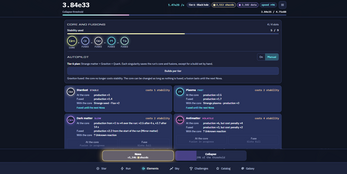
How we tested it
The build was loaded from games.debutplay.com in a headless Chromium session on ; the canvas started and no request was blocked. The guide was last checked on .
From the developer
A star is born from a cloud of stardust. Feed it, fuse it, collapse it — until it swallows the galaxy around it.SINGULARITY is an incremental game about the life of a star. Produce energy, trigger Novas to earn shards, light the laws of your constellations, and push your star through seven stages, from a faint nebula to a black hole. Then the real game begins: your black hole devours the galaxy, and a bigger one forms around it.Build your starTen elements — Stardust, Plasma, Dark matter, Antimatter, Chronon, Strange matter and more, each with its own way of shaping production.Core and fusions: place one element at the core, fuse others around it, and discover 45 reactions between them. Every build has a stability cost, so choose wisely.Seven tiers: Nebula, Protostar, Star, Giant, Supernova, Neutron star, Black hole. Each one is faster and unlocks new mechanics.Light the skyEvery Nova earns shards that light stars in your…
Frequently asked questions
Is Singularity free?
Yes. Singularity is free to play in a browser, with no purchase needed to start the game.
What does it run on?
It is an HTML5 build that opens in a browser, so there is no download or install step before the first star appears.
Does progress continue while the game is closed?
Yes. The first hour of away time counts immediately, and further time fills a reserve that can be released whenever the player chooses. Probes also keep travelling in real time.
What happens after the black hole forms?
Act 2 begins. The black hole devours galaxies, each collapse earns data for a Milky Way-shaped research map, and collapses automate more of the early game over time.
How many elements and reactions are there?
Ten elements and 45 reactions between them. One element occupies the core, the rest fuse around it, and every configuration carries a stability cost.
Is the game finished?
No. It is in active development: balancing is still moving, and more content is planned after Act 2, so numbers and pacing can change between sessions.
What games are similar to Singularity?
The closest matches on DebutPlay are Ember Vault, Sai no Kawara, Hundred Rooms. They share the same genre, so the controls and the pace carry over.
Something wrong or missing? Tell us. How we test games.