Puzzle · New game
Hearthstring Eve
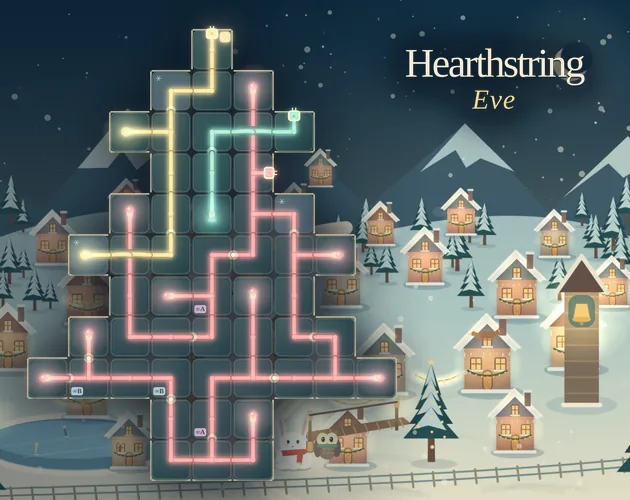
A cozy Christmas Eve tile puzzle in Emberfold, where Pippa the rabbit and Tallow the owl turn light-string tiles until every bulb glows.
#14 this weekAI-assisted: Code, Graphics, Sound, Text
The game runs in this tab. No install, no account.
The short answer
Hearthstring Eve is a singleplayer holiday puzzle about turning tiles so every bulb connects to its plug. Pippa the rabbit and Tallow the owl light windows across Emberfold as boards are solved. There are no timers, no fail state, and unlimited undo. The browser demo covers Emberfold Hill boards 1 to 30. The full download offers 120 story boards across four chapters for $2.99.
What is Hearthstring Eve?
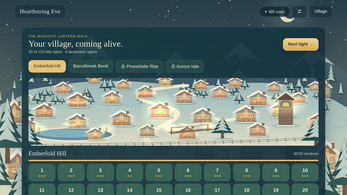
Hearthstring Eve is a cozy Christmas puzzle built around strings of lights. The setting is Christmas Eve in Emberfold, a snowy village that gradually glows as boards are completed. Pippa the rabbit and Tallow the owl carry a pocketful of bulbs and work through picture-like boards made of tiles. A board may take the shape of a tree, wreath, star, stocking, candy cane, or snowflake, and the goal is to turn its tiles until each bulb connects to its plug and no wire end stays open. When the string is complete, a lit path travels from the plug through to the final bulb. Each finished story board lights one of the village windows. The browser demo covers Emberfold Hill, the first chapter, with boards 1 to 30, their landmarks and keepsakes, plus the daily light, endless mode, and decorations. The paid download raises the story to 120 boards in four chapters and a village with 120 windows, 24 landmarks, and 24 keepsake ornaments. It is a singleplayer game with a calm holiday mood and no fail state.
How to play
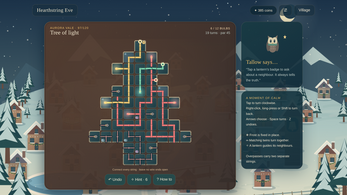
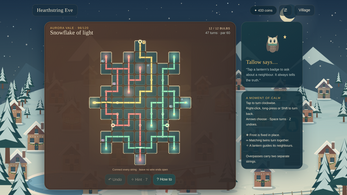
Every puzzle board is a small picture assembled from tiles. Tapping a tile rotates it clockwise, and the task is to keep turning until all bulbs are connected to the plug and no wire end remains open. A solved board rewards the player with a lit route from the plug to the final bulb. Story boards are arranged as chapters; each completion illuminates a window in Emberfold. There are no countdowns and no losing condition, and undo can be used without limit, so a board can be explored at a relaxed pace. Later boards introduce more complex wiring. A second string color appears from board 31, and a third from board 61, using gold, red, and green. Overpasses let two strings cross without merging. Bulbs carry circle, diamond, or triangle shapes, making the colors easier to distinguish. Frosted tiles are fixed in place, twin tiles rotate together, and lanterns indicate the correct turn for a neighboring tile. Finishing within par earns three stars, while hints replenish as boards are completed.
Controls
On desktop, mouse input handles most turns: tap a tile to rotate it clockwise. Right-click or Shift-click turns the same tile back. On large boards, swipe the table to reach the edges. Touch play follows the same idea, with a tap rotating a tile clockwise and a long press turning it back. Keyboard control is also available for players who prefer it. Arrow keys choose a tile, Space rotates it clockwise, and Shift plus Space rotates it back. Z undoes a move, and L asks a lantern for guidance. The game supports browser play and downloadable versions for Windows, macOS, and Linux. The controls are simple enough for a casual puzzle session, but the keyboard shortcuts give precise correction when a board becomes tangled. Because undo is unlimited, a mistimed turn does not carry a penalty. The input scheme stays consistent across the demo and the larger story boards.
| Input | Action |
|---|---|
| Mouse | Tap a tile to turn it clockwise; right-click or Shift-click to turn it back. |
| Touch | Tap a tile to turn it clockwise; long press to turn it back. |
| Touch on large boards | Swipe the table to reach the edges. |
| Keyboard | Arrow keys choose a tile; Space turns it clockwise; Shift+Space turns it back; Z undoes; L asks a lantern. |
Tips for your first run
Begin with the browser demo, which contains the first Emberfold Hill chapter and boards 1 to 30. The early boards are a good place to learn how a complete string looks before frosted tiles, twin tiles, and lanterns complicate the layout. Treat undo as a normal planning tool; there is no penalty for reversing a rotation. When a board includes a lantern, ask it which way a neighboring tile should face rather than guessing. From board 31 onward, use bulb shape as well as color, since the extra string can make the wiring harder to read. Overpasses let two strings cross, so trace each path separately before turning a shared area. If a tile is frosted, plan around its fixed position. If two tiles are twins, remember that one turn moves both. Finishing within par is the route to three stars, so clean routes are worth more than frantic turning.
- Use unlimited undo to test a route without risk.
- Ask lanterns for the correct turn when a neighboring tile is unclear.
- Check circle, diamond, and triangle bulb shapes once multiple colors appear.
- Watch frosted and twin tiles before starting a chain of rotations.
- Finish within par to earn three stars.
Content and replayability
The browser demo packages Emberfold Hill as a complete first chapter: boards 1 to 30, the related landmarks and keepsakes, the daily light, endless mode, and decorations. The full download raises the story to 120 boards spread across Emberfold Hill, Biscuitbrook Bend, Pinewhistle Rise, and Aurora Vale, with the midnight aurora waiting at the end. The village grows alongside progress, reaching 120 windows, 24 landmarks, and 24 keepsake ornaments. Replay value comes from more than the story route. A daily light presents the same puzzle to everyone, and three small daily tasks add a repeatable routine. Endless mode offers a relaxed alternative when the main chapters are finished. A journal tracks 35 achievements, while coins earned through play buy decorations and bulb styles such as stars, snowflakes, and candle flames. Hints refill as boards are completed. The game contains no purchases and no ads, so the reward loop stays inside normal play.
Presentation and performance
Hearthstring Eve presents a 2D winter village with a Christmas theme and a relaxed, cozy tone. As story boards are finished, windows light up and the settlement becomes more alive; the full game's village includes 120 windows, 24 landmarks, and 24 keepsake ornaments. The art, music, and sound are generated in code, giving the presentation a self-contained holiday character. Gentle music and sound effects play in the game, with separate switches for music, sounds, glow, and motion, so the atmosphere can be adjusted. The HTML5 build runs in a browser, and the full edition is available for Windows, macOS, and Linux. The download plays offline after unzipping and opening index.html. In the browser demo, progress is saved in the browser. The interface and input scheme remain focused on tile turning, with mouse, touch, and keyboard options covered above.
Who should play it
This is a comfortable pick for players who want a Christmas puzzle without pressure. The absence of timers and a losing state, together with unlimited undo, makes it suitable for a quiet session or for someone who prefers to think through each board. The tile-turning goal is easy to understand, while frosted tiles, twin tiles, lanterns, overpasses, and multiple string colors add layers for players who want more detailed wiring. Holiday themes, a snowy village, and characters like Pippa the rabbit and Tallow the owl give the game a seasonal identity. Players who enjoy watching a world fill in will find the lit windows, landmarks, and keepsake ornaments rewarding. Daily light, daily tasks, endless mode, and 35 journal achievements give completionists reasons to return. The free browser demo is a low-commitment way to try the first chapter, while the $2.99 full download offers 120 story boards across four chapters. It is singleplayer and contains no purchases or ads.
Screenshots
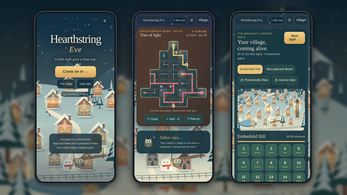
How we tested it
The build was loaded from games.debutplay.com in a headless Chromium session on ; the canvas started and no request was blocked. The guide was last checked on .
From the developer
Hearthstring Eve is a cosy Christmas puzzle about strings of lights. It is Christmas Eve in Emberfold, and Pippa the rabbit and Tallow the owl have a pocketful of bulbs and a whole snowy village waiting to glow. Each board is a little picture made of tiles: a tree, a wreath, a star, a stocking, a candy cane or a snowflake. Turn the tiles until every bulb is joined to its plug and no wire is left open, and the whole string lights up with a run of light from the plug to the last bulb. Every story board you finish lights a window in the village. There are no timers and no way to lose, and undo is unlimited. Free demo (play it in your browser above) Emberfold Hill, the whole first chapter: boards 1 to 30 with their landmarks and keepsakes, plus the daily light, endless mode and decorations. Your progress is saved in your browser. Full game (download) 120 story boards in four chapters: Emberfold Hill, Biscuitbrook Bend, Pinewhistle Rise…
Frequently asked questions
What is Hearthstring Eve?
It is a Christmas tile puzzle set in Emberfold on Christmas Eve. Pippa the rabbit and Tallow the owl turn light-string tiles until each bulb connects to its plug and no wire end stays open.
How much does it cost?
The browser demo is free. The full downloadable game costs $2.99.
Which platforms are supported?
The demo runs as an HTML5 browser frame. The full game is available for Windows, macOS, and Linux.
Is there a timer or a way to lose?
There are no timers and no losing condition, and undo can be used without limit.
Does the browser demo save progress?
Yes. Progress in the browser demo is saved in the browser.
Can the full game be played offline?
Yes. The download plays offline after unzipping and opening index.html.
What games are similar to Hearthstring Eve?
The closest matches on DebutPlay are Heart Potion Sort, ARCANUM: Path of the Magus, OSSELWICK: The House That Listens. They share the same genre, so the controls and the pace carry over.
Something wrong or missing? Tell us. How we test games.