Simulation · New game
I’m the Ticket Gate
A short HTML5 simulation about impersonating a broken ticket gate, matching each passenger card with the right sound while the machine around the player falls apart.
#10 this weekAI-assisted: Code, Graphics, Sound, ai.textdesigned, ai.directed, ai.tuned and playtested by me. the code was written with claude (anthropic) under my direction. no image or audio generation models were used: every visual is drawn procedurally on html5 canvas, ai.and every sound effect is synthesized live with the web audio api — both by code written with claude. the in-game english and japanese text was drafted with claude and edited by me. there is no music.
The game runs in this tab. No install, no account.
The short answer
This is a roughly five-minute single-player simulation set at a train station gate. Read each card, choose the correct beep or bong at the instant of contact, and compare the passenger’s FROM station with the remaining balance. Four phase breakdowns add math, memory, and sticker tracking. It is released and free to play in a browser, with English and Japanese text.
What is the Ticket Gate premise?
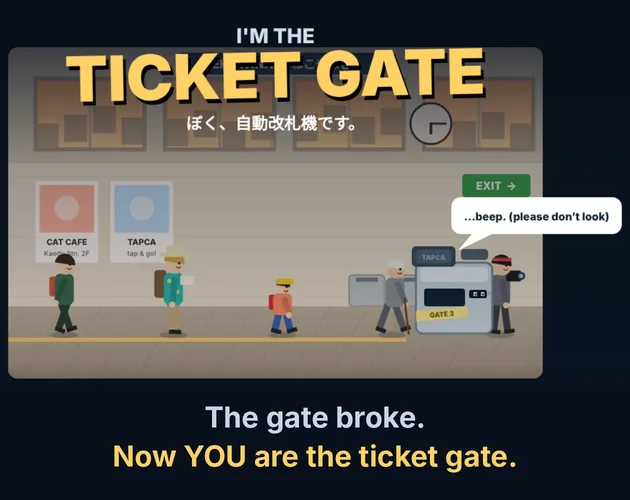
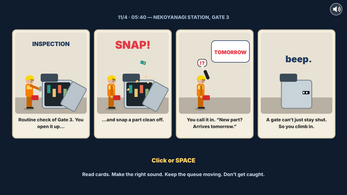
The setup is a single shift at Gate 3. An inspector has snapped a part clean off, and the replacement will not arrive until the next day. Rather than keep the gate shut, the inspector climbs inside and impersonates the machine. That premise turns the game into a one-shift simulation about a person pretending to be a ticket gate.
The tone is built around the gap between human judgment and machine routine: cards must be read, the queue must keep moving, and no passenger should notice there is a person inside. The setting is a Japanese train station, presented in 2D and framed as a short, funny management and math challenge. It is released and free to play in an HTML5 browser.
How to play
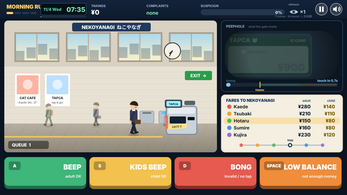
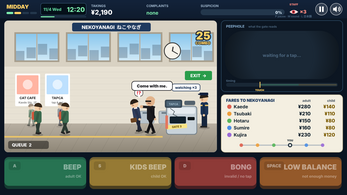
Each passenger walks up and touches a card to the gate. The person at the keyboard supplies the sound the gate would make. A is the normal beep for an adult card that covers the fare, a valid pass, or the correct ticket. S is the kids beep for a child's KIDS card. D is the bong for rejected cases such as an expired pass, a ticket that is too cheap, a cheat, or no tap. SPACE is the low-balance warning for a card that cannot cover the fare.
The fare board matters. Find the passenger's FROM station, compare that information with the balance, and react at the touch. Timing is part of the job: a sound at the moment of contact earns PERFECT, while an early sound gives away the act because a machine does not beep before a card touches it.
Mistakes raise SUSPICION. Staff on patrol and camera-happy train fans make each mistake count three times, and reaching 100% ends the run with the accusation 'And you are… WHO, exactly?!' Surviving until the last train is the goal; the replacement part arrives at dawn.
Controls
The gate is operated with a small set of keys. A is the normal beep for an adult card that covers the fare, a valid pass, or the correct ticket. S is the kids beep for a child's KIDS card. D is the bong for rejected cases such as an expired pass, a ticket that is too cheap, a cheat, or no tap. SPACE is the low-balance warning for a card that cannot cover the fare.
Mouse or touch users click or tap the large on-screen buttons. The game works on phones in landscape. P pauses, M toggles sound, and L switches between Japanese and English. Keyboard, mouse, and touch are all supported.
The sound keys are the gate's response, so each input is also the answer to the card in front of the player. The interface reduces the job to four sound choices plus pause, audio, and language toggles.
| Input | Action |
|---|---|
| A | Give the normal BEEP for an adult card with enough balance, a valid pass, or the correct ticket |
| S | Give the KIDS BEEP for a child with a KIDS card |
| D | Give the BONG for an invalid card, expired pass, cheap ticket, cheat, or no tap |
| SPACE | Give the LOW BALANCE warning when the card lacks enough fare |
| Mouse / touch | Click or tap the large on-screen buttons |
| P | Pause |
| M | Toggle sound |
| L | Switch between Japanese and English |
Tips for your first run
Treat the first run as a timing drill before the breakdowns arrive. Morning rush leaves the gate fully working, so use that phase to learn the four sound answers and the fare-board comparison. The later phases remove aids one by one, and suspicion punishes every slip, especially when staff or train fans are watching.
The core habit is simple: read the card, find the FROM station on the fare board, compare the balance, and answer at the touch. Do not rush the sound before contact; an early response is exactly the tell that a machine would never produce. Keep the queue moving while protecting the suspicion meter. A clean answer is better than a fast guess, and the four sound keys should become automatic before the display and sensor fail.
- Match the sound to the card at the instant of contact; an early beep is treated as impossible for a machine.
- Check the FROM station on the fare board before choosing between a normal beep, a low-balance warning, or an invalid bong.
- At midday, the balance display dies after each BEEP; pick the remaining balance with A, S, or D quickly.
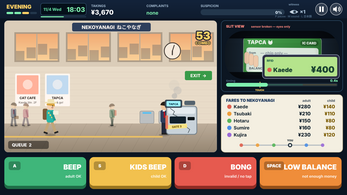
- In the evening, the card sensor dies; read the pocket RFID reader's flash at the touch and use the slit view.
- On the last train, the memory chip dies; place stickers on passed cards and catch the cards that come back.
- Watch for adults using KIDS cards, expired commuter passes, and fare-dodgers with cheap paper tickets; the bouncer handles the KIDS-card case.
Content and replayability
The scenario is a single shift of about five minutes, split into four escalating phases: morning rush, midday, evening, and last train. Morning rush keeps the gate working. Midday kills the balance display and asks for quick arithmetic after each BEEP. Evening kills the card sensor and leans on a pocket RFID reader. Last train kills the memory chip and turns passed cards into stickers that may come back.
Each phase changes the information available. The run is single-player, and the pressure comes from suspicion, queue management, and the three-times penalty from staff and train fans. A failed run ends at 100% suspicion; a successful one reaches the last train and the dawn delivery of the replacement part.
The short length and the four-part breakdown schedule are the main replay hook. The game includes English and Japanese, and L switches languages.
Presentation and performance
The game is a 2D HTML5 title built for browser play. Its feedback is audio-led: the player produces beeps, a kids beep, a bong, and a low-balance warning, while suspicion, queue pressure, and the changing gate condition carry the tension. The Japanese train-station setting and the absurd premise give the short shift its comic tone.
The delivery method is browser-based HTML5, with keyboard, mouse, and touch input. The game works on phones in landscape, and four screenshots are included. Sound can be toggled with M, and the language can be switched with L. The controls stay on a few large buttons, which suits a timing-focused format.
The interface does not rely on hidden inputs: A, S, D, and SPACE cover the four gate responses, while P, M, and L cover pause, audio, and language.
Who should play it
This is for players who like a short simulation with a clear comic hook. The job is simple to understand—read a card, choose a sound, keep the queue moving—but the four phases keep changing which information is reliable. Players who enjoy time-management, light math, and train-station settings will find the premise doing a lot of work.
The game is single-player and free, with English and Japanese options. It suits a five-minute browser session and touch play on a phone in landscape, and the suspicion meter gives each mistake immediate weight.
The humor comes from the gap between a human pretending to be a machine and the machine's steady collapse. Players who prefer strict action or complex controls should look elsewhere; this one is built around four answers and a fare board.
Screenshots
How we tested it
The build was loaded from games.debutplay.com in a headless Chromium session on ; the canvas started and no request was blocked. The guide was last checked on .
From the developer
You came to inspect Gate 3. You snapped a part clean off. The replacement arrives TOMORROW. The gate can't just stay shut... so you climb inside. I Am the Ticket Gate. is a one-shift simulation about a human pretending to be a machine. Read every card, beep at exactly the right moment, keep the queue moving, and don't let anyone notice there's a person in there. ━━━━━━━━━━━━━━━━━━━━ HOW TO PLAY ━━━━━━━━━━━━━━━━━━━━ Passengers walk up and touch their card. You make the sound the gate would make. [A] BEEP – adult card with enough balance, valid pass, correct ticket [S] KIDS BEEP – a child with a KIDS card [D] BONG – invalid: expired pass, cheap ticket, cheats, no tap [SPACE] LOW BALANCE – the card doesn't have enough for the fare Find the passenger's FROM station on the fare board, compare it with the balance, and react. Sound off right at the touch for PERFECT. Too early and the gate "beeps before the card touched" – a machine never…
Frequently asked questions
Is the game free to play?
Yes. The game is free and runs in an HTML5 browser frame. It supports keyboard, mouse, and touch input.
How long does one shift take?
A shift is about five minutes. The run is built as a single shift with four phases: morning rush, midday, evening, and last train. Surviving until the last train brings the replacement part at dawn.
What platforms and controls are supported?
The game is an HTML5 browser title with keyboard, mouse, and touch controls. A, S, D, and SPACE produce the four gate sounds; P pauses, M toggles sound, and L switches Japanese and English. Touch play works on phones in landscape.
What raises suspicion?
Every mistake raises suspicion. Staff on patrol and camera-happy train fans make a mistake count three times. At 100% suspicion, the run ends with the accusation 'And you are… WHO, exactly?!'.
What makes a PERFECT beep?
A PERFECT comes from sounding the gate at the exact moment the card touches. An early sound is a giveaway because a machine does not beep before contact. The fare board and the card's balance determine which sound is correct.
Does the game support Japanese?
Yes. The game includes English and Japanese, and L switches between them. The interface language can be changed during play.
What games are similar to I’m the Ticket Gate?
The closest matches on DebutPlay are Maré de Azar (Demo), Warm Water, Bark Valley. They share the same genre, so the controls and the pace carry over.
Something wrong or missing? Tell us. How we test games.