Simulation · New game
Warm Water
A free documentary simulation that hands you a Florida manatee refuge for thirty-five winters, with budgets, swimmer rules, and counts that never show the whole herd.
#7 this weekAI-assisted: Code, Text
The game runs in this tab. No install, no account.
The short answer
Warm Water is a free single-player browser simulation of thirty-five winters at a manatee refuge in Kings Bay, Crystal River, Florida, running from 1983 to 2017. Each year the manager splits a small budget among patrol, outreach, counts, research, land, and water, then sets the rules for swimmers. Play it now for a short, sober management game built on real counts.
What is Warm Water?
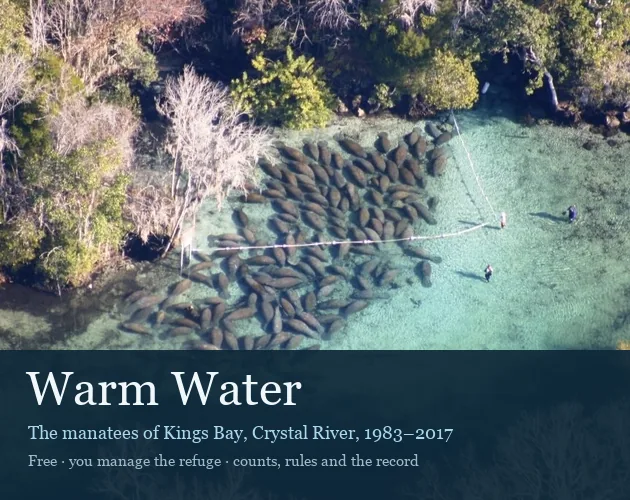
Warm Water is a free single-player simulation that puts the player in charge of a manatee refuge in Florida. It begins in 1983, when the U.S. Fish and Wildlife Service establishes that refuge in Kings Bay at Crystal River, a place where manatees crowd into the warm springs each winter and people arrive to swim beside them.
The game covers thirty-five winters, from 1983 to 2017, and it hides one thing throughout: the real size of the herd. The manager never sees the true number of manatees, only the counts that get funded and the range those counts imply, so every rule is written under uncertainty.
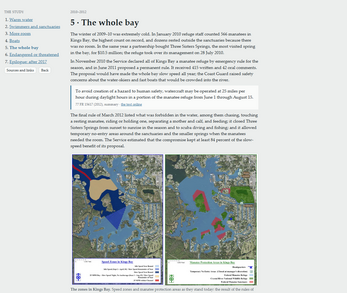
The structure is documentary rather than competitive. Two groups are tracked apart, the bay's residents who depend on tour boats, dive shops, and marinas, and the people who protect the herd, and the game reports both sides without merging them into one figure or naming a winner. Real decisions land on their historical dates: three more sanctuaries in 1994, a seventh in 1998, Three Sisters Springs and the emergency rule in 2010, the permanent Kings Bay Manatee Refuge rule in 2012, closures in 2015, and the 2017 reclassification from endangered to threatened.
How to play
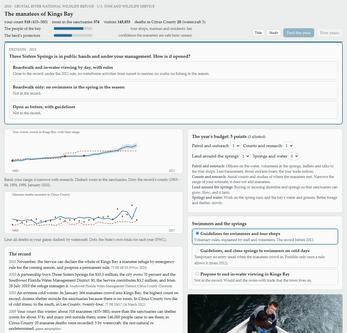
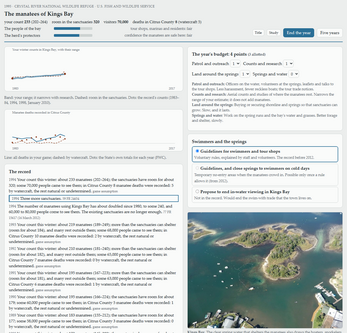
Every winter begins with money. A small budget has to be split among patrol and outreach, counts and research, the land around the springs, and the springs and water themselves. Each line competes with the others, so a heavier patrol presence or a wider outreach campaign draws resources away from surveys or from work on the springs and their water.
After the budget comes the rulebook. Swimmers come to these springs, and the manager sets what is permitted of them. Both decisions repeat each year, which is what turns a run into a slow negotiation between the people who make their living on the bay and the protection of the herd, rather than a single choice made once.
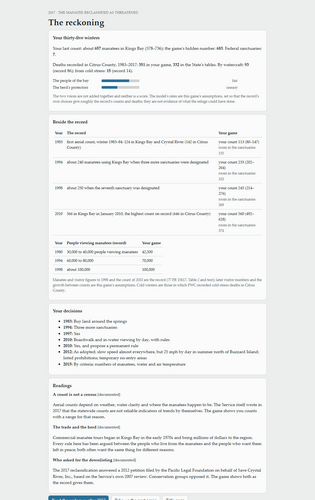
Each year's results are judged against real records instead of an invented target. Your counts appear beside the Service's aerial surveys, from 124 manatees in the first count of 1983-84 to roughly 240 in 1994, 250 in 1998, and 566 in January 2010, while your deaths sit next to the State of Florida's Citrus County mortality tables, which total 332 across 1983 to 2017, 86 of them caused by watercraft. Following the historical choices brings the simulation close to both figures, and the game states plainly that its rates are assumptions.
Controls
Warm Water runs inside a browser window as an HTML5 game, so there is no installation between the player and the first winter. Interaction is administrative rather than twitchy: the year's decisions are the controls. The refuge is steered by dividing the budget across patrol and outreach, counts and research, land around the springs, and the springs and the water, then by writing the rules swimmers must follow.
Between those decisions the calendar advances to the next winter, where counts and mortality figures show what the previous choices produced. The pace suits a simulation of thirty-five winters: decisions are made, compared against the record, and revised the following year rather than executed in real time. The manatee is never a controllable character and never speaks, so the only handle on the herd is the policy built around it.
The game page does not list its controls. Check the in-game tutorial or pause menu for the current scheme.
Tips for your first run
Pay for counts. The true herd size stays hidden for the entire run, so the only picture available is the survey you fund and the range it produces. Skipping that line leaves the rest of the budget being spent blind.
Keep an eye on the watercraft portion of the mortality comparison, which accounts for 86 of the 332 Citrus County deaths recorded between 1983 and 2017, and remember that several rules arrive on fixed dates, including the sanctuaries of 1994 and 1998, the emergency rule of 2010, the permanent rule of 2012, the closures of 2015, and the reclassification of 2017. Budget around decisions that cannot be avoided.
- Fund counts and research early; a range you can defend beats a guess.
- Revise the swimmer rules each year; the rulebook is yours to rewrite.
- Check your deaths against the Citrus County tables annually, not only at the end.
- Treat a run as 20 to 30 minutes and replay with a different budget split.
- Hold both constituencies in view; neither figure cancels the other.
Content and replayability
The game arrives with a study as well as a simulation. A seven-chapter account follows the refuge's history through the Federal Register, and an epilogue carries the story to 2025. That material sits alongside the thirty-five winters rather than replacing them, so a player can move between annual decisions and the paperwork that shaped them.
For anyone who wants the primary record, a separate volume collects it: Warm Water - The Documents, a 63-page PDF and EPUB sold for 5 USD while the game itself costs nothing. It contains the rules of 1994, 1997, 1998, and 2010 in full, the 2011 proposal and the 2012 permanent rule together with the Service's answers to hundreds of public comments, excerpts from the 2017 reclassification, and the State's Citrus County mortality table covering 1983 to 2017.
Replay value comes from the arithmetic. A run lasts 20 to 30 minutes, and every winter asks for a different split among patrol and outreach, counts and research, land, and water, with swimmer rules layered on top. Because the herd's real size never appears, two players can make defensible choices and finish with different counts, both measured against the same historical benchmarks.
Presentation and performance
Warm Water runs as an HTML5 game in a browser window, with nothing to install before the first winter. It is played in English and built for short sessions: 20 to 30 minutes covers a full run through thirty-five winters.
The register is documentary. The manatee is not a character and nobody speaks for it; the animal is expressed through counts, range, and mortality figures. Your aerial counts sit beside the Service's own series, and your losses are lined up against Florida's Citrus County tables year by year, which makes the comparison the drama rather than any single event.
Nothing is stored and nothing is sent anywhere, so there is no account to create and nothing left behind once the tab is closed. That self-contained design keeps the whole experience inside the browser, from the annual budget decisions to the closing comparison against the record.
Who should play it
Warm Water suits players who like management simulations with a paper trail: modest annual decisions, a long horizon, and results read off tables rather than explosions. Anyone drawn to conservation policy, Florida ecology, or the history of the manatee's listing will find the seven-chapter study and the yearly comparison against real counts unusually direct.
It is a poor fit for players who need a score, a winner, or fast feedback. The bay's residents and the herd's protectors are measured separately and never added together, so there is no single number to chase and no final victory to reach.
Teachers and curious browsers get a free, self-contained game of 20 to 30 minutes that leaves nothing on the machine, and the 5 USD documents volume is there for anyone who wants the rule texts and the comment responses in full. The project is independent and not affiliated with the U.S. Fish and Wildlife Service or any group named in it.
Screenshots
How we tested it
The build was loaded from games.debutplay.com in a headless Chromium session on ; the canvas started and no request was blocked. The guide was last checked on .
From the developer
1983. The U.S. Fish and Wildlife Service founds a refuge in Kings Bay, Crystal River, Florida, where manatees crowd into the warm springs every winter, and people come to swim beside them. You are its manager. You will never see the true number of manatees: only your counts and their range.Warm Water is a free documentary simulation of thirty-five winters, 1983–2017. Each year you divide a small budget between patrol and outreach, counts and research, land around the springs, and the springs and water, and you set the rules for swimmers. The record's decisions come on their dates: three more sanctuaries in 1994, a seventh in 1998, Three Sisters Springs and the emergency rule of 2010, the permanent Kings Bay Manatee Refuge rule of 2012, closures in 2015, and in 2017 the reclassification from endangered to threatened.Two voices, no winner. The people of the bay, who live from the tour boats, dive shops, and marinas, and the herd's…
Frequently asked questions
Is Warm Water free?
The game is free to play. The optional companion volume, Warm Water - The Documents, is a separate purchase at 5 USD for a 63-page PDF and EPUB.
How long does one game take?
A run covers thirty-five winters, 1983 to 2017, and takes roughly 20 to 30 minutes. The seven-chapter study and its epilogue to 2025 sit outside that time.
Do you ever see the actual number of manatees?
No. The manager works from funded counts and the range they imply, which is why the aerial figures from 1983-84, 1994, 1998, and January 2010 serve as comparisons rather than answers.
Is there a winning condition?
There is no single score and no winner. The people of the bay and the herd's protectors are tracked separately, and the game never adds the two together.
Is the manatee a character in the game?
No. The manatee is never given a voice or a personality; the herd is expressed through counts, range, and mortality figures instead.
What does the documents volume contain?
The full text of the rules of 1994, 1997, 1998, and 2010, the 2011 proposal and the 2012 permanent rule with the Service's answers to hundreds of public comments, excerpts from the 2017 reclassification, and the Citrus County mortality table for 1983 to 2017.
What games are similar to Warm Water?
The closest matches on DebutPlay are Maré de Azar (Demo), I’m the Ticket Gate, Bark Valley. They share the same genre, so the controls and the pace carry over.
Something wrong or missing? Tell us. How we test games.