Simulation · New game
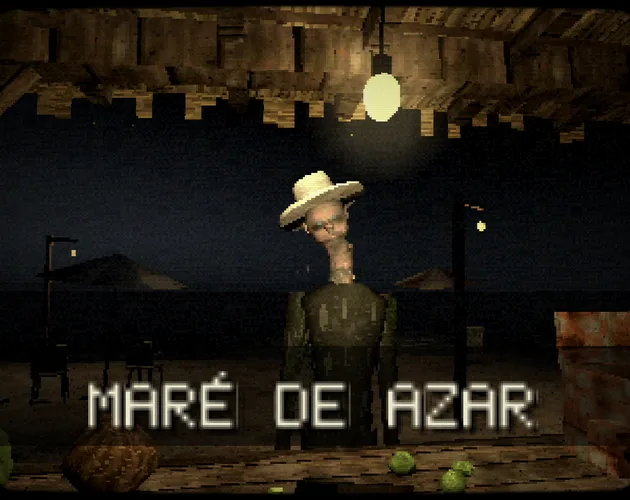
Maré de Azar (Demo)
A free browser demo about inheriting a beach shack, mixing drinks for the living, and hiding under the counter from whatever the tide sends after dark.
#39 this weekAI-assisted: Code, Graphics, Sound
The game runs in this tab. No install, no account.
The short answer
Maré de Azar is a first-person simulation demo set in a Brazilian beach shack, played entirely in a browser. Days go to cooking and serving; nights go to folklore visitors and a rules sheet that only mostly holds. A run lasts three days and three nights, about 25 to 40 minutes, and mistakes return later rather than ending the run on the spot.
What is Maré de Azar?
An inheritance opens the game, and it is not a clean one. Uncle Zeca has disappeared, leaving behind his beach shack and, attached to it, an unpaid debt framed as a pact with the Tide. That premise does the structural work for everything else: the shack is the workplace, the sea is the creditor, and the calendar is short.
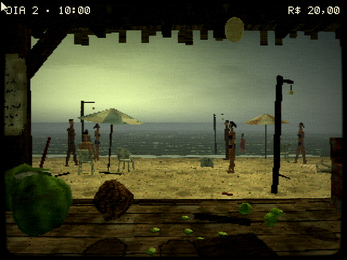
Daylight hours belong to the counter. The beach is hungry, customers form a queue, and each order has to be taken and then assembled at the prep station — caipirinhas mixed, coconuts cracked, fish fried — with a recipe card as the guide and the customer's patience as the timer. The clientele is written for comedy as much as pressure: a badly sunburned gringo, a surfer who revises his order halfway through, thirsty bathers, and an old woman who settles her bill in seashells.
After dark the tone changes. Brazilian folklore and the sea arrive as customers of their own, and a sheet of rules attached to a post explains the correct response — with gaps. The demo runs three days and three nights, roughly 25 to 40 minutes, across eight customers who range from ordinary people to strange people to things that should not exist, plus a beach populated with bathers.
How to play
The day shift is a service loop with a written recipe in front of you. Take the order at the counter, move to the prep bench, and follow the card step by step to produce the drink or food requested, then get it out before patience runs dry. Stock and incoming orders arrive through a delivery guy, so the bench is not only a cooking station but a supply line to manage.
Night shifts replace cooking with protocol. The paper on the post tells you what to do when something from folklore or the sea comes to buy, and the instructions are not entirely reliable. Getting it wrong does not usually kill you on the spot. Instead the visitor leaves and comes back later, which turns a small error into a debt you pay on a future night.
Not every visitor can be handled the same way. Some can be tricked by switching off the light and hiding beneath the counter; others cannot be fooled at all, so the correct move is to know which is which before the light goes out. Death is survivable in the sense that a failed night can be retried on its own, without replaying the whole run, and the first night is built to teach the basics.
Controls
Everything is handled with a mouse. Moving the cursor to the edge of the screen turns the view, a click interacts with whatever is in front of you, and holding the button pours a measure — the one action in the set that needs timing rather than a single press. The right mouse button zooms in for a closer look, which matters at a prep bench where the recipe card is the reference.
Escape pauses. A fullscreen toggle sits in the bottom-right corner of the game. The layout is deliberately spare: no key bindings to memorise beyond pause, no gamepad scheme, and no twin-stick camera control — you look around by pushing the cursor to the edges and get on with the job.
That leaves attention free for the two things that actually decide a shift: whatever the recipe card is asking for, and how much patience is left on the other side of the counter.
| Input | Action |
|---|---|
| Move cursor to screen edge | Look around |
| Click | Interact |
| Hold mouse button | Pour a measure |
| Right mouse button | Zoom |
| Esc | Pause |
| Fullscreen button (bottom right) | Toggle fullscreen |
Tips for your first run
Treat the first night as instruction rather than test. It exists to teach the basics, and the rules on the post are there to be read before a visitor is standing in front of you. Read them early, and expect at least one of them to be less honest than it looks.
- Take the order before touching the bench; a surfer who changes his mind halfway through is easier to handle when the ticket is confirmed first.
- Follow the recipe card exactly on early orders — caipirinhas, coconuts and fried fish each have their own steps, and guessing burns the waiting customer's patience.
- Watch the delivery guy for stock and incoming orders; running dry mid-order is a slower failure than a wrong ingredient.
- At night, decide whether the visitor can be fooled before reaching for the light switch — hiding under the counter only works on the ones that can be tricked.
- When a night collapses, retry that night instead of restarting; a run is only three days and three nights, so a repeat is cheap.
- Set the CRT effect to light, medium or strong before starting; the strength is a taste call about how much grit the PS1 look should carry.
Content and replayability
One demo run is short by design: three days, three nights, and an estimated 25 to 40 minutes depending on how quickly orders are handled and how many nights get retried. Eight customers are spread across that span — a mix of ordinary people, odd people, and creatures that should not exist — plus a beach full of bathers filling out the daytime crowd.
Replay value in the demo comes from the retry rule and from the rules themselves. Since a failed night can be attempted again on its own, the cost of learning is time rather than lost progress, and the night visitors are the part most worth seeing twice, because the countermeasures differ from one to the next.
The scope is explicitly a demo. The full version is promised to add more nights, more creatures, and more rules that mislead, which means the compact three-night structure here is a sample of a larger system rather than the finished shape. Two languages are supported, English and Portuguese, which fits the Brazilian setting and the folklore at the centre of the night shift.
Presentation and performance
The art direction aims at an obscure PlayStation 1 game viewed on a CRT television, and the filter is adjustable across three strengths — light, medium and strong — so the level of scanline grit is a personal setting rather than a fixed choice. It is a deliberate lo-fi look, not a neutral one, and the atmosphere tag fits the split between sunny counter work and the darker night shift.
Headphones are recommended for play, which tracks with a game whose tension is built from arrivals rather than action. The title runs in a browser as an HTML5 game with a playable frame, so nothing needs installing, and the fullscreen button in the bottom-right corner is the way to give the shack the whole screen.
Who should play it
This suits players who like cooking and service games but want the cheerful part to end at sunset. The daytime prep work is the familiar rhythm of orders, recipes and impatience; the night shift swaps that for rules-following under threat, which is a horror structure rather than a cooking one.
It is also for anyone drawn to Brazilian folklore as a horror source rather than a backdrop, and for players who like the specific texture of PS1-era visuals with a CRT filter over them. The three-night length makes it a single-sitting demo, and the retry-same-night rule keeps it from being punishing.
Less suited to anyone wanting a long management game or a combat-driven horror title: this is a short, mouse-only, browser-based sample with service work at its centre. Entry costs nothing, and the work is done in the browser.
Screenshots
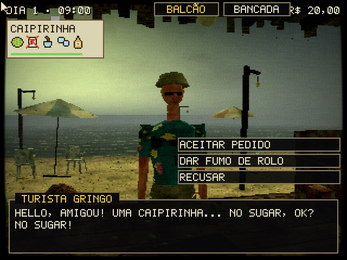
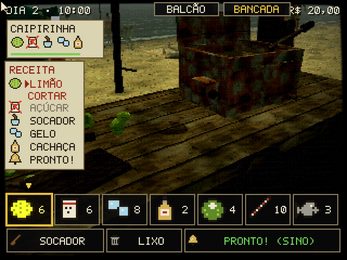
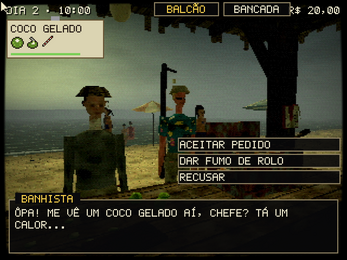
How we tested it
The build was loaded from games.debutplay.com in a headless Chromium session on ; the canvas started and no request was blocked. The guide was last checked on .
From the developer
ENGLISH Uncle Zeca is gone and left you his beach shack. It came with a debt: a pact with the Tide. By day, the beach is hungry. Customers line up at the counter: accept the order and make caipirinhas, crack coconuts and fry fish at the prep counter, following the recipe card, racing their patience. A sunburned gringo, a surfer who changes his order halfway, thirsty beachgoers, an old lady who pays in seashells. At night, Brazilian folklore and the sea come shopping. The rules paper on the post tells you what to do. Mostly. Mistakes don't kill you right away: they leave... and come back. Some you can fool by turning off the light and hiding under the counter. Others, you can't. 3 days and 3 nights, 25 to 40 minutes8 customers: people, weird people and things that shouldn't exist, plus a beach full of bathersPapa's-style prep counter with a guided recipe, stock and orders from the delivery guyThe first night teaches the basics. Died?…
Frequently asked questions
Is Maré de Azar free?
Yes. The demo is free to play in the browser.
How long does the demo take?
Three days and three nights, estimated at 25 to 40 minutes, depending on how many nights get retried.
What happens if you die?
A failed night can be retried on its own, so the same night is replayed rather than the whole run.
Do mistakes end the run immediately?
Usually not. Most errors leave the visitor walking away and returning later, so a mistake becomes a future problem instead of an instant loss.
Which languages are supported?
English and Portuguese, including the control list.
Is this the complete game?
No. It is a demo; the full release is planned to include more nights, more creatures and more rules that mislead.
What games are similar to Maré de Azar (Demo)?
The closest matches on DebutPlay are Decision Maker, DomeLand Demo, What is PGSX. They share the same genre, so the controls and the pace carry over.
Something wrong or missing? Tell us. How we test games.