Visual novel · New game
Last Train to Kaerazu
A late-night Hokkaido train ride turns into a folklore-flavoured mystery in a fifteen-to-twenty-minute browser visual novel where your own name and home country become part of the story.
#15 this weekAI-assisted: Code, Graphics, Text
The game runs in this tab. No install, no account.
The short answer
Last Train to Kaerazu is a short browser visual novel about waking on an empty last train to a station that appears on no route map. You type your name and the country you moved from, then read ordinary Japanese railway details as clues. Six endings, fourteen culture notes, English and Japanese switching, and a fifteen-to-twenty-minute run make it an easy first click.
What is Last Train to Kaerazu?
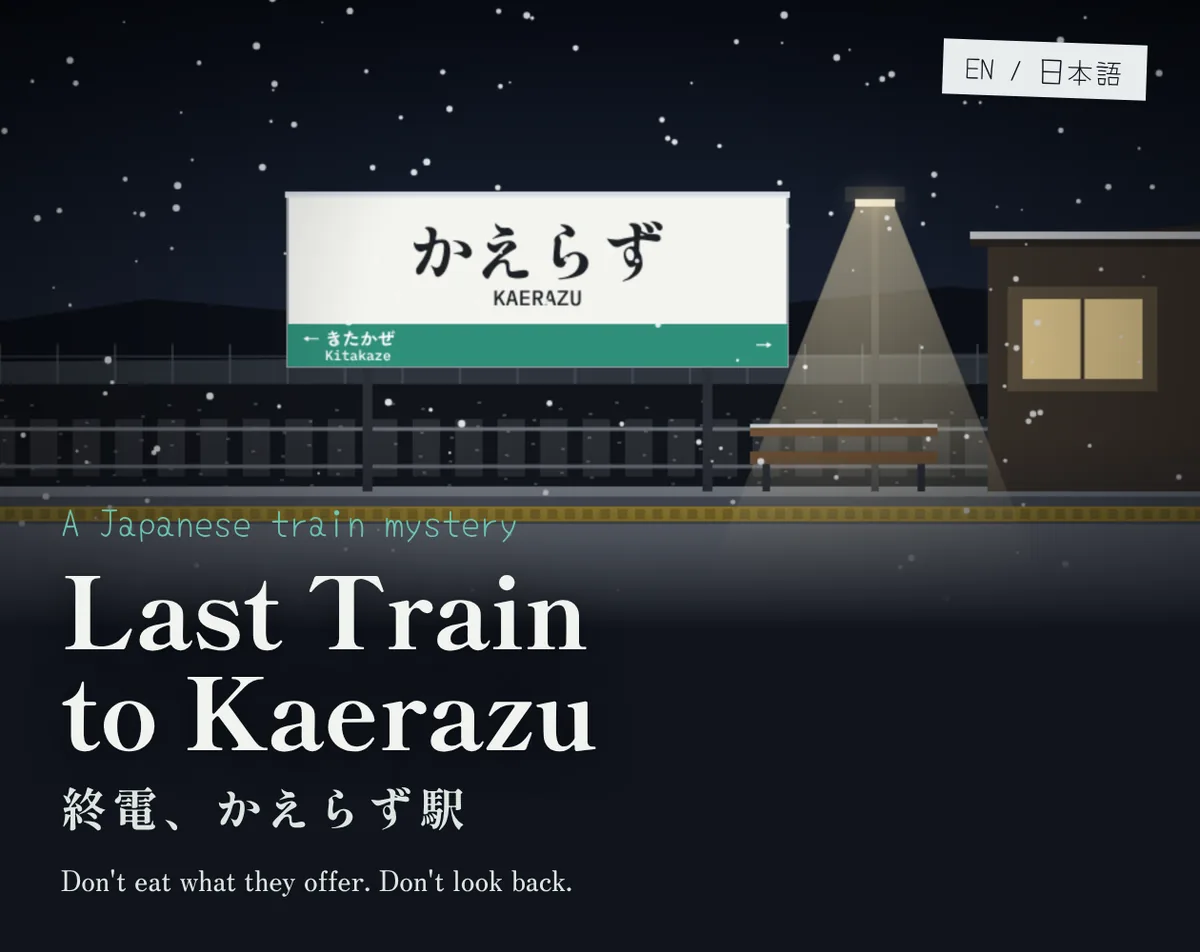
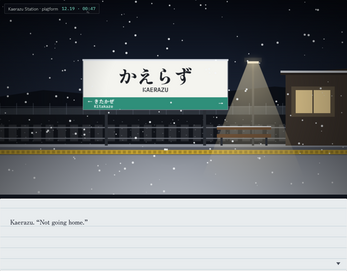
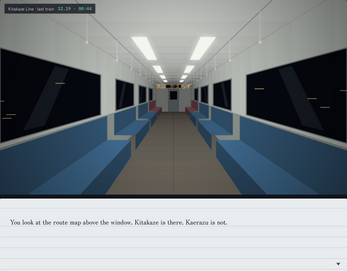
A compact mystery visual novel built for the browser, opening late on December 18th on a Hokkaido line. The clock reads 11:47 PM when the protagonist, who moved to Hokkaido two months earlier, catches the final train home and shuts their eyes for a second. On waking, the car is empty, the English announcement has stopped, and the next stop is announced as Kaerazu, a station that appears on no route map.
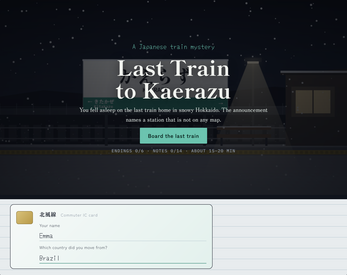
The opening asks for a name and the country the player moved from, and the story is written around that identity rather than around a fixed heroine or hero. It is the second game in a series about everyday Japan; the first, Desk No. 31, is a mystery about transferring into a Japanese high school. A single run is built to take roughly fifteen to twenty minutes.
Nothing in the premise is supernatural at first glance, and that is the hook. The tension grows out of a commute that quietly stops behaving like a commute, with the railway itself supplying the unease.
How to play
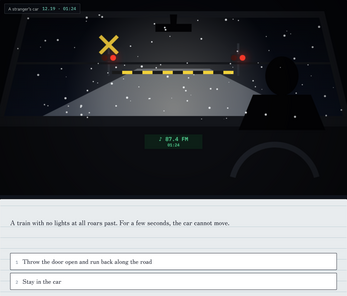
Most of a run is reading and advancing text, punctuated by choices that nudge events rather than halt them. The deduction work comes from treating ordinary Japanese railway furniture as evidence instead of scenery, and the game leans on details a daily commuter would normally ignore.
The station sign gives the previous stop but leaves the next one blank. An IC card gate record shows no station entry at all. A timetable offers just one train, the first at 5:12. A vending machine dispenses a can of hot soup with no brand on it. Somewhere a voice says okaeri, a word that should only reach someone who is genuinely home.
Two prohibitions borrowed from the Kojiki, Japan's oldest chronicle, dated 712, frame the danger: do not eat food from the other world, and do not look back. Choices stay small, but they carry weight, and they branch toward one of six endings. Fourteen culture notes covering trains, vending machines and folklore can be gathered along the way.
Controls
Input is deliberately light. A mouse click or the Space bar advances the text, and the number keys 1 through 4 select an option when a choice appears. The N key opens the notebook, where collected culture notes are kept and can be reread between scenes.
At the very start, the name and the country of origin are typed in, which is the only free-text entry in the flow as presented. The language can be switched between English and Japanese at any point, so a run can be read in either language or alternated scene by scene.
The game plays inside a browser on PC and mobile. Because the interface is text-first, the number keys carry most of the decision work once a scene gets going, and a single hand on the keyboard is enough to read through an entire path.
| Input | Action |
|---|---|
| Mouse click | Advance the text |
| Space | Advance the text |
| Number keys 1–4 | Select a choice |
| N | Open the notebook |
| Keyboard text entry | Type your name and the country you moved from |
Tips for your first run
The setting rewards attention more than speed. Ordinary objects hold the mystery, and the notebook exists so that a detail noticed on one screen can be weighed against a detail found several screens later. Read the objects as clues rather than decoration and the route map will start to feel like a puzzle.
Small decisions are the ones to watch. Six endings means a single pass will not show everything, so treat the first run as a reading of one possibility rather than the definitive answer.
- Open the notebook with N early and often; it collects fourteen culture notes covering trains, vending machines and folklore.
- Read the station sign twice: the previous station is named, the next one is blank, and that blank is the whole problem.
- Cross-check the IC card record and the timetable, where the only departure listed is the 5:12.
- Treat the two Kojiki prohibitions as survival rules: refuse food offered from the other world, and never look back.
- Note the greeting okaeri when it appears, because home is the thing the story keeps testing.
Content and replayability
Six endings and fourteen notebook entries set the scale. With a fifteen-to-twenty-minute runtime, finishing one path is a single sitting, which makes returning for a second or third ending a realistic evening plan rather than a commitment. The short length is the point: it invites immediate replay instead of a save file left untouched for a month.
Culture notes are the collection layer. Trains, vending machines and folklore each contribute entries, so curiosity about a station sign or a departure melody turns into something the notebook keeps. Small choices determine which parts of that material a given path surfaces.
The language toggle adds a second way to revisit a favourite scene, since English and Japanese can be swapped at any moment. The result is a compact story that can be read once for the plot and again for the details underneath it.
Presentation and performance
Sound does much of the atmospheric work. Train rumble, a departure melody and a railway crossing all feature, and headphones are recommended to hear the mix as intended. Those cues are also thematically loaded: a crossing bell and an arrival chime are exactly the sounds a late commuter trusts without thinking.
The story, code and illustrations were produced with generative AI assistance, with Claude credited, and the game was made in Hokkaido. It ships as an HTML5 build that runs in the browser on PC and mobile, so the same version is reachable from a desktop or a phone without hunting for a different release.
Who should play it
Players who like short, atmospheric mysteries and can finish one in a sitting are the natural audience, especially anyone curious about Japanese rail rituals and folk prohibitions. The premise is small and specific: one train, one late hour, one station that should not be there.
Readers who enjoy naming their protagonist and shaping a story through modest decisions will find the opening setup appealing, and completionists have six endings plus fourteen notebook entries to chase. Switching between English and Japanese mid-story gives bilingual players something extra to do with a second pass.
Anyone looking for action, combat or a long campaign should look elsewhere. What is on offer is a text-driven mystery with a hot soup can, a blank entry on a route map and one very specific rule about not looking back.
Screenshots
How we tested it
The build was loaded from games.debutplay.com in a headless Chromium session on ; the canvas started and no request was blocked. The guide was last checked on .
From the developer
December 18th, 11:47 PM. You moved to Hokkaido two months ago. Tonight you caught the very last train home, and closed your eyes for just a second. When you wake up, the car is empty. The English announcement is gone. “Tsugi wa… Kaerazu.” The next station is not on the route map. Last Train to Kaerazu is a short mystery visual novel (about 15–20 minutes) built on real Japanese train culture and folklore. Type your name and the country you moved from, and the story is about you. Everything that feels ordinary to people in Japan becomes a clue: The station sign: it tells you the previous station… and the next one is blank IC cards: the gate says you never entered a station at all The timetable: one train only, the first train at 5:12 A can of hot soup from a vending machine that has no brand name “Okaeri”: a word you should only hear when you are really home Small choices matter. Some of the rules come from the Kojiki, Japan’s oldest…
Frequently asked questions
Is Last Train to Kaerazu free to play?
Yes, it is free. It runs in a browser on both PC and mobile, and the language can be flipped between English and Japanese at any point during a run.
How long does one playthrough take?
About fifteen to twenty minutes, which is the intended length of a run. That short runtime is why going back for a different outcome stays practical rather than becoming a project.
How many endings are there?
Six endings. Small choices matter across the story, so one pass will not reveal everything, and fourteen culture notes about trains, vending machines and folklore can be picked up in the notebook along the way.
Can it be played on a phone?
Yes. The game plays in the browser on PC and mobile, so the same HTML5 build opens on a phone as on a desktop, with English and Japanese available on either.
Do you need to know Japanese railway culture beforehand?
No prior reading is required to follow the plot. The familiar details are explained as the mystery unfolds, and two rules taken from the Kojiki, recorded in 712, are the ones that actually govern behaviour: no food from the other world, and no looking back.
Is this connected to another game?
It is the second title in a series about everyday Japan. The first is Desk No. 31, a mystery about transferring to a Japanese high school, so there is a companion story in the same spirit.
What games are similar to Last Train to Kaerazu?
The closest matches on DebutPlay are Monsoon, Dating Killmulator, Narinig Mo Ba?. They share the same genre, so the controls and the pace carry over.
Something wrong or missing? Tell us. How we test games.