Browser games · New game
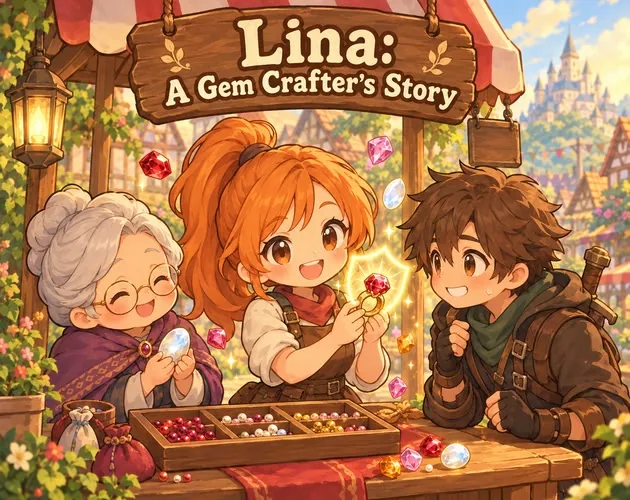
Lina: A Gem Crafter's Story
A free browser prototype that pairs bead-matching counter work with a grandmother's secret, a sleeping gem, and five days of rent to cover.
#65 this weekAI-assisted: Code, Graphics, Sound, Text
The game runs in this tab. No install, no account.
The short answer
Lina: A Gem Crafter's Story is a free HTML5 prototype set in Thimblewick, an adventurers' town. Customers arrive with a thought bubble, Lina rebuilds the piece with beads and stones, and the stall has five days to earn its rent. Granny Opal's tutorials and a gem-waking story fill the space between sales.
What is Lina: A Gem Crafter's Story?
Lina: A Gem Crafter's Story is a short browser game about minding a jewellery counter in Thimblewick, a town that lives off adventurers. Lina has taken over her grandmother's small street stall, and keeping it open is the job. It is a free HTML5 prototype from solo developer Elymar Apao, released under the name aely on 23 October 2026 and built for the Jamference jam around the theme of Crafting.
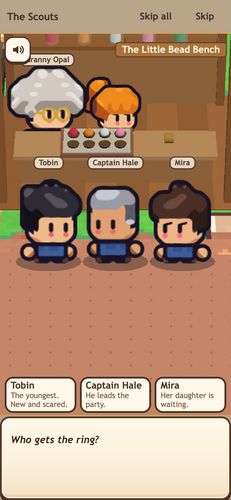
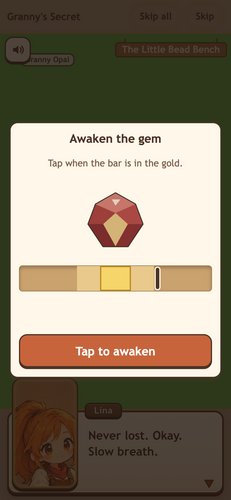
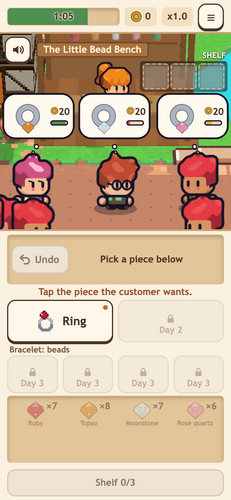
The work splits in two. At the counter, adventurers step up with a thought bubble showing the piece they want, whether that is a ring, a pair of earrings or a bracelet, and Lina has to reproduce it bead by bead before the customer loses patience. Running alongside is a story: a poor young adventurer brings in a sleeping gem, Granny Opal knows the secret to waking it, and the thread carries on through a ring that saves his life, a journey to a mining town, commissions for two heroes, a troll, and a quiet finish with a bunch of wildflowers.
Between days there are upgrades to take, and rent has to be paid. Nothing stands between a curious player and the counter: the game is free, opens in a browser, and accepts either touch or a mouse.
How to play
Every order starts as a thought bubble above the counter, showing a finished piece. The task is to rebuild that design rather than invent one. Tap the piece type first, choosing a ring, earrings or a bracelet, then tap beads and stones from the tray to fill the setting. Once the arrangement copies the bubble, sell it, and the sale lands as long as the customer's patience has not run out.
Granny Opal handles the teaching. Each piece type gets an explanation the first time it appears, and the order is fixed: rings first, then earrings, then bracelets. That progression keeps the earliest shifts narrow and adds the later formats only once the basics of copying a bubble are familiar.
The stall trades across five days. Upgrades sit between those days, and rent is owed, so the five-day stretch doubles as a budgeting problem on top of a matching one.
Story scenes break up the shifts. A Skip option sits in any story scene, so a player who would rather be selling can move straight back to the counter.
Controls
Input is deliberately minimal. Tap a piece type to select a ring, earrings or a bracelet, then tap beads and stones in the tray to place them on the piece. Tap Skip during a story scene to move past it. A speaker button turns the music off.
The layout is portrait and phone-first, with large buttons and targets sized for a thumb, and the same taps respond to a mouse cursor when the game is opened in a desktop browser. Everything runs inside an HTML5 frame in the page, so there is nothing to install before playing. Because the whole scheme is tapping, the barrier to a first order is low: select, place, sell, repeat.
| Input | Action |
|---|---|
| Tap | Select a ring, earrings or a bracelet, then place beads and stones from the tray |
| Tap Skip | Move past a story scene |
| Speaker button | Turn the music off |
| Mouse | Perform the same taps in a desktop browser |
Tips for your first run
The opening shifts are the ones to study closely, because rings are the first format Granny Opal teaches and the pattern of copying a bubble carries over to everything after. Treat each order as a copy job rather than a design exercise.
- Rebuild the bubble exactly, then sell; the aim is a match, not an approximation.
- Watch patience as closely as the bead tray, since a late sale is the one thing the counter cannot absorb.
- Notice which piece comes next: rings, then earrings, then bracelets, each introduced by Granny Opal on first meeting.
- Budget across the whole five days, because upgrades are taken between days and rent still has to be covered.
- Skip is available in any story scene, though the narrative holds a sleeping gem, a mining town trip and a troll worth seeing once.
Content and replayability
A run is organised around five days behind the counter, with upgrades between them and rent hanging over the entire stretch. Three piece types rotate through the orders: rings, earrings and bracelets, each assembled from the beads and stones in the tray.
Wrapped around that loop is a story with several distinct beats: a young adventurer's sleeping gem, Granny Opal's method for waking it, a ring that saves his life, a trip to a mining town, two heroes who need pieces made for them, and a troll along the way. It closes quietly with wildflowers. Fight scenes appear in text and simple pictures, with no gore.
This is a jam-week prototype, so the scope is one campaign rather than a menu of modes. A second visit means repeating the matching loop and the same story beats, with the Skip option available for anyone who wants the selling without the scenes.
Presentation and performance
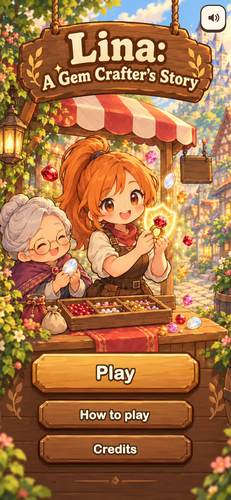
Thimblewick's pixel town art comes from Sunnyside World by Daniel Diggle, while the in-game people and the stage are drawn in code. The cover, the title screen and the character portraits were produced with ChatGPT image generation and Higgsfield (GPT Image 2.5). The soundtrack is two tracks made with Suno, and the speaker button silences them when the counter gets busy.
Everything about the presentation follows the phone-first brief: portrait framing, chunky buttons and a layout that answers to a mouse as readily as a thumb. Under the hood, the build was checked with automated tests and a bot that plays the game, coded with Claude Code agents under the developer's direction, with AI research feeding into bead-craft design rules, interface patterns and balance. Dialogue was drafted with AI help and then edited by hand. Roughness should be expected rather than treated as a fault, since the game was finished inside jam week.
Who should play it
This fits players who enjoy shop-counter games with a craft twist: short orders, visible customer demands, and a timer in the form of a patience meter. The five-day structure and the upgrades between days give each session a shape without demanding a long commitment, and the free browser build removes any risk in trying it.
It also suits anyone who wants a story with their matching, since Granny Opal's secret, the sleeping gem and the trip to the mining town run through the whole run rather than sitting at the edges. Phone players get a portrait layout with large buttons, and desktop players can use a mouse.
Players hunting a deep management sim, a long campaign or a finished, polished product should adjust expectations: this is a prototype made during a jam, with one campaign and three piece types. Those curious about small AI-assisted solo projects will find the credits as interesting as the counter.
Screenshots
How we tested it
The build was loaded from games.debutplay.com in a headless Chromium session on ; the canvas started and no request was blocked. The guide was last checked on .
From the developer
Lina has just taken over her grandmother's little street stall in the adventurers' town of Thimblewick. Customers stop at the counter with a thought bubble that shows the piece they want. Pick a ring, earrings or a bracelet, tap in the beads and stones to copy the bubble, and sell before their patience runs out. Five days, upgrades in between, and a rent to pay. The story is the other half of the game. A sleeping gem from a poor young adventurer, Granny Opal's secret for waking it, a ring that saves his life, a trip to the mining town, two heroes who need pieces made for them, a troll, and a quiet ending with a bunch of wildflowers. How to play Tap a piece (Ring, Earrings, Bracelet), then tap the beads and stones from the tray to copy the bubble. Granny Opal teaches each piece the first time you meet it. Rings first, then earrings, then bracelets. Tap Skip in any story scene if you want to get to the selling. The speaker button turns…
Frequently asked questions
Is Lina: A Gem Crafter's Story free?
Yes. It is a free HTML5 game that opens in a browser, with no purchase needed to play.
What does a player actually do?
Copy a customer's thought bubble by placing beads and stones on a ring, earrings or bracelet, then sell before their patience runs out, across five days with rent due.
Does it work on a phone?
It is built for phones: portrait orientation, touch input and large buttons. The same taps respond to a mouse in a desktop browser.
Can the story be skipped?
Yes. A Skip option is available in any story scene, so the selling loop can be reached directly.
Who made it?
Solo developer Elymar Apao, working as aely, with Claude Code agents, ChatGPT image generation and Higgsfield for art, Suno for music, and pixel town art by Daniel Diggle.
Is there violence in it?
Only mild fantasy fight scenes told in text and simple pictures, with no gore.
What games are similar to Lina: A Gem Crafter's Story?
The closest matches on DebutPlay are Pixel Descent, EraTrail. They share the same genre, so the controls and the pace carry over.
Something wrong or missing? Tell us. How we test games.