Puzzle · New game
Mate in One — Shogi Puzzles
Two hundred single-move checkmate problems, a short course that teaches every piece, and hints that show why a wrong answer fails make this a gentle doorway into shogi.
#10 this weekAI-assisted: Code, Graphics, Sound
The game runs in this tab. No install, no account.
The short answer
Mate in One is a free browser puzzle game built on shogi, the Japanese board game where captured pieces can be dropped back into play. It holds 200 checkmate-in-one problems spread across three board sizes, a 13-puzzle beginner course, hints, movement guides and a 30-second challenge. No prior shogi knowledge is required to start.
What is Mate in One — Shogi Puzzles?
Mate in One is a single-player puzzle game built on shogi, the traditional Japanese board game often described as Japanese chess. Every position asks for the same thing: the one move that finishes the king. The set runs to 200 puzzles split across three board sizes, opening on a tiny 3×3 grid and widening out to the standard 9×9 board.
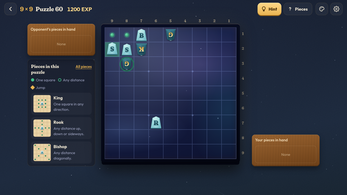
The split is deliberate. Seventy puzzles use the 3×3 board, seventy use 5×5, and sixty use the full 9×9 board, so a newcomer can meet the pieces on a nearly empty grid before facing the complete shogi layout. Saiba, the creator, made the game as a way to introduce shogi to players outside Japan, and the rule singled out as shogi's great pleasure is that captured pieces return to the board on the capturing side.
This is a teaching tool and a puzzle collection rather than a full shogi match. Positions are solved one move at a time, and solving them earns EXP that unlocks more boards, piece sets and backgrounds. Piece labels can appear as letters such as K, R and B or as kanji, and the interface works in both English and Japanese.
How to play
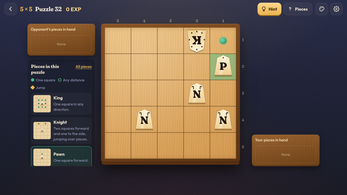
Each puzzle hands over a position where your pieces point up, and the task is a single move that checkmates. Click or tap one of your own pieces, then choose one of the marked squares to commit the move.
Pieces held in hand can be dropped instead of moved: select the piece in hand, then pick an empty square. That drop rule is the heart of shogi, and the puzzle set leans on it from the beginner course onward rather than saving it for the 9×9 board.
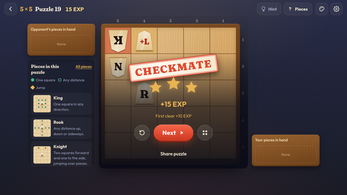
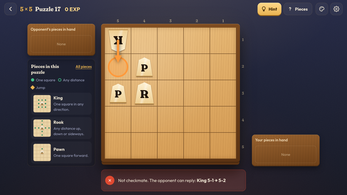
Mistakes are treated as teaching material. A wrong move triggers an explanation of why it fails, with the opponent's reply drawn directly on the board so the refutation is visible instead of abstract. A hint option names which piece to move when a position stalls.
Optional movement guides overlay dots and lines on each piece to show its reach, and a reference covering how every piece moves stays one tap away during play. Progress and settings are saved in the browser, so a session can be closed and resumed. The 30-second challenge is a separate way in: solve as many puzzles as possible before the clock expires.
Controls
Two input methods cover everything. With a mouse or a tap, select a piece that points up and then a marked destination square; pieces in hand are placed onto empty squares the same way, one selection at a time.
Keyboard play uses the arrow keys to move between squares, Enter to select, and Esc to cancel. That trio handles choosing a piece, committing a destination and backing out of a mis-tap without reaching for the mouse.
Display preferences sit alongside the input options. Movement guides can be switched on so dots and lines appear on the selected piece, and piece labels can flip between letters and kanji depending on which reading is quicker for the player. Settings and progress are stored in the browser, so guide and label choices carry over between sessions.
Nothing needs to be installed. The game loads as a browser build, so the first puzzle is available immediately after pressing Play.
| Input | Action |
|---|---|
| Mouse or tap | Select one of your pieces, then a marked square; select a piece in hand, then an empty square |
| Arrow keys | Move between squares |
| Enter | Select |
| Esc | Cancel |
Tips for your first run
Start with the beginner course rather than the main list. Its 13 short puzzles introduce each piece in turn, then cover drops and promotion, the two shogi rules most likely to trip up someone arriving from chess. Only after that does the wider set make sense as practice rather than guesswork.
Treat a failed attempt as information. The board shows the opponent's answer to the move, and that answer usually points at the square being guarded or the escape route left open.
- Work through the 13 beginner puzzles before touching the 200-puzzle list.
- Keep movement guides on at first so dots and lines show each piece's reach.
- After a wrong move, study the drawn opponent reply before trying again.
- Clear the 70 puzzles on the 3×3 board before moving up to 5×5.
- Save the 30-second challenge until the untimed sets feel familiar, since speed follows pattern recognition.
- Switch piece labels between letters and kanji to find the faster reading.
Content and replayability
The headline count is 200 puzzles, split cleanly into 70 on the tiny 3×3 board, 70 on 5×5 and 60 on the standard 9×9. Because each problem is a single move, sessions are short by design, and the collection layer supplies the reason to come back after the first sitting.
Solving puzzles earns EXP, and EXP unlocks a set of 10 boards, 12 piece sets and 9 backgrounds. Those rewards change how the game looks rather than how it plays, so the puzzle content stays consistent while the board and pieces change underneath it.
The 30-second challenge is the score-chasing mode layered on top of the untimed sets, and it is the clearest reason to replay positions already solved once. Progress and settings are saved in the browser, so unlocks are not lost between visits.
Alongside the main set sits a 13-puzzle beginner course covering piece movement, drops and promotion. For a player starting from zero, the real amount of material is broader than the headline number implies.
Presentation and performance
The game is an HTML5 build that runs in the browser with no download, so pressing Play opens the puzzle rather than an installer. The interface is bilingual, with English and Japanese both supported, and piece labels can be drawn as letters like K, R and B or as kanji characters.
The board carries most of the visual load. Movement guides add optional dots and lines over the pieces, and failed moves are illustrated rather than described, with the opponent's reply drawn onto the board so the refutation can be read at a glance. A full piece-movement reference stays one tap away instead of buried in a menu.
Variety comes from the unlockables: 10 boards, 12 piece sets and 9 backgrounds earned through EXP, alongside additional boards and pieces that arrive as play continues. Everything sits inside a small browser game, with no large install standing between a curious player and the first 3×3 puzzle.
Who should play it
Absolute beginners are the obvious audience. The 13-puzzle beginner course teaches how each piece travels, then covers drops and promotion, and a movement reference remains available during play, so an unfamiliar board is not a barrier to the first move.
Chess players curious about the Japanese variant will recognise the mate-in-one format and meet the difference that matters most: captured pieces come back into play on the capturing side, which is why drops feature in the puzzles. Letter labels such as K, R and B ease the transition from chess notation.
Puzzle players who want something short will find the format suits a few minutes at a time, with 200 positions to work through and a timed challenge for scored runs. It is a single-player experience throughout, with no matchmaking and no opponent across a full game, so it works best as a teaching tool and a puzzle set rather than a complete shogi match.
Screenshots
How we tested it
The build was loaded from games.debutplay.com in a headless Chromium session on ; the canvas started and no request was blocked. The guide was last checked on .
From the developer
200 bite-sized checkmate puzzles. No shogi experience needed. Mate in One is a free browser puzzle game based on shogi, a traditional Japanese board game that is still enjoyed today. No download or shogi experience needed. Start with a tiny 3×3 board and discover Japanese chess, one move at a time. Play free in your browser. New to shogi? Start with the beginner course. You’ll learn how the pieces move before choosing your puzzles. Unlock new boards, pieces and backgrounds as you play. 200 puzzles on three boards: 3×3 (70), 5×5 (70) and the standard 9×9 (60) Beginner course: 13 short puzzles that teach each piece, drops and promotion Learn from mistakes: a wrong move shows why it fails, with the opponent's reply drawn on the board Hints: see which piece to move when you need a nudge Movement guides: optional dots and lines on each piece show how it moves 30-second challenge: solve as many puzzles as you can against the clock…
Frequently asked questions
Is Mate in One free to play?
Yes. The full game is free to play in the browser, and an optional contribution is welcome from anyone who wants to support the creator's work.
Do you need shogi experience to start?
No. The beginner course covers how each piece moves, then drops and promotion, and a movement reference stays one tap away. The 3×3 board is the intended entry point.
How many puzzles are there?
There are 200 mate-in-one puzzles: 70 on the 3×3 board, 70 on 5×5 and 60 on the standard 9×9 board, plus a separate beginner course of 13 puzzles.
What happens when a move is wrong?
The game explains why the move fails and draws the opponent's reply on the board. If a position stalls, a hint shows which piece to move.
Does the game save progress?
Progress and settings are saved in the browser, so unlocked boards, piece sets, backgrounds and preferences carry over between sessions.
How does the timed mode work?
The 30-second challenge asks for as many puzzles as possible before the clock runs out, which makes it a scoring mode alongside the untimed sets.
What games are similar to Mate in One — Shogi Puzzles?
The closest matches on DebutPlay are Hearthstring Eve, Heart Potion Sort, Gourd Crimes. They share the same genre, so the controls and the pace carry over.
Something wrong or missing? Tell us. How we test games.