Puzzle · New game
Gourd Crimes
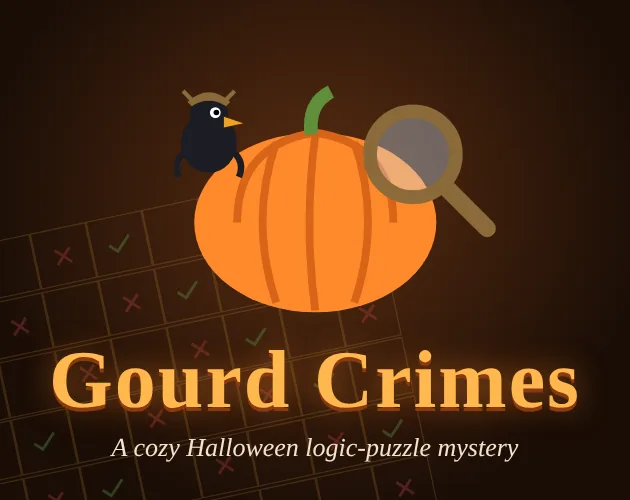
A cozy Halloween deduction puzzle about a harvest festival, a disappearing prize pumpkin, and a crow partner who thinks he runs the investigation.
#18 this weekAI-assisted: Unspecified
The game runs in this tab. No install, no account.
The short answer
Gourd Crimes is a logic-grid detective puzzle set during Maple Hollow's Halloween harvest week. Match suspects to costumes, places, and treats, question eleven townsfolk, and use evidence to unlock hidden testimonies. The full game has sixteen cases plus a bonus, five endings, and Midnight Mode; the free browser demo covers the first five cases.
What is Gourd Crimes?
Gourd Crimes is a logic-grid detective puzzle set in Maple Hollow during Halloween week, when the town's harvest festival is supposed to be a celebration rather than a crime scene. A prize-winning pie disappears, the corn maze signs are flipped, and the mayor's fake mustache goes missing. The bigger threat is Big Bertha, a 900-pound prize pumpkin that vanishes before the week is over. The player takes the role of the festival's volunteer detective. The partner is Caw, a crow in a deerstalker hat who is convinced that he is the one running the case. The structure is a set of sixteen logic-grid cases plus one bonus cold case. Each puzzle has a single solution, and the full run contains 262 clues. Suspects are matched to costumes, locations, and later treats; crossing off impossible options leaves the culprit. The tone is cozy, cute, and comic rather than grim, with a small-town mystery running underneath the weekly incidents. The full game costs $2.00, and the browser demo covers the first five cases in about 25 minutes.
How to play
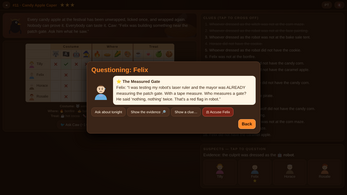
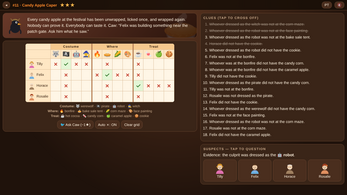
Each case is a logic grid. The task is to connect every suspect to a costume and a place, then add a treat in later cases. Clues eliminate possibilities; tapping a cell marks or crosses it, and an optional automatic crossing feature handles some of the bookkeeping. Used clues can be struck through so the remaining information stands out. The grid is not the only layer. Suspects can be questioned by showing them clues and evidence, and the right witness paired with the right evidence reveals one of twelve hidden testimonies. The final case asks for motive, means, and opportunity, using cards collected across the week. Stars are the scoring currency: a case can award up to three, while hints and wrong accusations reduce the total. Caw can be asked for help when a puzzle stalls, but his revealed fact costs a star. The campaign is divided into three acts, with sixteen standard cases and one bonus cold case. The opening act is the free browser demo, while the paid version contains the complete investigation.
Controls
The main control is tap-to-solve grid interaction. Tapping a cell fills or crosses off a possibility, which keeps the deduction moving without a separate note-taking tool. An optional automatic crossing function can reduce repeated taps, and clues can be struck through once their information has been used. Questioning is handled by presenting clues and evidence to the eleven townsfolk, so the useful action is choosing the right witness and the right piece of evidence rather than typing questions. When a case stalls, Caw can be asked for a fact, and that help is exchanged for a star. The interface is phone-friendly, and Android is among the platforms, so touch play is part of the package. The full game is also supplied for Windows, macOS, and Linux as an offline HTML file, while the browser demo runs in HTML5.
| Input | Action |
|---|---|
| Tap | Mark or cross off logic-grid cells and interact with puzzle elements |
Tips for your first run
Start each grid by reading every clue before tapping. The optional automatic crossing is useful, but manual strike-throughs make it easier to see which statements have already paid off. Treat stars as a resource rather than a score to chase on the first pass. A wrong accusation costs stars, and Caw's single-fact hint costs one as well, so save both for a case that has genuinely stalled. When questioning townsfolk, focus on evidence that directly addresses the clue in hand; the goal is to unlock one of the twelve hidden testimonies, not to exhaust every conversation. Keep track of cards collected during the week because the final case uses them to establish motive, means, and opportunity. The browser demo covers the first five cases, so it is a low-pressure place to learn the grid rhythm before committing to the full set. If a case feels tangled, clear the obvious exclusions first and let the single-solution design narrow the rest.
- Read all clues before marking the grid.
- Use automatic crossing, but still strike through clues you have used.
- Avoid wrong accusations; they reduce the star total.
- Ask Caw only when a case is truly stuck, since the hint costs a star.
- Save collected cards for the final motive, means, and opportunity case.
- Use the free opening act to learn the grid before the full campaign.
Content and replayability
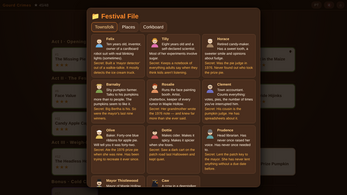
The paid version contains sixteen logic-grid cases plus a bonus cold case, with 262 clues and exactly one solution per puzzle. The story is built across three acts and runs about two hours. Eleven townsfolk can be questioned, and twelve hidden testimonies are available through the right witness and evidence combinations. The finale asks the player to prove motive, means, and opportunity from cards gathered during the week. Five endings are included, one of them secret. Twenty badges and the Festival File add collection goals; the file covers townsfolk secrets, places, and a corkboard. Midnight Mode allows any case to be replayed against the clock, which gives the grid a second life after the story is solved. A case awards up to three stars, so replays can also target cleaner solutions. The full game supports English and Brazilian Portuguese, auto-saves, and ships as one offline HTML file for Windows, macOS, Linux, and Android. The free browser demo contains the opening act, cases one through five, and takes about 25 minutes.
Presentation and performance
The visual and comic identity comes from small-town Halloween details: a harvest festival, a corn maze with flipped signs, a stolen fake mustache, and a 900-pound prize pumpkin at the center of the threat. Caw's deerstalker hat and his belief that he is the senior detective give the case framing a running joke, while the eleven townsfolk each have their own voice. The game is built for short, readable puzzle sessions rather than action. The practical layer is built for low-friction sessions: auto-save, a phone-friendly interface, an HTML5 browser demo, and an offline HTML file for the full game on Windows, macOS, Linux, and Android. The overall effect is a cozy mystery that keeps the Halloween theme light, with a prize pumpkin as the looming disaster.
Who should play it
Gourd Crimes suits players who enjoy logic-grid deduction more than reflex-driven action. The appeal is the single-solution puzzle structure: sixteen cases plus a bonus, 262 clues, and a clear culprit that falls out of the grid. Halloween fans get a cozy festival setting, a corn maze, a fake mustache, and a 900-pound prize pumpkin without a grim horror tone. Detective-story readers get questioning, evidence presentation, twelve hidden testimonies, and a finale built on motive, means, and opportunity. Completionists have five endings, one secret, plus twenty badges and the Festival File. Players who like short mysteries can finish the main run in about two hours across three acts. The free browser demo covers cases one through five and takes about 25 minutes, which makes it a sensible test for the grid interface before buying the $2.00 full game. The English and Brazilian Portuguese options, auto-save, and Android listing also make it a fit for phone-friendly play.
Screenshots
How we tested it
The build was loaded from games.debutplay.com in a headless Chromium session on ; the canvas started and no request was blocked. The guide was last checked on .
From the developer
🎃 Gourd Crimes Maple Hollow's Harvest Festival, Halloween week. A prize pie vanishes. Somebody turns every sign in the corn maze around. The mayor's magnificent fake mustache is stolen. And Big Bertha, the 900-pound prize pumpkin, is next. You're the festival's volunteer detective — and your partner is Caw, a crow in a deerstalker who is absolutely certain he's in charge. 🧩 16 logic-grid cases + 1 bonus cold case: match every suspect to a costume, a location and (later) a treat, cross off the impossible, and the culprit falls out of the grid. 262 clues, every puzzle with exactly one solution.🗣 Question the suspects: show them clues and evidence — eleven townsfolk, each with their own voice. The right witness with the right evidence reveals one of 12 hidden testimonies.⚖️ A final case that ties it all together: prove motive, means and opportunity with the cards you collected all week.✗✓ Tap-to-solve grid with optional auto-cross,…
Frequently asked questions
How much does Gourd Crimes cost?
The full game is priced at $2.00. A free browser demo covers the opening act, cases one through five, and runs about 25 minutes.
How long is the full game?
The main run is about two hours across three acts, with sixteen standard cases and one bonus cold case.
Which platforms are supported?
The full game is available for Windows, macOS, Linux, and Android as an offline HTML file. The demo runs in HTML5 in a browser.
Is there mobile support?
Android is listed, and the interface is phone-friendly with tap-to-solve grid interaction.
What do stars do?
Each case can award up to three stars. Hints from Caw and wrong accusations reduce the star total, so clean deductions are rewarded.
How many endings and replay options are there?
There are five endings, one of them secret, plus twenty badges, the Festival File, and Midnight Mode for replaying any case against the clock.
What games are similar to Gourd Crimes?
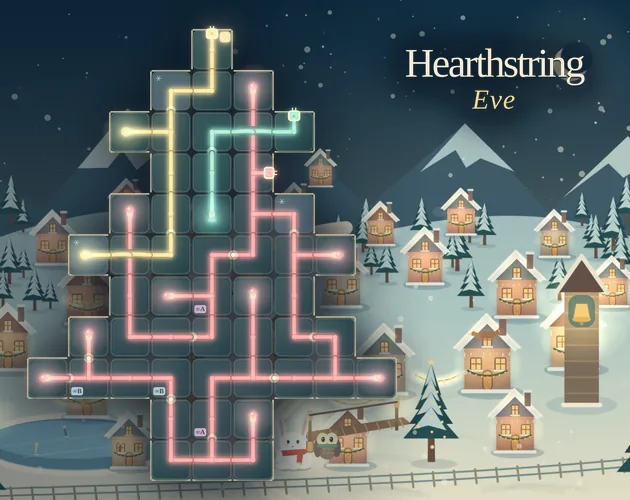
The closest matches on DebutPlay are Hearthstring Eve, Heart Potion Sort, Mate in One — Shogi Puzzles. They share the same genre, so the controls and the pace carry over.
Something wrong or missing? Tell us. How we test games.