Adventure · New game
ORACLE_ISLE
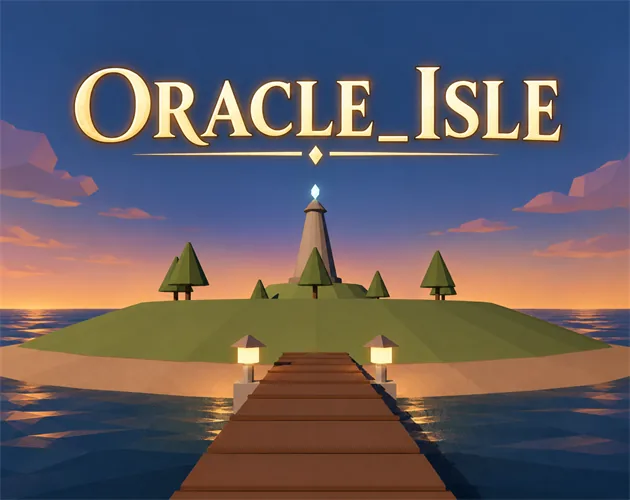
ORACLE_ISLE sends players to a twilight island to scout six ruins, collect cores, manage survey crews, and solve a tower console.
#34 this weekAI-assisted: Code, Graphics, Sound, Text
The game runs in this tab. No install, no account.
The short answer
ORACLE_ISLE is a free HTML5 exploration adventure built around pre-rendered scenes and a Myst-like structure. Players investigate six ruins on a twilight island, gather their cores, and activate a central tower console. The challenge comes from choosing survey lanes that match each site, reading the journal, and using the Oracle terminal wisely.
What is ORACLE_ISLE?
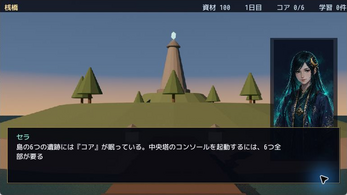
ORACLE_ISLE is a challenging exploration adventure set on a twilight island. The player arrives guided by recorded footage from Sera, a priestess, and must survey six ruins scattered across the island. Each ruin holds a core, and the long-term goal is to bring all six cores to the central tower and start its console.
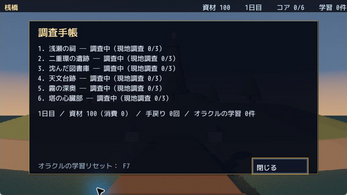
The structure leans on pre-rendered scenes and a Myst-like approach, with observation and note-taking mattering more than reflexes. A journal gathers clues automatically, while the Oracle terminal at the bottom left connects the player to Sera’s advice. The Oracle, called RouteNet, recommends a survey lane, but its accuracy depends on how thoroughly the site has been scouted and how much the Oracle has learned.
Difficulty is intentionally high. Ruins require a survey setup scaled to their true size: too little preparation causes failure and lost time, while excess preparation wastes supplies. That tension between information, cost, and risk shapes every major decision.
How to play
Play starts by clicking or tapping across the island. At each ruin, the first task is scouting, which can advance through three stages. More discoveries make the Oracle’s lane recommendation more accurate, so exploration and advice are linked.
The Oracle terminal sits at the bottom left. From there, the player can hear Sera’s advice, select a survey lane, and run the survey. The lane costs are STANDARD 6, COMPLEX 12, HIGH 20, and ESCALATE 30 supplies. A lane below the ruin’s true tier fails and consumes a day, but that failure exposes the real tier and gives the Oracle more to learn from.
Supplies can be replenished at the pier: 40 supplies arrive, and one day passes. Island mechanisms, including rings and a star dial, open through clues found during investigation. The journal records those clues automatically. After all six cores are collected, the tower console becomes the final target; its three dials are answered from journal information.
The final rating weighs days taken, supplies spent, and setbacks, so efficient investigation matters as much as reaching the tower.
Controls
Mouse input uses hover to select and click to confirm, with Esc going back. Touch users tap to confirm. Keyboard users move focus with arrow keys or WASD, confirm with Enter or Space, and go back with Esc or X. J opens the journal, and F7 resets the Oracle’s learning.
A gamepad moves focus with the D-pad or left stick, confirms with A, and goes back with B. On Windows, Alt + Enter toggles fullscreen, while Alt + Backspace resets the window scale.
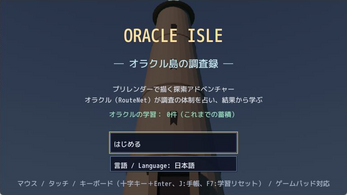
The title screen includes a Language option for Japanese and English, and the choice remains active for the current session. The track Sunlit Oracle begins with the first title-screen action and loops at 2 minutes 30 seconds. Sound effects accompany selections, movement, mechanisms, successes, and failures.
| Input | Action |
|---|---|
| Mouse | Hover to select and click to confirm; Esc goes back. |
| Touch | Tap to confirm. |
| Keyboard | Arrow keys or WASD move focus; Enter or Space confirms; Esc or X goes back; J opens the journal; F7 resets Oracle learning. |
| Gamepad | D-pad or left stick moves focus; A confirms; B goes back. |
| Windows window controls | Alt + Enter toggles fullscreen; Alt + Backspace resets window scale. |
| Language menu | Title-screen Language option switches Japanese and English for the current session. |
Tips for your first run
The first run is less about speed than about reducing uncertainty. The Oracle can only advise well when the site has been studied and when its learning has something to work with.
- Scout a ruin through all three stages before selecting a lane; the extra information can change the recommendation.
- Use the journal as the main clue archive for mechanisms such as rings and the star dial, because findings are recorded automatically.
- If a lane is below the true tier, the survey fails and a day is lost, but the true tier is revealed and the Oracle learns; weigh that cost against a safer, more expensive lane.
- Resupply at the pier only when supplies are short: 40 supplies arrive, but one day passes.
- On Windows, Oracle learning carries into later runs; on the web, reloading the page or pressing F7 clears it, so plan sessions around that limit.
- Set Japanese or English on the title screen before starting, because the choice lasts only for the current session.
Content and replayability
Six ruins form the main map objective, each tied to a core. Scouting has up to three stages per ruin, and surveys use four named lanes with different supply costs. Beyond the ruins, the island includes mechanisms such as rings and a star dial, then a central tower console with three dials.
Replay value comes from the rating system and the Oracle’s learning. The final score reflects days used, supplies spent, and setbacks, which encourages cleaner routes and better lane choices. On Windows, the Oracle’s learning is saved and carries over; on the web, it lasts only while the page remains open, and F7 resets it. The combination of fixed objectives and performance scoring gives each run a clear benchmark.
Presentation and performance
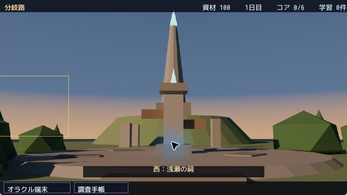
The visual pitch is a twilight island rendered through pre-rendered scenes, with six ruins and a central tower as anchors. The Myst-like framing favors still, inspectable locations over constant motion.
Audio includes the looping track Sunlit Oracle, which starts with the first title-screen action and runs for 2 minutes 30 seconds before repeating. Sound effects mark selections, movement, mechanism use, successes, and failures.
The title screen carries a Language option for Japanese and English, and the selection remains active for the current session. The game is HTML5 and built on the TinCLE engine. On Windows, Alt + Enter toggles fullscreen and Alt + Backspace resets the window scale. The interface extends across mouse, touch, keyboard, and gamepad input, so the presentation is not tied to one control style.
Who should play it
This is for players who enjoy Myst-like exploration, careful reading, and deduction from a journal. The six-ruin structure rewards scouting before commitment, and the lane costs make resource planning part of the adventure rather than a side detail.
It also suits players who want a genuinely challenging investigation. A low lane can fail, a day can be lost, and excess spending wastes supplies, so patience matters. Those who prefer constant action or dislike note-based puzzle solving are less likely to enjoy the pacing.
Language support for Japanese and English broadens the audience, and mouse, touch, keyboard, and gamepad options cover several play styles. Returning Windows players can build on Oracle learning, while web players get a fresh Oracle state after reloading or pressing F7.
Screenshots
How we tested it
The build was loaded from games.debutplay.com in a headless Chromium session on ; the canvas started and no request was blocked. The guide was last checked on .
From the developer
# ORACLE ISLE ― オラクル島の調査録 ― プリレンダー画像で描く、Myst 風の探索アドベンチャーです。 夕暮れの島に点在する 6 つの遺跡を調査して「コア」を集め、中央塔のコンソールを起動するのが目的です。 **難易度は高め**に作ってあります。手帳をよく読み、現地をよく調べてから判断してください。 ## 物語 調査者であるあなたは、巫女セラの記録映像に導かれて島へやってきました。 遺跡の調査には「規模に見合った体制」が必要です。足りなければ失敗して手戻りになり、過剰でも資材を浪費します。 セラの相棒である占い機械「オラクル」(RouteNet)が体制を助言してくれますが、占いの精度は **あなたがどれだけ現地を調べたか** と **オラクルがどれだけ学習したか** で変わります。 ## 遊び方 1. 画面の各所をクリック(タップ)して島を歩き回ります。 2. 遺跡では、まず「調べる」で現地調査を進めます(各 3 段階)。分かることが増えるほど、オラクルの助言が的確になります。 3. 画面左下の「オラクル端末」を開き、セラの助言を聞いて体制(レーン)を選び、「調査実行」します。 - 体制のコストは STANDARD 6 / COMPLEX 12 / HIGH 20 / ESCALATE 30。 - 規模に届かない体制では失敗し、1 日を失います。その代わり、本当の規模が判明し、オラクルが学習します。 - 調査結果をオラクルが学習します。Windows 版では `oracle_net.txt` に保存され、次のプレイにも受け継がれます。Web 版ではページを開いている間だけ保持され、再読み込みすると初期化されます(F7 でも初期化)。 4. 資材が足りなくなったら、桟橋で補給できます(資材 +40、代わりに 1 日経過)。 5. 島の仕掛け(環・星盤など)は、どこかにある手がかりをもとに解いてください。手がかりは自動で「調査手帳」に記録されます。 6. コアを 6 つ集めたら、塔のコンソールへ。3 つのダイヤルの答えは、手帳の中にあります。 スコアは「日数・消費資材・手戻り」から評価されます。 ## 操作 - **言語**:タイトル画面の「言語 /…
Frequently asked questions
Is ORACLE_ISLE free to play?
Yes. ORACLE_ISLE is free.
What do you do on the island?
Survey six ruins, collect their cores, solve mechanisms, and activate the central tower console.
How do survey lanes work?
Lanes cost supplies: STANDARD 6, COMPLEX 12, HIGH 20, and ESCALATE 30. A lane below a ruin’s true tier fails, costs a day, reveals that tier, and teaches the Oracle.
What happens when supplies run low?
The pier restores 40 supplies, but one day passes.
Does Oracle learning carry over?
On Windows, learning is saved and carries into later runs. On the web, it lasts until the page is reloaded; F7 resets it.
Can the game be played in English?
Yes. The title screen switches between Japanese and English, and the choice lasts for the current session.
What games are similar to ORACLE_ISLE?
The closest matches on DebutPlay are Maple Leaf, Prompt Asylum, Pracinhas. They share the same genre, so the controls and the pace carry over.
Something wrong or missing? Tell us. How we test games.